


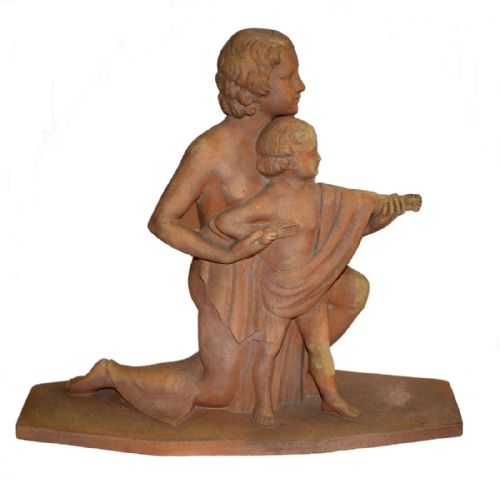
Vintage Porcelain Children
Vintage porcelain children figures capture domestic innocence in delicate ceramic, offering collectors charming snapshots of youth moulded across various eras.
Vintage Porcelain Children
Vintage porcelain children encompass sculpted figures, pairs, and groups depicting young subjects created in ceramic materials across multiple centuries. When searching for vintage porcelain children, a buyer encounters everything from eighteenth-century soft-paste bowls and nineteenth-century French bisque pairs to twentieth-century Art Deco pieces and mid-century English character models.
The selections span distinct stylistic movements, including Victorian sentimentality, Art Nouveau curves, Art Deco angles, and Scandinavian decorative traditions. Figures frequently portray everyday childhood activities, such as carrying puppies and kittens, reading nursery rhymes, or sharing quiet domestic moments.
How they were made
Makers utilised porcelain, bisque porcelain, and biscuit porcelain to form these child subjects, often applying glaze, enamel paint, or gold leaf for surface decoration. Soft-paste porcelain appears in earlier English productions, whereas later twentieth-century figures rely on hard-paste bodies and matte bisque finishes.
Techniques range from slip-casting and hand-modelling to intricate underglaze blue and white painting, polychrome enamelling, and professional firing in high-temperature kilns.
Several charming figures depict children earnestly wrestling with oversized puppies and kittens rather than sitting still.
What varies in quality
The application of surface finishes dictates overall visual refinement, where finely controlled enamel painting, delicate gilding, or smooth bisque surfaces elevate the piece. The complexity of the composition, such as multi-figure groups or intricate animal pairings, reflects greater technical ambition in the manufacturing process.
Royal Dux·Royal Copenhagen·Royal Worcester
The Vintage Porcelain Children Glossary
- Bisque porcelain
- Unglazed porcelain fired once to produce a matte, porous surface resembling marble. It is frequently utilised for realistic flesh tones on figure groups.
- Soft-paste porcelain
- An early ceramic composition of clay, glass, and frit fired at lower temperatures than hard-paste. It creates a warm, creamy body common in eighteenth-century bowls.
- Biscuits
- Another term for biscuit porcelain or unglazed ceramic ware before final decoration. It provides a tactile, non-reflective finish favoured by nineteenth-century French workshops.
- Ginger jars
- High-shouldered ceramic vessels with fitted lids originally designed for storing spices. They occasionally feature decorative child or figurative motifs.
- Gold leaf
- Extremely thin sheets of beaten gold applied to ceramic surfaces for accent work. It highlights borders and decorative garments on select figures.
Vintage Porcelain Children: Frequently Asked Questions
How do I date these figures?
Dating relies on factory marks stamped or painted on the underside, stylistic indicators like Art Deco geometry or Victorian sentimentality, and the specific ceramic body used. Examining the type of glaze and colour palette also helps place the piece within its historical manufacturing period.
Changes in production techniques across the eighteenth, nineteenth, and twentieth centuries provide further clues for chronological placement.
What is bisque porcelain?
Bisque porcelain is unglazed ceramic ware that has undergone a single firing to achieve a smooth, matte texture. This finish allows sculptors to capture subtle details in skin and drapery without the gloss of traditional glazes.
It gained popularity in nineteenth-century figure groups for its realistic representation of human forms.
How should I display porcelain figures?
These ceramic pieces require stable display surfaces away from heavy foot traffic to prevent accidental tipping or impact. Placing them inside enclosed cabinets protects delicate bisque surfaces and painted enamels from accumulated dust and airborne moisture.
Proper lighting enhances the modelling details without exposing the pigments to direct, harsh sunlight.