



Vintage Military Desk
A vintage military desk brings portable utility into a room, combining durable hardwoods with functional brass fittings made for officers on the move.
Vintage Military Desk
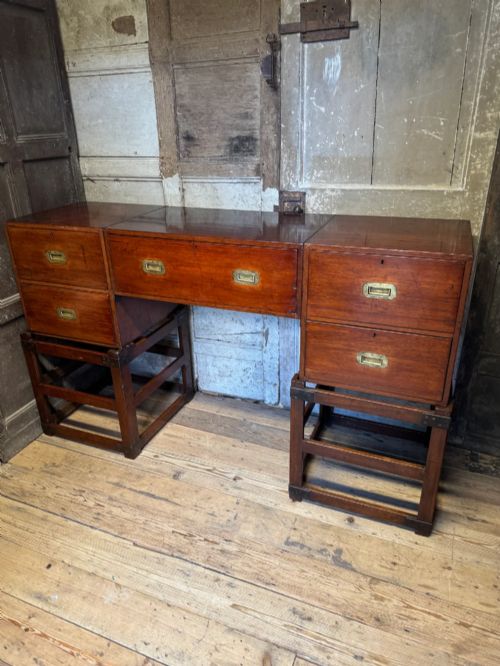
A vintage military desk encompasses robust campaign furniture designed to dismantle or fold for transport across distant territories. The selection here brings together pieces spanning the Georgian, Victorian, and Edwardian eras, alongside later twentieth-century examples.
Buyers will encounter pedestal forms, secretaire chests, and smaller folding writing slopes originating from distinct periods of service. These functional items reflect the practical requirements of officers stationed far from home.
Solid woods like mahogany, teak, and camphor wood dominate the form, often reinforced with brass corners and flush handles to withstand rough transit. Each piece demonstrates how utilitarian design met the rigorous demands of military life.
Materials and construction methods
Carpenters utilised dense tropical hardwoods such as teak, padouk, and mahogany because these timbers resist warping in humid climates. Grain patterns range from plain mahogany to burr surfaces, selected for both strength and appearance.
Brass corners, straps, and flush-mounted pull handles protect vulnerable edges and allow modular sections to lock together securely without protruding hardware snagging on canvas tents or pack animals.
Internal compartments often feature leather writing surfaces and secret drawers, constructed with precise joinery to endure the vibrations and shocks of long journeys.
Vintage Military Desk Retail Price Guide 2026
Typical asking prices for vintage military desk among the pieces listed under this phrase on Sellingantiques today, from the lower quarter to the upper quarter. They describe what is for sale here now, not the wider market.
The listings span multiple centuries, incorporating brass, mahogany, teak, iron, and oak across Victorian, Georgian, and Edwardian periods.
Assessing craftsmanship and finish
Superior examples display precise dovetail joinery and original brass hardware that fits flush into recessed channels without gaps. The quality of the timber selection dictates the overall presence, with well-figured grain commanding greater attention.
The integrity of folding mechanisms and removable legs separates utilitarian field equipment from finer pieces made for senior officers. Original leather inserts and working brass locks further distinguish superior desk construction.
The Vintage Military Desk Glossary
- Campaign chest
- A modular storage cabinet built in two or more stacking sections designed for easy transport. These units feature recessed brass handles and removable feet.
- Secretaire
- A desk form featuring a pull-down writing flap that conceals small drawers and pigeonholes inside. This fitted interior allows secure storage for correspondence.
- Writing slope
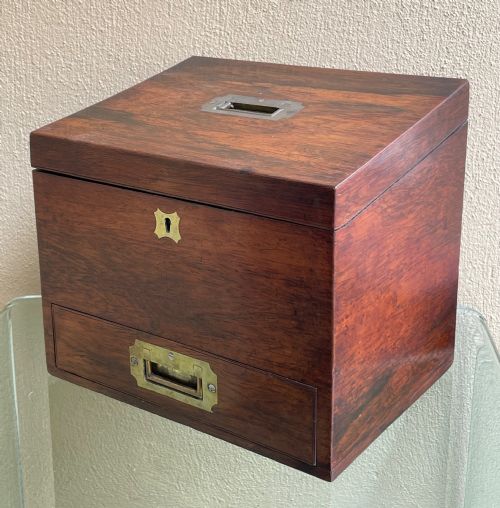
- A portable box with a slanted writing surface that folds flat when closed. Inside compartments hold inkwells, pens, and paper.
- Flush handle
- A metal pull inset into the wood surface so it does not project beyond the edge. This design prevents snagging during transport.
- Brass bound
- Furniture reinforced along the edges and corners with brass strips and brackets. This reinforcement adds structural rigidity and protects against impact.
Vintage Military Desk: Frequently Asked Questions
How do I spot a genuine campaign desk?
Look for modular construction where sections separate, alongside recessed brass hardware and carrying handles designed for transport.
Examine the secondary woods inside drawers, as period pieces typically employ timbers appropriate to their stated era of manufacture.
What woods were used for military desks?
Makers relied heavily upon durable tropical timbers such as teak, mahogany, camphor wood, and padouk because they withstood changing climates.
These dense hardwoods resisted splitting and warping during long sea voyages and overland campaigns.
Can I use a campaign desk daily?
These desks suit everyday study or office use very well, offering practical storage within a compact footprint.
Their sturdy historical construction often surpasses modern flat-pack furniture in durability and resilience.
How should I care for the leather top?
Maintain the leather insert by dusting gently and applying a suitable leather conditioner to prevent drying and cracking.
Avoid placing damp items or direct heat sources near the writing surface to preserve the finish.