







Military Secretaire Desk
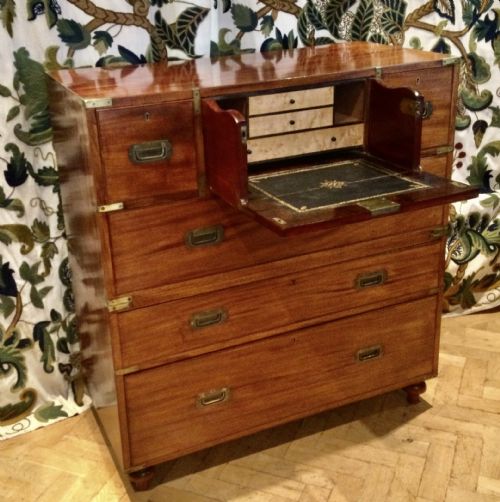
A military secretaire desk is a rugged, collapsible chest of drawers that doubles as a writing cabinet for officers on the move.
Military Secretaire Desk
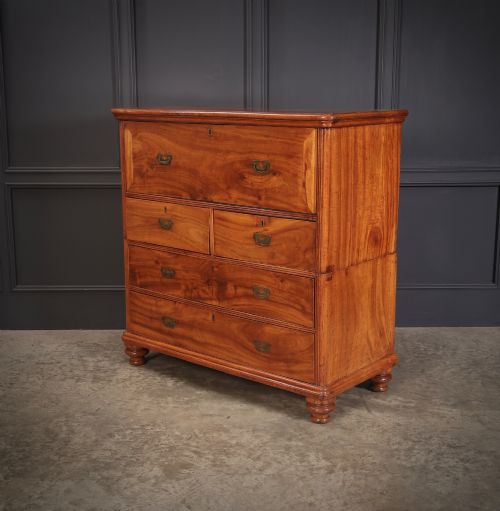
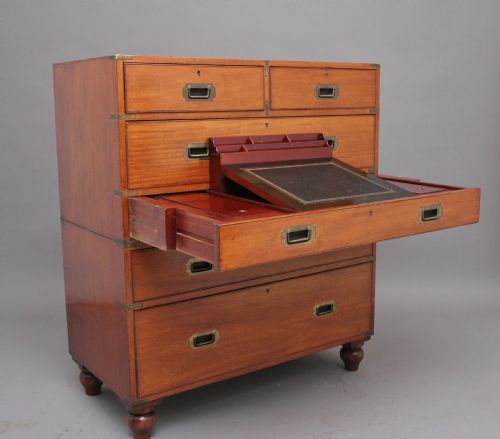
A military secretaire desk combines a chest of drawers with a fitted writing drawer that drops down to reveal pigeonholes and small compartments. You will frequently encounter these in Victorian mahogany, camphor wood, and teak, often built in two separate stacking sections for easy transport on campaign.
The primary forms take shape as secretaire chests, secretaire bureaux, and cabinets on secretaire bases. These sturdy pieces served officers in the field, carrying uniforms and documents while providing a stable writing surface wherever duty took them.
Materials and construction
Cabinet makers built these pieces using dense, durable timbers such as mahogany, teak, and camphor wood to withstand tropical climates and rough transit. Ebony details and leather writing surfaces appear regularly within the fitted drop-down compartments.
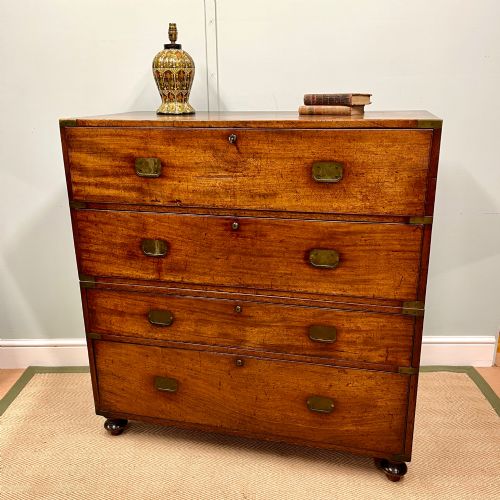
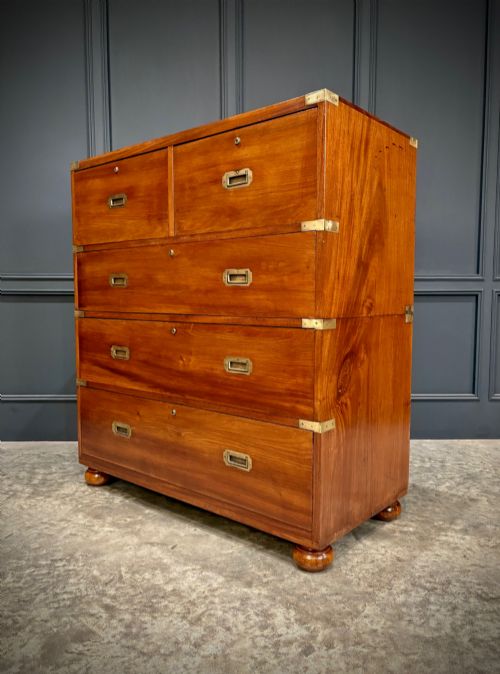
Brass corners, strapwork, and flush-fitting recessed carrying handles protect the edges and prevent snagging during movement. Iron carrying handles and solid brass mounts provide additional structural reinforcement for pieces designed to be dismantled into sections.
Military Secretaire Desk Retail Price Guide 2026
Typical asking prices for military secretaire desk among the pieces listed under this phrase on Sellingantiques today, from the lower quarter to the upper quarter. They describe what is for sale here now, not the wider market.
Certain chests still carry the ghost of old campaigns in their brass inset plates, once bearing the names of travelling captains.
Factors that distinguish quality
The sophistication of the interior fitments marks the upper tier of these pieces, particularly secret compartments, smoothly sliding pigeonholes, and undamaged tooled leather writing inserts. Superior examples maintain crisp joinery in dense camphor wood or figured mahogany, retaining their original brass hardware and recessed drawer pulls.
Construction details reveal the standard of workshop execution, notably the precision of the two-part sectional joins and the flush setting of brass mounts into the timber. Pieces retaining original cast iron or brass carrying handles and uncompromised internal drawer configurations demonstrate superior original utility.
The Military Secretaire Desk Glossary
- Campaign chest
- A sturdy chest of drawers built in two or more stacking sections with recessed brass hardware for military transport.
- Secretaire
- A desk disguised as a chest of drawers, featuring a drop-front top drawer that opens to reveal a writing surface and small compartments.
- Camphor wood
- An aromatic timber native to Asia, prized in military and colonial furniture for its insect-repellent properties.
- Anglo-Indian
- Furniture made in India by local craftsmen following British forms, often utilising dense rosewood or teak.
- Flush mount
- Hardware set level with the wood surface so nothing catches during transit.
- Two-part chest
- A piece constructed as separate upper and lower boxes that stack and lock together for travel.
Military Secretaire Desk: Frequently Asked Questions
What is a military secretaire desk?
A military secretaire desk is a portable chest of drawers featuring a drop-front writing drawer designed for officers on campaign.
These pieces combine storage with a fitted desk surface, utilising sectional construction for easy transport.
Why are they made of camphor wood?
Camphor wood was chosen for colonial and campaign furniture because its strong aroma naturally repels insects and protects stored papers and uniforms.
This timber also resists moisture well in tropical environments.
How do you date a campaign chest?
Dating relies on timber choices, brass hardware styles, and construction methods spanning the nineteenth century.
Victorian pieces often feature mahogany or teak with precise recessed brass corners and flush handles.
Are these desks built in sections?
Many campaign pieces are constructed as two separate boxes that stack one on top of the other.
This modular design allowed officers to load smaller, manageable sections onto pack animals or wagons.
What woods were commonly used?
Makers utilised durable hardwoods such as mahogany, teak, and camphor wood to endure harsh travel conditions.
Rosewood and ebony also appear in specific Anglo-Indian and colonial pieces.