



Vintage Mercury Thermometer Barometer
These vintage mercury thermometer barometer instruments record atmospheric pressure and temperature inside timber cases fashioned across Georgian, Regency and Victorian eras.
Vintage Mercury Thermometer Barometer
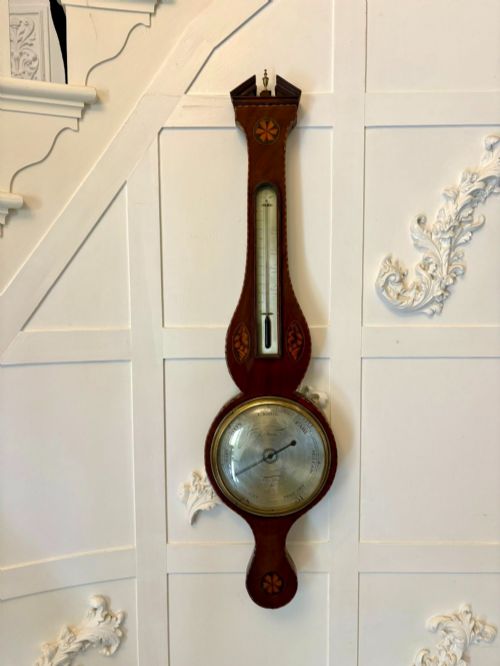
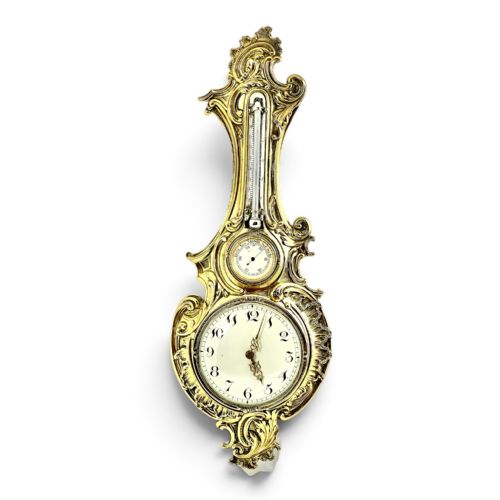
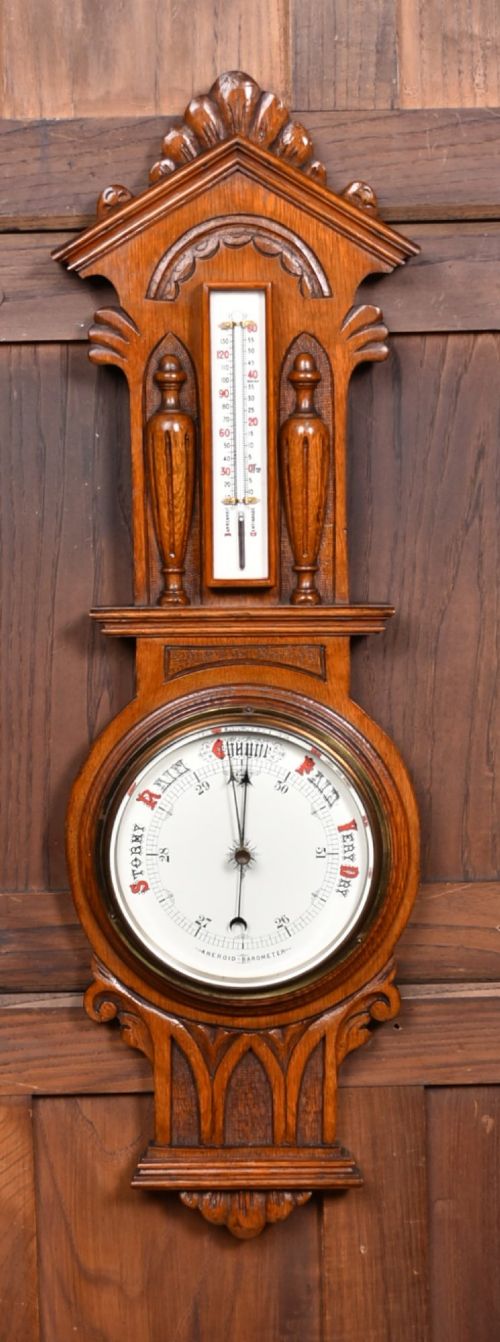
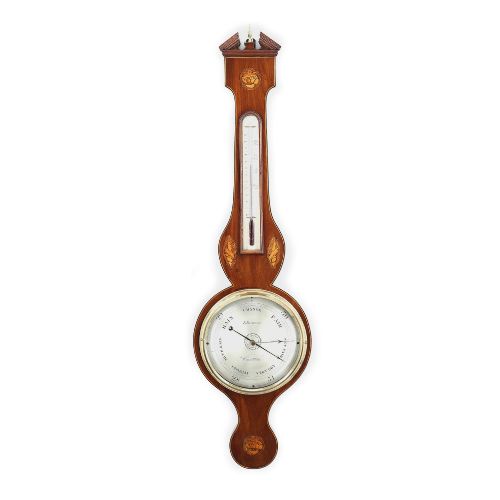
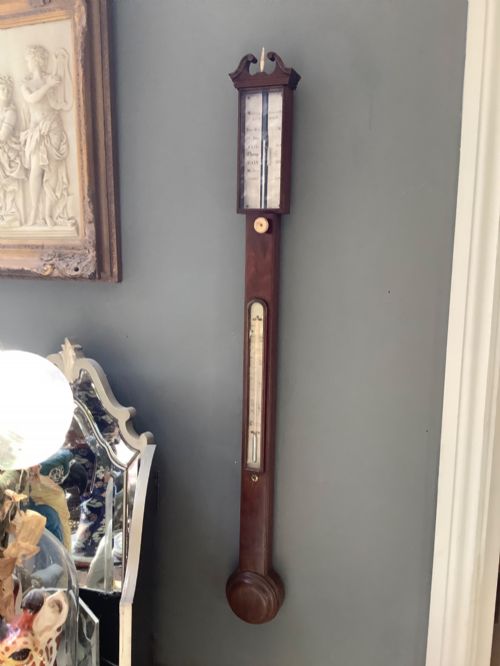
When you search for a vintage mercury thermometer barometer, you meet wall-hanging instruments designed to measure atmospheric pressure and ambient temperature within a single domestic housing. The examples here span Georgian, Regency and Victorian periods, taking forms such as the classic banjo shape, the slender stick barometer and the larger dial wheel barometer.
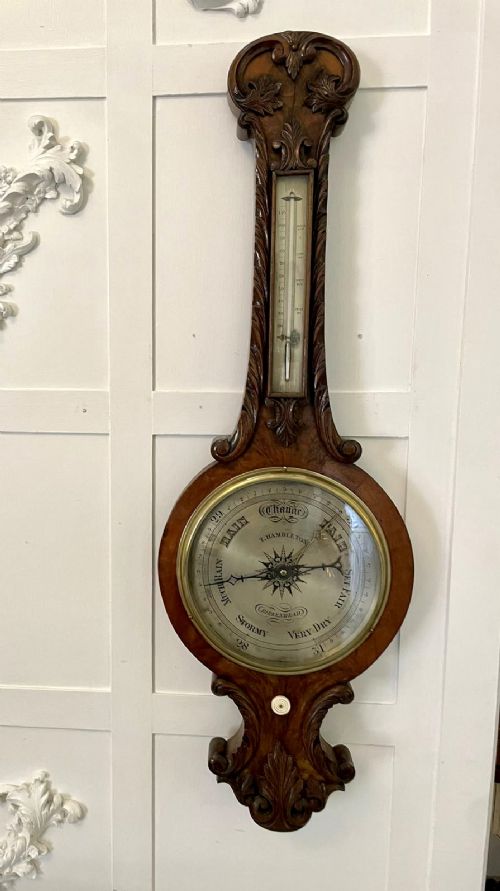
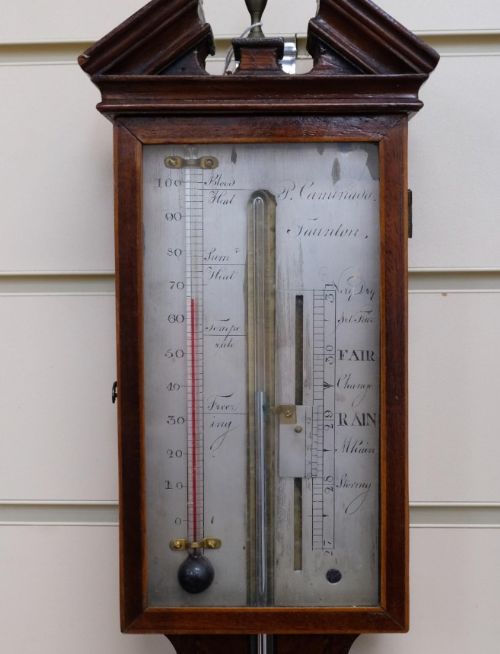
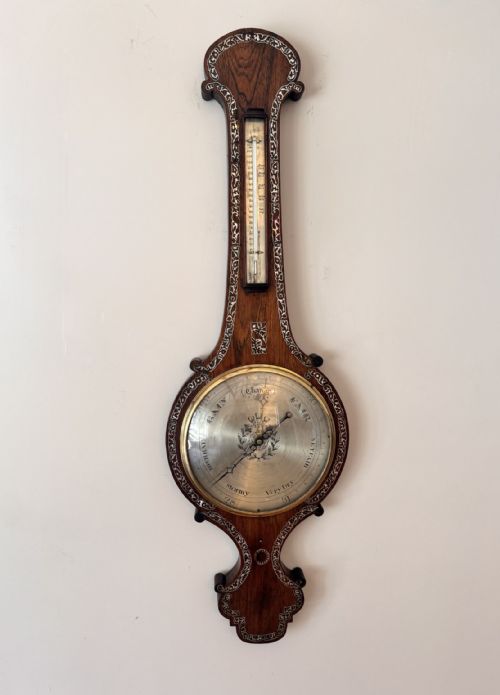
Mahogany, rosewood and oak dominate the timber cases, frequently enriched with shell inlay, brass fittings or mother-of-pearl detail. Makers signed their silvered brass dials, placing their names alongside provincial towns or London addresses from Taunton to Weymouth.
You will encounter pieces ranging from architectural upright stick designs to carved walnut and burr walnut banjo variants. Each utilises traditional mercury columns and bonded fluid tubes to register meteorological shifts in domestic halls and libraries.
Materials and construction methods
Cabinet makers constructed the housings using dense hardwoods like mahogany, rosewood, oak and walnut, often applying veneers and intricate shell marquetry or mother-of-pearl inlay. These timbers were shaped into architectural pediments, onion tops and curved banjo profiles to house the delicate glass tubes securely.
Dial faces and thermometer scales were engraved on silvered brass plates, complemented by cast brass bezels and bone adjustment knobs. Artisans mounted open mercury columns and sealed cisterns inside the trunk, connecting them to visible indicator needles via internal pulleys and linkages.
Listings feature instruments spanning the Georgian, Regency and Victorian periods, constructed from mahogany, rosewood, oak and walnut.
Differentiating quality across examples
The degree of refinement in the cabinetwork and the crispness of the engraved silvered brass dial set superior pieces apart. Finer examples display meticulously matched timber veneers, delicate boxwood stringing and elaborate mother-of-pearl or shell inlay rather than plain surfaces.
The distinction also lies in the provenance and signature of the maker inscribed upon the dial, alongside the architectural integrity of the carved crests and pediments. Original glass, unblemished mercury columns and well-preserved carved wooden bezels elevate the standing of an instrument.
P. Caminada·B. Besozzi·Prada of High Wycombe·Molton of Norwich·Jenkins Of Old Swindon·J Hughes London·James H Kelly of Glasgow·W.E. Pain of Cambridge·Vecchio & Co·J Groce, York·J C Moretti·Dominic Gatty·Corti of Exeter·Negretti & Zambra·George Dollond
The Vintage Mercury Thermometer Barometer Glossary
- Banjo barometer
- A domestic weather glass housed in a case shaped like a banjo, typically featuring a hygrometer, thermometer, spirit level and a large circular dial at the base.
- Stick barometer
- A tall, narrow wall instrument containing a vertical mercury tube exposed or protected by a glass door, allowing direct observation of barometric height.
- Wheel barometer
- An instrument utilising a siphon tube with a glass float resting on the mercury, connected by a silk thread to a pulley that turns the indicator hand on a round dial.
- Silvered brass
- A brass plate treated with a silver compound to produce a matte white metallic surface, then engraved with graduations and maker details.
- Aneroid barometer
- A non-liquid barometer measuring changes in pressure using a flexible metal capsule, though traditional models on this page rely on mercury.
Vintage Mercury Thermometer Barometer: Frequently Asked Questions
What is a vintage mercury thermometer barometer?
It is a combined meteorological instrument designed to measure both atmospheric pressure through a column of mercury and ambient temperature via an attached thermometer scale, housed within a decorative wooden wall case.
These pieces served as both practical scientific tools and statement furnishings in period homes, recording changes in weather while displaying fine cabinetmaking.
How do you read a stick barometer?
You observe the height of the mercury column within the vertical glass tube against the engraved scale to determine whether air pressure is rising or falling.
Many examples include a vernier scale adjusted by a small ivory or brass knob to take precise measurements of atmospheric shifts.
Where were these barometers originally placed?
They were typically mounted in the hallways, libraries or entrance passages of Georgian and Victorian residences where household members checked the weather before venturing out.
Because they required stable temperatures to function accurately away from direct heat sources, main hallways provided the ideal environment.
How do I date a mahogany banjo barometer?
Dating relies on stylistic clues such as the shape of the pediment, the presence of shell inlay, the design of the visible spirit level and the typography engraved on the dial.
Georgian models often favour simple architectural lines, while Victorian versions incorporate heavier carving, burr walnut veneers or mother-of-pearl embellishments.
Can these mercury barometers still be used today?
Yes, many retain their original glass tubes and internal linkages, functioning properly when handled and hung with care.
Transporting them requires tilting the instrument slowly to secure the mercury column in the cistern before mounting it securely on a wall.