




Carved Oak Weather Glass
These carved oak weather glass instruments combine domestic utility with robust Victorian and Edwardian craftsmanship to measure atmospheric pressure.
Carved Oak Weather Glass
A carved oak weather glass is a functional domestic instrument designed to measure atmospheric pressure changes, housed within a solid timber case. When you search for this phrase, you encounter wall-hanging aneroid and mercurial barometers from the nineteenth and early twentieth centuries.
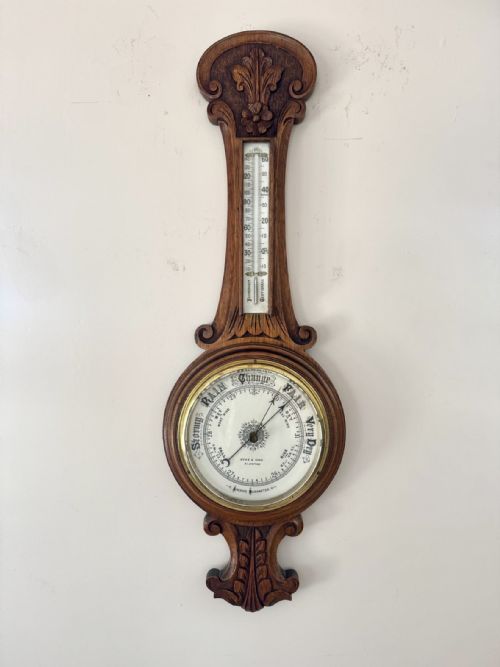
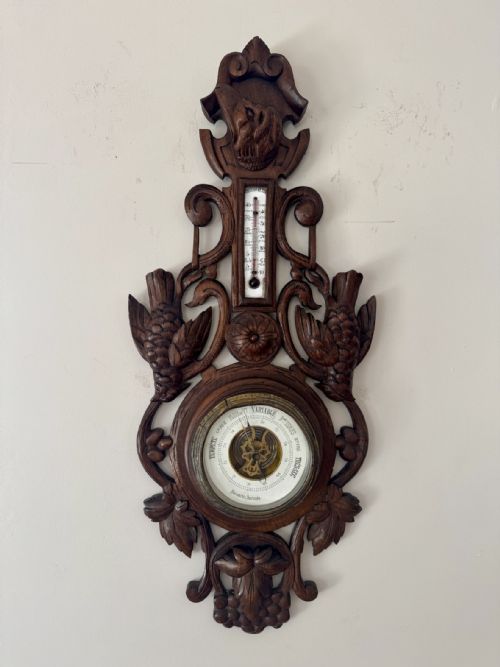
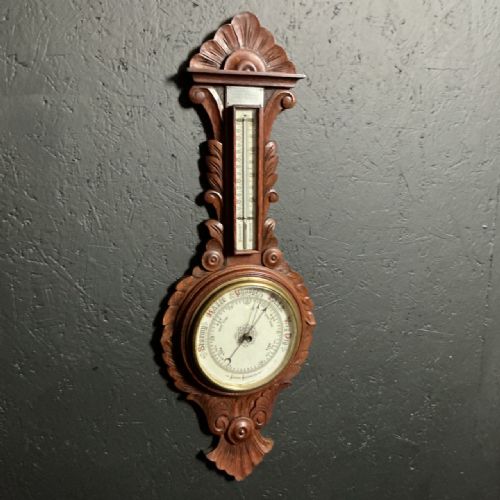
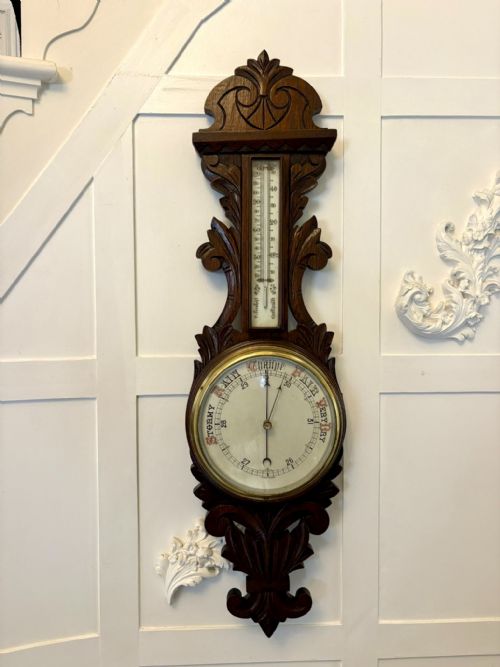
The pieces on this page span the Victorian and Edwardian eras, appearing in forms such as banjo barometers, stick barometers, and wall-mounted clock combinations. Most examples feature carved oak frames, with distinct regional interpretations including Black Forest carving styles and Dutch designs.
Makers such as Negretti & Zambra and James Pitkin produced these instruments alongside lesser-known provincial retailers. The domestic interior they occupied relied upon them for daily meteorological observation before modern forecasting.
Materials and construction
The primary structural material is oak, selected for its grain and strength, allowing deep relief carving of foliage, geometric patterns, and birds. Workshops utilised brass bezels, ceramic dials, and paper scales to display meteorological readings alongside glass tubes or aneroid mechanisms.
Makers integrated mercury columns in stick barometers and flexible metal bellows in aneroid dials to measure air pressure accurately. Many examples incorporate subsidiary alcohol or mercury thermometers mounted alongside the main dial.
At least one Victorian oak barometer commemorates the life of the Duke of Wellington, combining meteorology with military remembrance.
The spectrum of quality
Quality rests in the crispness and depth of the timber carving and the precision of the signed instrument maker. Well-executed pieces display sharply defined botanical motifs or animal carvings rather than shallow, mechanical stamping.
The integration of multiple instruments, such as combined clocks and hygrometers within the same oak housing, indicates a more ambitious commission. Original mercury tubes and signed porcelain or ceramic dials retain higher fidelity to the maker's output than later replacements.
Negretti & Zambra·James Pitkin London·Hyde & Sons Sleaford·J Hughes London·W Watson & Sons·J Hicks of London
The Carved Oak Weather Glass Glossary
- Aneroid barometer
- An instrument that measures air pressure using a flexible metal capsule rather than liquid mercury. The expansion and contraction of this sealed chamber move the indicator needle.
- Stick barometer
- A tall, vertical barometer containing an open column of mercury that rises and falls within a glass tube against a calibrated scale. These long-case instruments represent traditional mercurial design.
- Banjo barometer
- A wall barometer featuring a rounded top dial connected to an extended lower body that often houses a thermometer or humidity gauge. This symmetrical shape dominated Victorian interior display.
- Admiral Fitzroy barometer
- A storm glass barometer design promoted by the British meteorologist in the nineteenth century, featuring instructions for interpreting chemical changes within a sealed tube alongside a standard barometer.
- Black Forest style
- A distinctive decorative carving tradition originating in central Europe, characterised by deeply undercut foliage and animal figures. These frames utilise dark oak to create high-relief ornamentation.
Carved Oak Weather Glass: Frequently Asked Questions
How do aneroid and stick barometers differ?
Aneroid barometers use a sealed metal vacuum box that expands and contracts with pressure changes, operating without liquid. Stick barometers rely on a visible column of mercury inside a glass tube.
Stick designs offer traditional mercurial readings, while aneroid movements provide compact wall-hanging options that suit domestic domestic spaces without fluid maintenance.
Where were these barometers displayed?
These instruments hung in hallways, studies, and entrance spaces where household occupants checked atmospheric conditions before heading outside. Their carved oak frames matched the heavy wood panelling and furniture of the period.
Farmers and merchants also utilised stick barometers to monitor weather patterns affecting daily agricultural and maritime work.
What is an Admiral Fitzroy barometer?
An Admiral Fitzroy barometer combines a standard atmospheric pressure indicator with chemical storm glass tubes and detailed weather interpretation notes. Robert Fitzroy developed these systems for coastal communities and shipping safety.
The large oak cases often feature printed instructions pasted beneath the glass dial to help users predict gales.
How do I date an oak barometer?
Dating relies on stylistic clues, case construction, and the signature of the instrument maker. Victorian pieces often display heavy leaf carving, whereas Edwardian examples favour lighter framing.
Makers recorded in the inventory active between eighteen-fifty and nineteen-ten provide reliable chronological anchors based on their operational years.