


Brown Oak Aneroid Barometer
These brown oak aneroid barometer pieces offer mechanical weather-tracking housed in warm timber cases, built to last for generations.
Brown Oak Aneroid Barometer
When you search for a brown oak aneroid barometer, you are looking at domestic scientific instruments designed to measure atmospheric pressure without the use of liquid mercury. The examples appearing on this page span several decades from the nineteenth and early twentieth centuries, capturing the shift towards reliable weather forecasting in the home.
The origins of these instruments stretch from late Victorian workshops to Edwardian parlours, reflecting domestic habits of observing local barometric trends before stepping outside. Each barometer serves as a functional relic of an era when daily meteorology became a household pursuit.
How they were made
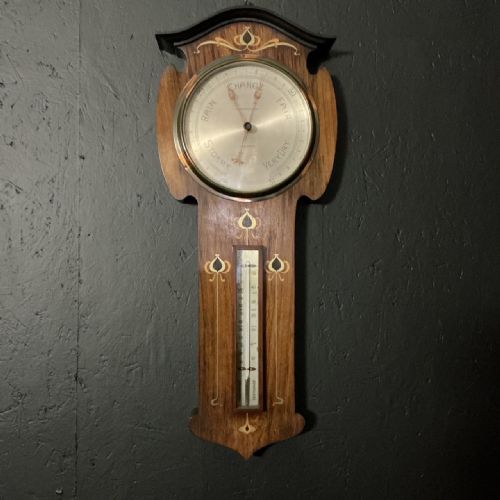
The construction relies on seasoned timber cases, predominantly oak alongside walnut and mahogany, shaped through carving, inlay, and geometric moulding. Cabinetmakers housed the delicate mechanical aneroid capsules within robust wooden surrounds to protect the sensitive internal metal springs.
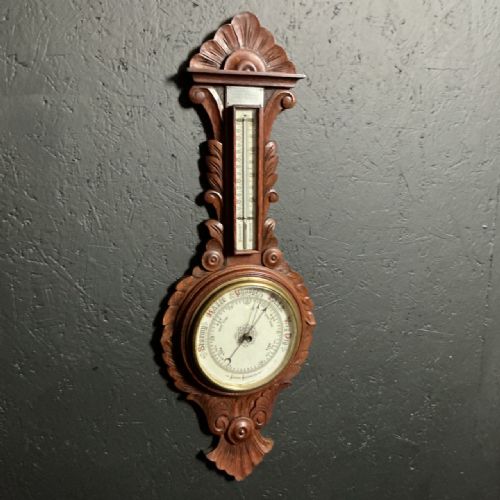
Glass faces protect the dial and indicator needles, while cast brass bezels frame the instrument face and secure the glazed panels in place. Carved ornamentation, particularly in Black Forest and Arts and Crafts examples, demonstrates hand-chiselling directly into the solid wood grain.
Some Victorian barometers travelled from Black Forest workshops with hand-carved leaves guarding the weather glass.
What varies in quality
The standard of the timber selection and the crispness of the hand-carved detailing distinguish finer specimens from simpler utility models. Heavy geometric casing or deep relief carving requires considerable carpentry skill compared to plain surfaces.
The sophistication of the dial face and the inclusion of supplementary instruments like thermometers or clock movements elevate the execution of the piece. Maker attribution, visible in brass inscriptions or dial signatures, also marks out workshop provenance.
Maple & Co·Negretti & Zambra
The Brown Oak Aneroid Barometer Glossary
- Aneroid barometer
- A device that measures atmospheric pressure by the expansion and contraction of a flexible metal capsule, eliminating liquid mercury. This design allowed barometers to be mounted on walls in various orientations.
- Banjo barometer
- A wall instrument shaped with a rounded dial head above a long tapering body, frequently housing a thermometer or hygrometer below. This silhouette dominated domestic interiors during the nineteenth century.
- Black Forest
- A regional style of wood carving originating from central Europe, characterised by deeply undercut foliage, animals, and natural motifs. These pieces showcase elaborate sculptural woodwork applied to instrument cases.
- Bezel
- The metal rim that holds the glass cover in place over the barometer dial. Brass was the standard material used for these protective rings.
- Arts and Crafts
- A design movement promoting traditional craftsmanship and simple forms over mass production. Items from this tradition emphasise the natural grain and texture of the oak.
Brown Oak Aneroid Barometer: Frequently Asked Questions
What is an aneroid barometer?
An aneroid barometer measures atmospheric pressure using a sealed, flexible metal box that expands or contracts as pressure changes. This movement turns gears to point a needle across a calibrated dial.
Unlike mercury barometers, these sealed units do not require vertical liquid columns, making them safer and easier to mount securely on domestic walls.
How do I date an oak barometer?
Dating relies on stylistic clues found in the woodwork, dial typography, and case construction methods. Victorian examples often feature dark finishes and heavy carved motifs, while Edwardian pieces lean towards simpler lines.
Maker signatures printed on the dial face or stamped into the brass work can also narrow down the year of production.
Where should I hang a wall barometer?
These instruments belong on interior walls away from direct sunlight, radiators, and damp areas that might warp the wooden case. Stable room temperatures ensure the internal metal mechanisms operate without interference.
Choose a spot at eye level in a hallway or study where you can easily tap the glass lightly before reading the needle.
Did Victorians use barometers daily?
Middle-class Victorian households relied on these instruments to anticipate rain or fair weather before planning outdoor activities or travel. Checking the air pressure was a standard part of the morning domestic routine.
The inclusion of thermometers and clock faces on many wall-mounted units turned them into multi-purpose information hubs for the home.