



Vintage Medallion Kilim
These vintage medallion kilim pieces bring tribal character and flatweave texture to a room, offering graphic centrepieces for modern interiors.
Vintage Medallion Kilim
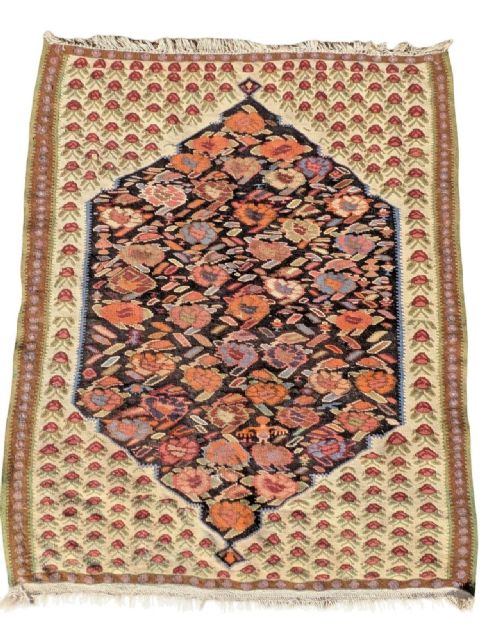
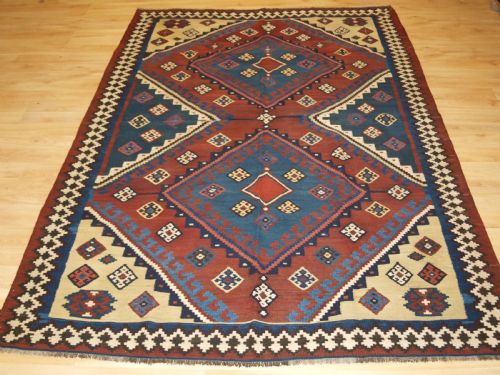
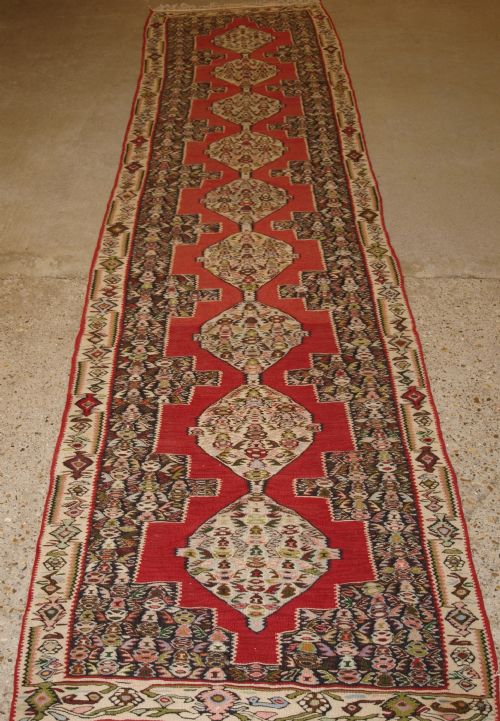
A vintage medallion kilim represents a flatwoven flatbed textile defined by central geometric motifs rather than a pile. These pieces emerge from regions spanning Anatolia, Persia, the Caucasus, and the Balkans, reflecting diverse tribal traditions.
The selections available here showcase rugs and carpets from the early twentieth century, specifically dating across the 1900s, 1910s, 1920s, and 1930s. Buyers frequently encounter formats ranging from compact runner rugs to large room-size carpets carrying distinct repeat or single medallion layouts.
How they were made
Weavers constructed these flatweaves using interlocking slit-tapestry techniques with wool and cotton foundations. Natural dyes imbued the yarns with durable colour before the introduction of early synthetic dyes in the twentieth century.
Certain regional pieces incorporated camel hair grounds to add natural variation in texture and tone. The absence of a knotted pile kept the textiles light and durable for domestic floor use.
The inventory records pieces originating from Persian, Anatolian, Caucasian, and Balkan traditions, utilising wool, cotton, and camel hair.
What varies in quality
The distinction between standard and superior pieces rests upon the crispness of the geometric drawing and the balance of the medallion layout. Master weavers achieved sharper lines and more complex iconography within tribal workshops.
Material selection also dictates overall grade, with tightly spun wool and specific camel hair grounds holding dye more uniformly over decades of use.
The Vintage Medallion Kilim Glossary
- Kilim
- A flatwoven textile produced without a pile by tightly interweaving warp and weft threads. This technique creates a lightweight rug suitable for floors or wall hangings.
- Slit tapestry
- A weaving technique where the weft threads are looped back at the boundary of each colour area, creating small vertical slits. This method defines the sharp diagonal lines seen in tribal flatweaves.
- Warp
- The stationary vertical threads stretched across the loom before weaving begins. The weft is passed horizontally over and under these foundational strands.
- Weft
- The transverse threads passed through the warp to form the pattern and colour of the textile. In kilims, these packed horizontal threads completely conceal the vertical warp.
Vintage Medallion Kilim: Frequently Asked Questions
Where should I place a kilim?
These flatweaves suit low-traffic areas or dining spaces where a flat surface prevents chair legs from catching. Their light weight makes them adaptable for hallways and smaller rooms.
Keep them away from damp environments to protect the natural wool and cotton fibres over time.
How do I clean my flatweave?
Regular gentle vacuuming without a beater bar removes loose dust trapped between the tight weft threads. Professional specialist cleaning is recommended for deeper maintenance.
Avoid soaking the textile in water to prevent dye bleed and distortion of the wool foundation.
Are these rugs reversible?
Most traditional flatweaves display a similar pattern and coloration on both sides due to the slit-tapestry construction method. Occasional floating threads may appear on the reverse side.
Reversing the textile periodically distributes wear evenly across both faces.
How do I identify regional styles?
Regional attribution relies on the specific geometry of the central medallion, the repeat structure, and the palette used by the weavers. Persian pieces often present intricate diamond motifs, while Caucasian and Balkan examples tend toward bolder, graphic symbolism.
Materials such as camel hair grounds also point toward specific eastern origins and production dates.