
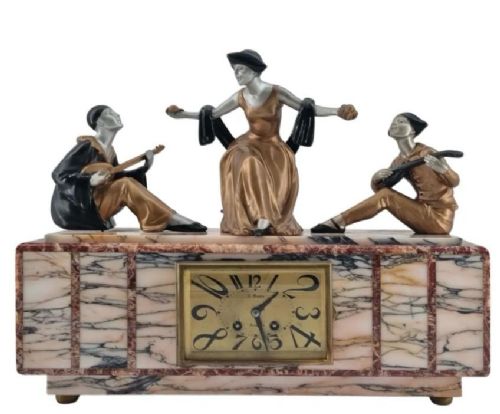


Vintage Marble Clock
A vintage marble clock anchors a room with heft and presence, bringing architectural weight and classical polish to a mantelpiece.
Vintage Marble Clock
When you search for a vintage marble clock, you encounter heavy architectural timepieces designed primarily for the mantelpiece, desk or side table. These objects range from severe neoclassical designs in white or red marble to streamlined geometric pieces from the twentieth century.
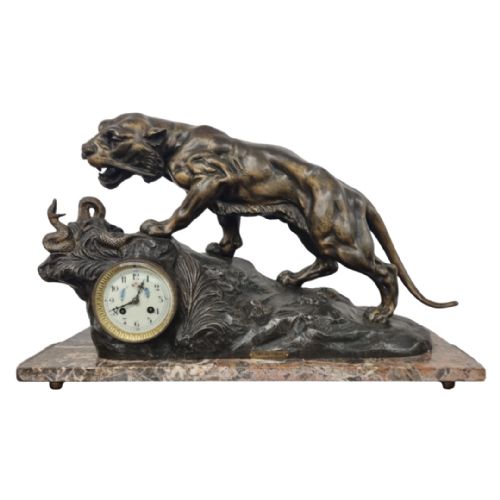
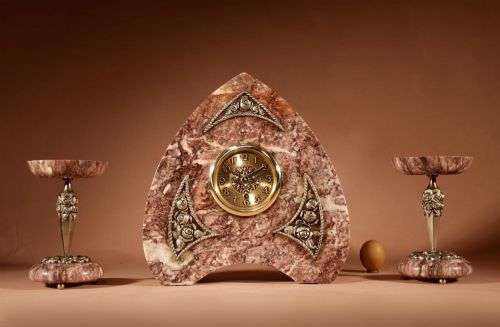
The versions you meet most frequently on this page span the Victorian era through the Art Deco period, often accompanied by matching side garnitures or cast metal figures. They combine solid stone bodies with enamel dials, brass bezels and occasionally complex mechanical movements.
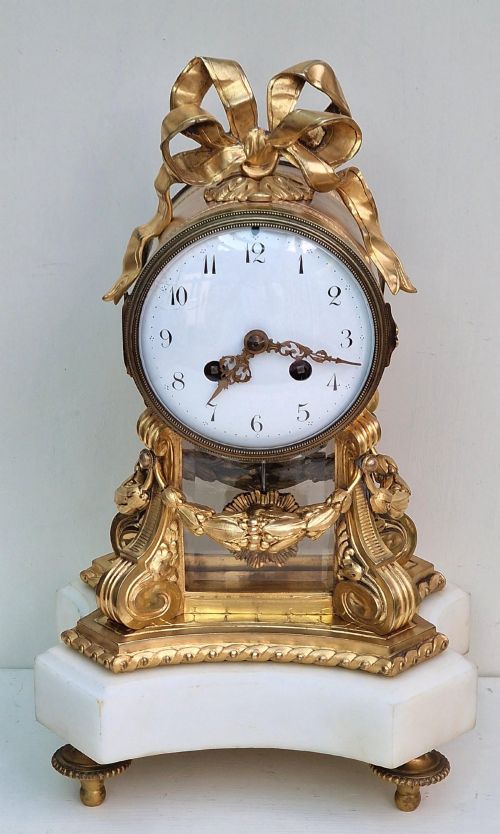
Makers housed these timepieces in substantial stone housings that utilised contrasting mineral colours, faux finishes or polished gilt bronze mounts. Whether taking the form of a lyre, a portico or a stepped geometric block, each piece functions as both a reliable instrument and a sculptural centrepiece.
How they were made
Craftsmen shaped dense blocks of natural stone, including black, white, red marble and green onyx, into architectural cases using saws, chisels and extensive hand polishing. They integrated cast brass, ormolu, gilt bronze and spelter mounts directly into or onto the stone body, securing them with threaded pins and nuts.
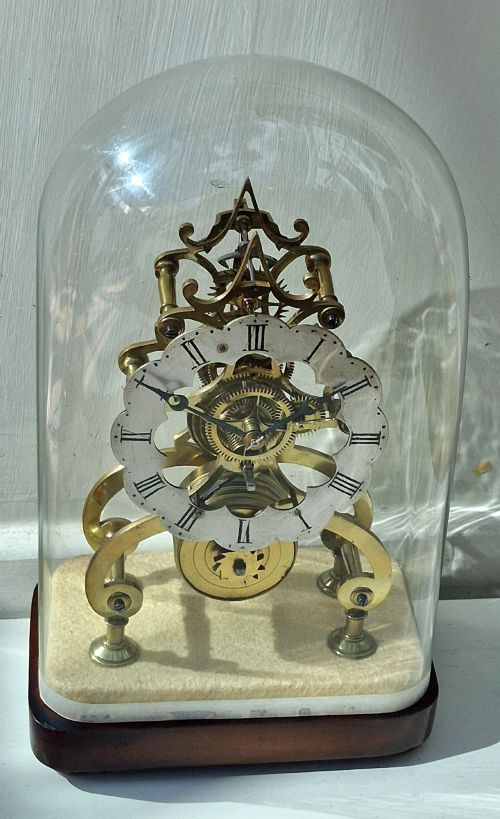
Dial faces were typically constructed from white enamel over copper plates, featuring painted roman or arabic numerals protected behind bevelled glass panes within brass bezels. Movements ranged from standard eight-day spring-driven mechanisms to skeleton frames that exposed the intricate brass gear trains.
The inventory encompasses diverse forms, including industrial nautical desk pieces, giant carriage clocks, skeleton movements and elaborate garniture sets.
What varies in quality
The distinction between ordinary and exceptional examples lies in the selection and assembly of the materials. Superior pieces feature choice blocks of heavily figured or solid marble paired with finely chiselled ormolu mounts rather than plated spelter, showing crisp casting detail and heavy gauge brass components.
Movement execution also dictates grade, with higher quality pieces housing robust, finely finished French movements bearing maker signatures. The integration of the design matters profoundly, where garniture sets match the central clock precisely in stone grain, patination and decorative motif.
R Varnier·Sega·Elliott·Louis Goret·Luxor·DEP
The Vintage Marble Clock Glossary
- Garniture set
- A matching set consisting of a central clock flanked by side ornaments such as urns, vases or figural candelabra. These groups were designed to create a balanced decorative display across a mantelpiece.
- Ormolu
- Finely ground high-carat gold applied to a bronze base using a mercury amalgam technique, producing a rich golden lustre. It provides ornate decorative mounts on nineteenth century stone clock cases.
- Spelter
- A zinc alloy frequently used as a cheaper alternative to bronze for casting decorative figural elements and statues. It is typically painted or bronze-plated to simulate heavier metals.
- Skeleton clock
- A timepiece stripped of a traditional solid dial case to reveal the fully exposed brass gear train and movement plates. They sit under glass domes to protect the delicate exposed mechanism.
- Enamel dial
- A metal disc fused with powdered glass fired at high temperatures to create a smooth, glossy white surface. Black numerals and minute tracks are painted onto this durable vitreous layer.
Vintage Marble Clock: Frequently Asked Questions
Where should I place a heavy marble clock?
Due to the substantial weight of solid stone and metal housings, position the clock on a sturdy, level surface such as a mantelpiece or heavy sideboard. An uneven foundation can throw the pendulum off-beat and cause the movement to stop.
Keep the piece away from direct sunlight and damp environments to protect the polished stone surface and the delicate paper or enamel dials behind the glass bezel.
How do I tell an Art Deco clock from a Victorian one?
Victorian clocks rely heavily on classical revival styles, featuring heavy columns, architectural pediments, white marble, black slate and ornate gilt bronze mounts. They project a sense of nineteenth-century grandeur and historical weight.
Art Deco clocks embrace streamlined geometries, stepped cases, contrasting green onyx or chrome elements, and playful figural accents like greyhounds or dancers. Their silhouettes are clean, symmetrical and distinctly modern for the interwar period.
What is a clock garniture set?
A clock garniture set comprises a primary mantel clock accompanied by two matching side pieces, often styled as decorative urns, vases or matching lamps. These matched objects were designed to create a unified focal point on a drawing room mantel.
The side pieces share the exact same marble type, metal mounts and stylistic vocabulary as the central clock, ensuring a cohesive decorative arrangement.
Why does my clock keep stopping?
A vintage mechanical clock often stops because it sits slightly out of level, which disrupts the delicate tick of the escapement and pendulum. Adjust the small leveling feet or shift the base until the beat sounds even and steady.
If the beat sounds regular but the clock still stops, the internal oil may have dried up over the decades, requiring professional cleaning and servicing by a horologist.