
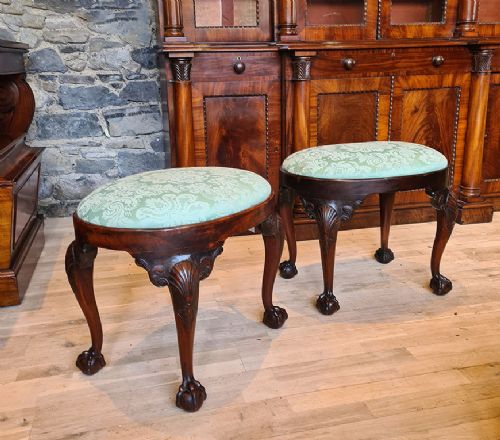


Vintage Mahogany Window Seat
A vintage mahogany window seat brings practical seating and period character to a hall, landing or bay.
Vintage Mahogany Window Seat
A vintage mahogany window seat combines solid timber frames with upholstered surfaces, spanning forms from single stools to long benches, day beds and salon settees. Buyers seeking a vintage mahogany window seat encounter pieces originating from the eighteenth century through to the early twentieth century, with Edwardian examples and nineteenth-century variants appearing most frequently.
The selection ranges from simple footstools and piano stools to large country house storage ottomans and chair-back end-of-bed seats. Makers and workshops utilise mahogany alongside satinwood inlay, brass, and diverse textiles, creating versatile furniture designed to fit narrow spaces or sit beneath low windows.
What varies in quality
The sophistication of the timber frame work separates standard production from superior pieces, particularly where hand-carved details or precise satinwood inlay define the mahogany surface. Heavier proportions in large country house storage ottomans or extended benches indicate robust internal framing designed for heavier domestic use.
The choice of original or period-appropriate textile coverings, from woven kilim to plush velvet, influences the tactile and visual appeal of the seating. Pieces that retain integrated elements like brass castors or distinct stylistic revivals demonstrate higher design ambition.
The listings on this site span multiple eras, including Georgian, Regency, William IV, Victorian, and Edwardian periods.
Hallett & Sons·Morris & Co.
The Vintage Mahogany Window Seat Glossary
- Mahogany
- A dense, durable tropical hardwood prized for its reddish-brown colour and ability to hold fine carved details. It serves as the primary structural material across nineteenth-century and Edwardian seating.
- Satinwood inlay
- A decorative technique inserting lighter yellowish satinwood veneer into contrasting mahogany surfaces to create geometric or floral patterns. This ornamentation appears on various Edwardian salon furniture.
- Kilim
- A flat-woven textile produced in the Middle East and Eastern Europe, utilised as a durable and decorative upholstery covering for nineteenth-century footstools.
- Ottoman
- A low, upholstered seat or bench without a back or arms, frequently incorporating internal storage space beneath a hinged lid. Large examples serve multiple functions in country house interiors.
- Duet stool
- An extended piano stool designed to seat two players side by side during musical performances. These pieces often feature upholstered tops and sturdy mahogany frames.
Vintage Mahogany Window Seat: Frequently Asked Questions
Where should I place a window seat?
These pieces fit naturally beneath low windows, along narrow hallways, or at the foot of a bed.
Their shallow depth allows them to provide seating without blocking walkways or natural light.
Can I use a piano stool as a window seat?
Many piano stools and duet stools share similar proportions and height dimensions with traditional window seats.
They offer compact upholstered seating that suits smaller alcoves and narrow spaces.
How do I care for mahogany frames?
Maintain the timber by keeping it away from direct heat sources and sudden temperature changes to prevent wood movement.
Dust regularly with a dry cloth and apply occasional wax polish to nourish the grain.