


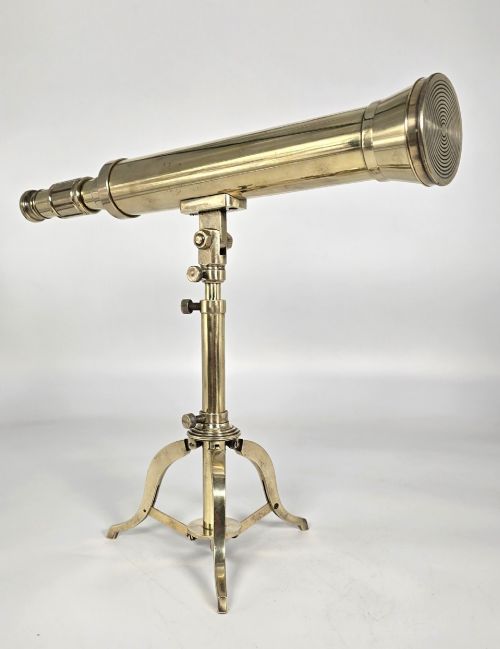


Vintage Library Spyglass
These vintage library spyglass pieces are brass and mahogany scientific instruments built for terrestrial and astronomical viewing.
Vintage Library Spyglass
When you search for a vintage library spyglass, you are looking at optical instruments designed for desktop study, navigation or surveying within homes and offices. These brass and mahogany devices span the Georgian, Victorian and Edwardian periods, stretching from the eighteenth century into the early twentieth.
You are most likely to meet multi-draw brass telescopes mounted on folding tripod stands or cased in wood. Examples range from compact four-draw versions to substantial instruments by makers in London and Sheffield.
How they were made
These instruments combine polished brass tubes with turned mahogany bodies and leather grips. Glass lenses provide magnification, while iron and steel components appear in internal fittings and stands.
Workshops utilised multi-draw sliding brass sections to extend the focal length while allowing the telescope to collapse into a portable form. Stands incorporated folding brass legs or heavy wooden bases to stabilise the weight of the optics.
Vintage Library Spyglass Retail Price Guide 2026
Typical asking prices for vintage library spyglass among the pieces listed under this phrase on Sellingantiques today, from the lower quarter to the upper quarter. They describe what is for sale here now, not the wider market.
Listings span from the 18th Century through the Victorian era to the 20th Century, constructed from brass, mahogany, leather and iron.
What varies in quality
The distinction between ordinary and exceptional pieces lies in the precision of the optics and the reputation of the maker. Signed barrels from established London workshops indicate higher grade materials and finer optical calibration.
The presence of original accessories, such as fitted mahogany cases, folding brass tripods and dust caps, separates complete library instruments from bare tubes.
Nairne & Blunt·W. & T. Gilbert·Clarkson·Steward of London·Chadburn Brothers·S & B Solomons·Matthew Berge·G.adams
The Vintage Library Spyglass Glossary
- Draw
- A sliding tubular section of a telescope that pulls out to focus the instrument. Multiple draws allow a long focal length to collapse into a compact size.
- Terrestrial
- An optical design configured to show upright images for viewing land-based objects rather than inverted views of the stars.
- Tripod
- A three-legged folding stand that supports the weight of a heavy library telescope during use. These stands were frequently made of brass or cast iron.
- Achromatic
- A lens combination designed to reduce chromatic aberration and produce clearer colour reproduction across the field of view.
Vintage Library Spyglass: Frequently Asked Questions
How do I use a library spyglass?
Extend the sliding brass draws fully until the internal lenses lock into position for viewing. Support the barrel on its fitted tripod stand or rest it steadily on a flat surface.
Adjust the final draw slowly until distant terrestrial objects come into sharp focus through the glass.
Were these telescopes used outdoors?
Library telescopes were primarily designed for indoor use on desks or near tall windows overlooking estates and gardens. Their substantial brass barrels and wooden stands made them less portable than smaller field spyglasses.
Some examples were mounted on folding tripods for easy relocation between rooms or balconies within a grand home.
How do I date a brass telescope?
Examine the style of the engraved signature, the font used for the maker's name and the number of sliding draws. Eighteenth-century models often feature simpler mahogany barrels with minimal brass reinforcement.
Victorian and Edwardian versions frequently incorporate complex rack-and-pinion focusing mechanisms and heavy folding tripod stands.
What is the difference between a spyglass and a telescope?
The terms are often used interchangeably, though historical library instruments are technically refracting telescopes. Spyglass usually refers to smaller, handheld collapsible tubes carried by travellers or mariners.
Library instruments are larger, heavier brass devices intended for stationary use on stands inside study rooms.