


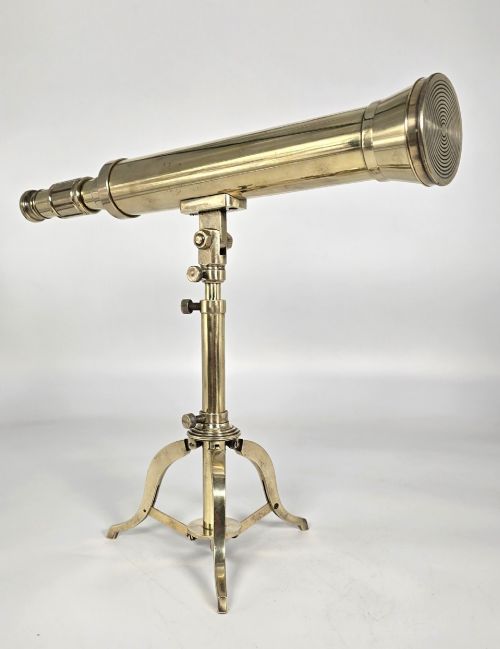


Antique Desktop Telescope
These antique desktop telescope examples bring brass and mahogany optics to your study, offering both period scientific craftsmanship and functional historic utility.
Antique Desktop Telescope
An antique desktop telescope is a precision optical instrument designed for table or library use, combining scientific utility with period craftsmanship. These instruments span the eighteenth century, the Georgian era, and the Victorian period, reflecting centuries of optical development.
You are most likely to meet brass and mahogany library telescopes on this page, often supplied with dedicated folding stands or original fitted cases. Forms range from two-draw and three-draw portable configurations to substantial Gregorian and astronomical instruments.
Makers from London workshops produced many of these pieces, utilising durable materials like cast iron, leather, and glass alongside polished brass and timber. Each piece represents the intersection of practical navigation, astronomy, and domestic study during the eighteenth and nineteenth centuries.
How they were made
Makers constructed the primary optical tubes from polished brass, often incorporating multiple draw sections to adjust focus and length. These metal components were frequently paired with turned mahogany barrels or wrapped in stitched leather for grip and protection.
Scientific instrument makers utilised glass lenses to achieve magnification, mounting the main tubes on folding brass tripod stands or heavy table bases. Original fitted wooden cases accompanied many pieces, lined to protect the delicate optical assemblies during storage and transport.
Antique Desktop Telescope Retail Price Guide 2026
Typical asking prices for desktop telescope among the pieces listed under this phrase on Sellingantiques today, from the lower quarter to the upper quarter. They describe what is for sale here now, not the wider market.
Scientific instruments include named London workshops alongside Gregorian and astronomical forms.
What varies in quality
The distinction between standard production and the top of the range rests upon the precision of the signed maker and the completeness of the original housing. Named London workshops command attention for superior optical tuning and robust mechanical construction.
The survival of original components, such as folding brass tripods and fitted mahogany cases, defines the desirability of a piece. Finer examples retain crisp signatures on the brass draw tubes alongside clear glass optics and uncompromised timber surfaces.
Nairne & Blunt of London·S & B Solomons·Matthew Berge London·Broadhurst & Co
The Antique Desktop Telescope Glossary
- Draw
- A sliding section of a telescope tube that extends to adjust the focus. Multiple draws allow the instrument to collapse into a shorter length.
- Gregorian
- A type of reflecting telescope designed by James Gregory in the seventeenth century. It uses concave mirrors to form an image viewed through an eyepiece at the back.
- Library telescope
- A large optical instrument intended for indoor study rather than field use. These pieces typically rest upon a dedicated table stand.
- Tripod
- A three-legged folding stand that supports the weight of the telescope. Many period examples feature collapsible brass legs for stability.
Antique Desktop Telescope: Frequently Asked Questions
What is an antique desktop telescope?
An antique desktop telescope is a historic optical instrument designed for use on a table or desk within a library or study. These pieces combine scientific utility with decorative appeal, featuring brass and mahogany construction.
Most examples date from the Georgian and Victorian eras, reflecting the period interest in astronomy and navigation. They range from small two-draw models to larger mounted library instruments.
How were library telescopes used?
Library telescopes served as both serious scientific tools and objects of display for educated households. Owners used them to observe distant terrestrial views or celestial bodies from the comfort of an indoor room.
Because they were mounted on sturdy table stands or tripod bases, they provided stable magnification without requiring the user to hold the heavy brass barrel steady.
How do I date an antique telescope?
Dating relies heavily upon the stylistic details, materials, and any maker signatures engraved on the brass draw tubes. Earlier pieces from the eighteenth century often feature distinct mahogany barrels and simpler mounting configurations.
Victorian instruments frequently incorporate multi-draw brass construction with leather grips and standardised maker stamps. Comparing the form to documented workshop dates helps narrow the period.
How do I care for a brass telescope?
Care involves keeping the instrument in a stable environment away from excessive moisture and extreme temperature fluctuations. The polished brass requires minimal intervention, and gentle dusting preserves the historic finish.
If the telescope includes leather sections or wooden mounts, treating the timber and leather with appropriate conservation care maintains their condition. Handling the draw tubes with clean hands prevents oils from tarnishing the brass.