

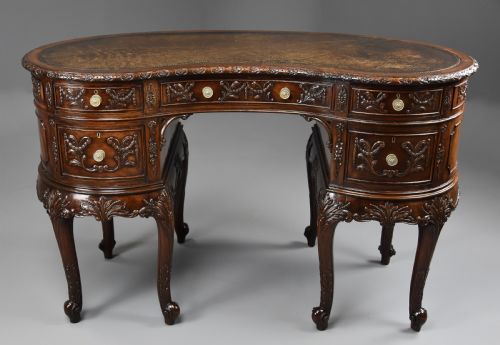
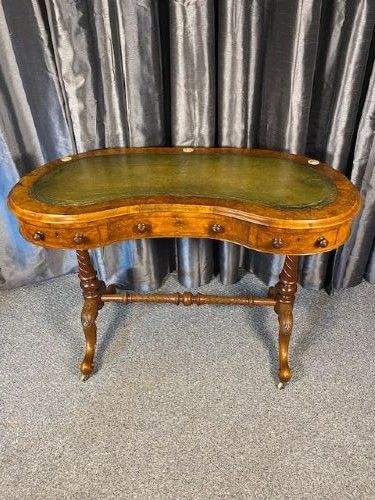
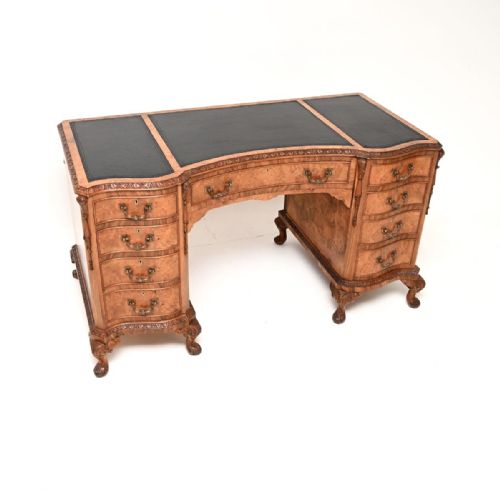
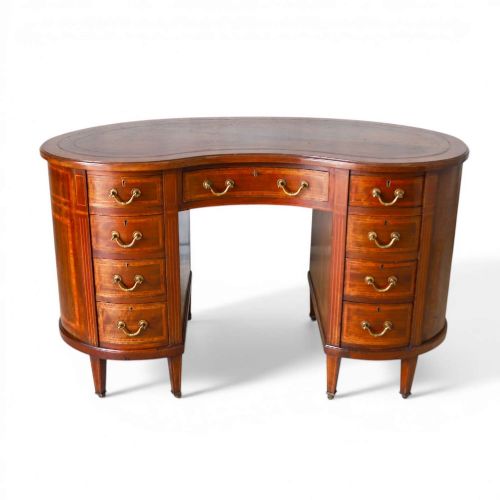



Vintage Kidney Desk Table
A vintage kidney desk table offers a distinctive curved silhouette designed for writing, with examples appearing across Edwardian and Victorian periods.
Vintage Kidney Desk Table
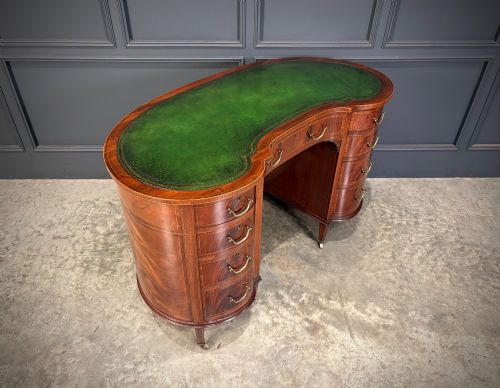
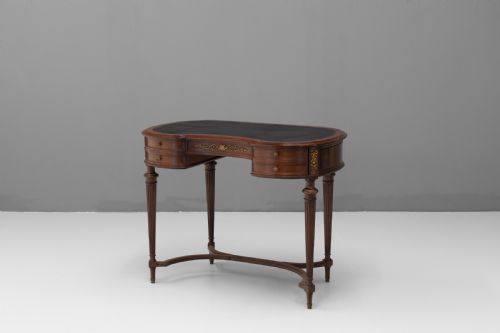
A vintage kidney desk table presents a characteristic crescent curve that allows the user to sit nestled into the centre of the piece. These items function primarily as writing desks, side tables, or occasional tables within domestic spaces.
The selection on this page relies heavily on Edwardian and Victorian examples, alongside pieces from the late nineteenth century and early twentieth century. Mahogany and walnut form the core of the available forms, frequently accompanied by distinct inlaid details.
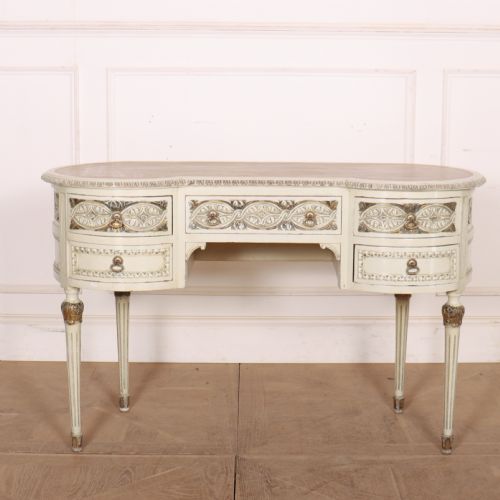
Makers such as Wolfe and Hollander, Gillows, and Maurice Adams contribute to the broader range of desks and tables found here. Buyers encounter everything from simple painted wood surfaces to elaborate burr walnut structures mounted with ormolu.
Materials and construction methods
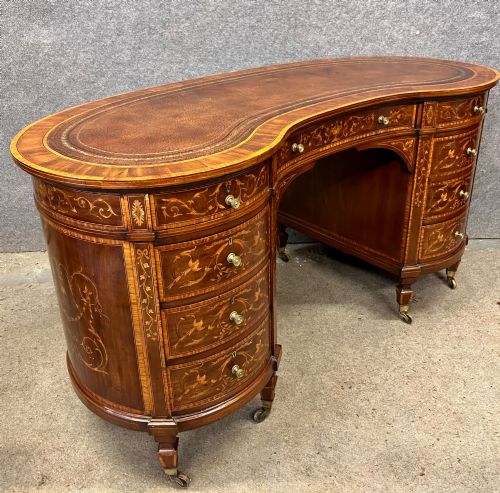
Cabinet makers utilised solid timbers and selected veneers, applying mahogany and walnut across the curved frames of these desks. Burr walnut and satinwood appear as decorative veneers, often framed by contrasting stringing and marquetry inlay.
Working a piece of timber into a kidney shape requires specialist curving techniques for the rails and drawers. Leather inserts, frequently gold-tooled, provide the traditional writing surface set into the top of the desk.
Mounts in brass and ormolu decorate the corners and feet of finer examples, while hand-painted finishes appear on decorative dressing tables and writing desks. Dovetailed drawer construction and turned wooden handles complete the internal build.
Vintage Kidney Desk Table Retail Price Guide 2026
Typical asking prices for vintage kidney desk table among the pieces listed under this phrase on Sellingantiques today, from the lower quarter to the upper quarter. They describe what is for sale here now, not the wider market.
Listings feature items spanning the 1870s through to the 1930s, encompassing Victorian, Edwardian, and Art Deco periods alongside Revival styles.
Distinguishing quality in curved desks
The sophistication of the timber selection dictates much of the visual merit, with finely figured burr walnut and rich mahogany commanding attention above plain painted surfaces. The crispness of the marquetry inlay and the delicacy of the stringing reveal the hand of a skilled workshop.
Hardware such as original brass handles, ormolu mounts, and leather writing inserts in sound condition elevate a piece from standard utilitarian furniture to high craftsmanship. The structural integrity of the curved drawers and the smoothness of their operation remain central to the assessment.
Wolfe & Hollander·Gillows·Maurice Adams
The Vintage Kidney Desk Table Glossary
- Kidney desk
- A writing table featuring a concave front curve that wraps around the seated user. The distinctive bean-shaped top defines this specific category of antique furniture.
- Marquetry
- The art of applying decorative pieces of veneer to a structure to form intricate pictorial or geometric patterns. This technique appears across many Edwardian inlaid surfaces on this page.
- Ormolu
- Gilded bronze ornamentation applied to the mounts, feet, and edges of fine furniture. It provides a bright metallic contrast against dark walnut and mahogany timbers.
- Pedestal desk
- A heavy freestanding desk supported by two banks of drawers or cupboards beneath the work surface. Several nineteenth-century variations include kneehole configurations.
- Sheraton Revival
- A late nineteenth and early twentieth-century design movement inspired by the neoclassical furniture of George Sheraton. Pieces from this revival often incorporate satinwood inlay and graceful tapering legs.
Vintage Kidney Desk Table: Frequently Asked Questions
What is a kidney desk?
A kidney desk is a writing table shaped with a curved, concave front that wraps around the person sitting at it. This distinctive form allows the user to reach the drawers and writing surface with ease while occupying a compact footprint.
Craftsmen produced these tables primarily in mahogany and walnut during the Victorian and Edwardian eras. They served as ladies writing desks or decorative occasional tables in formal rooms.
How do I date a kidney desk?
Dating relies on examining the timber, secondary woods, construction techniques, and decorative styles visible on the piece. Edwardian examples often feature delicate satinwood inlay and Sheraton Revival motifs, whereas Victorian pieces tend to utilise heavier mahogany and walnut.
Makers' marks or stamps inside the drawers can occasionally provide a precise attribution to firms like Gillows or Wolfe and Hollander. The style of the brass hardware and the type of leather tooling also offer clues to the decade of manufacture.
Where were these desks placed?
These pieces suited drawing rooms, boudoirs, and libraries where a freestanding desk needed to look attractive from all angles. Because the curved back is finished as carefully as the front, they often sat away from walls in the middle of a room.
Smaller versions functioned effectively as dressing tables or side tables in bedrooms. Their compact scale made them versatile additions to domestic interiors throughout the nineteenth and early twentieth centuries.
How do I care for leather desk tops?
The leather writing surface benefits from gentle dusting with a dry cloth and occasional treatment with appropriate leather dressings to prevent cracking. Avoiding direct sunlight helps preserve the colour and the gilt tooling around the edges of the insert.
Solid wood frames require standard polishing with a quality wax to nourish the grain of mahogany or walnut. Keeping the furniture away from extreme temperature fluctuations protects the veneers and curved joints.