

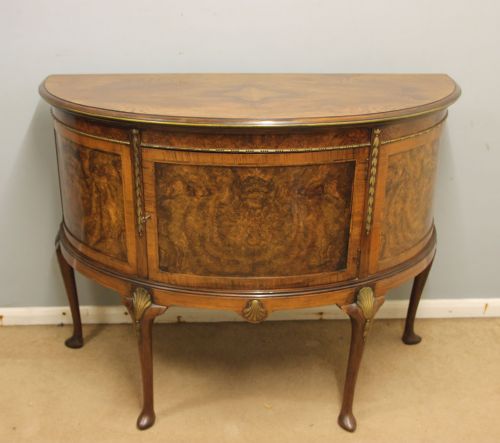


Vintage Half Moon Cabinets
These vintage half moon cabinets bring curved grace to narrow hallways and corners.
Vintage Half Moon Cabinets
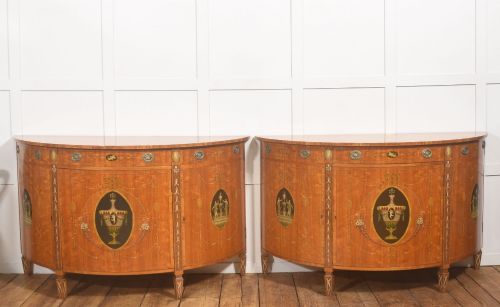
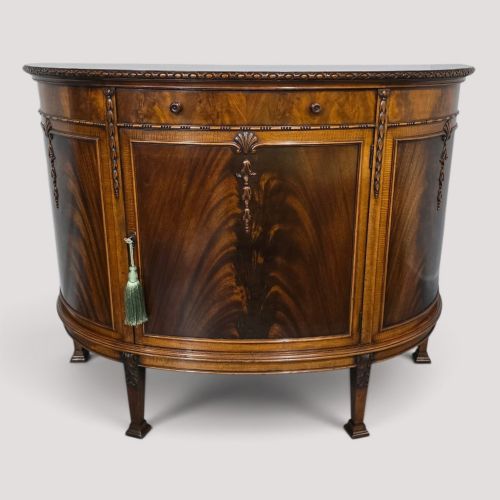
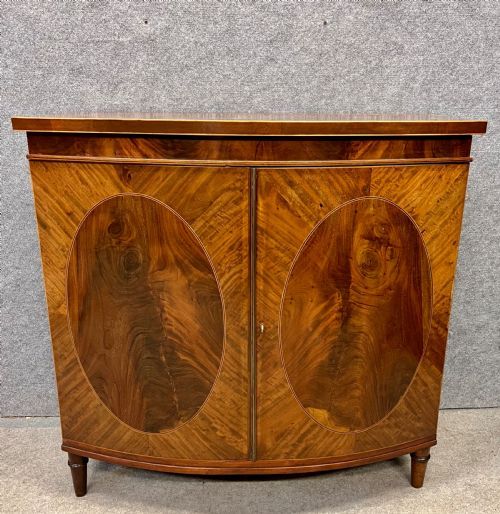
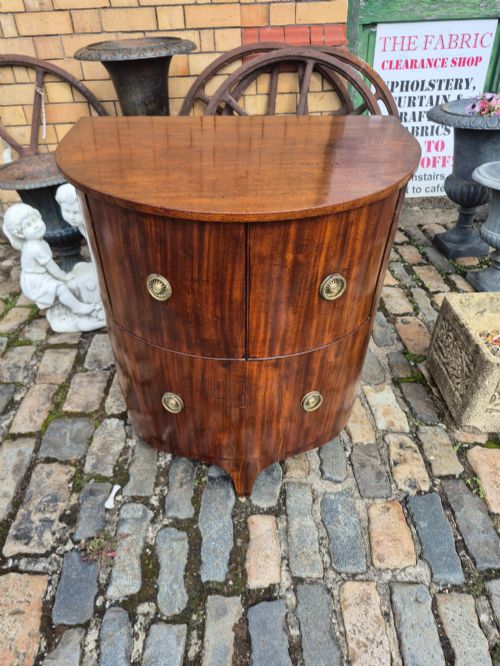
When you search for vintage half moon cabinets, you encounter semicircular pieces designed to sit flush against a wall while saving floor space. These items appear as side cabinets, display units, commodes, and small bedside tables.
The selections here span from the late nineteenth century through the Edwardian era and into the 1930s. Revival styles dominate, particularly Sheraton Revival and Neoclassical designs.
Mahogany, walnut, and satinwood form the backbone of the selection, often enriched with painted details and decorative inlay. Sideboards and side cabinets provide the most common large formats among these listings.
How they were made
Cabinet makers utilised solid timbers alongside finely figured veneers to achieve the characteristic curved facades. Mahogany and walnut provide sturdy carcases, while satinwood serves as a pale canvas for intricate painted decoration.
Inlay and stringing define the Edwardian and Sheraton Revival pieces, demanding precision woodworking to bend and fit veneers around tight radiuses. Brass hardware often accents the doors and drawers of these semicircular forms.
Vintage Half Moon Cabinets Retail Price Guide 2026
Typical asking prices for vintage half moon cabinets among the pieces listed under this phrase on Sellingantiques today, from the lower quarter to the upper quarter. They describe what is for sale here now, not the wider market.
Period styles represented include Edwardian, French Louis XVI, Grand Regency, and Sheraton Revival.
What varies in quality
The standard of timber selection and veneer matching dictates the visual impact of each piece. Superior examples display continuous grain patterns across the curved doors and drawers without disruption.
Hand-painted floral or classical motifs vary significantly in execution, with finer artistry lifting a cabinet from a standard utility item into a decorative focal point. The crispness of inlaid stringing and the weight of the brass mounts also separate standard workshop output from finer craftsmanship.
The Vintage Half Moon Cabinets Glossary
- Demi-lune
- A French term meaning half-moon, describing furniture with a semicircular shape and a flat back for wall placement. This outline allows the furniture to fit into tight spaces.
- Sheraton Revival
- A late nineteenth and early twentieth century style drawing inspiration from the lighter neoclassical designs of Thomas Sheraton. These pieces often feature satinwood and delicate painted motifs.
- Satinwood
- A lustrous, yellow-toned hardwood prized for decorative veneer work. It provides a bright surface suited for fine inlay and painted details.
- Inlay
- A technique where pieces of contrasting timber, shell, or bone are inserted into depressions in the carcase to form patterns. It adds surface ornamentation without altering the structural profile.
- Commode
- A low piece of furniture with drawers or doors, originating in France. In this context, it describes decorative semicircular storage cabinets.
Vintage Half Moon Cabinets: Frequently Asked Questions
Where should I place a half moon cabinet?
These cabinets suit narrow hallways, landings, and corners where rectangular furniture protrudes too far into the walkway. Their flat backs sit flush against the wall while the curved front softens the transition between rooms.
They also function effectively as bedside tables or compact sideboards in dining areas where surface space is limited.
How do I date a vintage cabinet?
Dating relies on timber choices, construction methods, and stylistic revival cues. Edwardian and 1920s examples often draw heavily on eighteenth-century Sheraton or Hepplewhite revivals.
Materials like satinwood and specific inlay patterns point towards the late nineteenth and early twentieth centuries rather than earlier periods.
What is the difference between a demi-lune and a half moon cabinet?
There is no functional difference between the two terms. Demi-lune is simply the traditional cabinetmaker designation for a half-moon shape.
Both terms describe a semicircular top and flat back designed for wall placement.
Are these cabinets practical for storage?
The curved interior shape requires a different approach to organisation than rectangular cupboards. Deep central areas accommodate bulkier items while the tapering sides suit smaller goods.
Many pieces combine cupboard space with drawer storage, depending on whether the format is a sideboard, commode, or bedside table.