
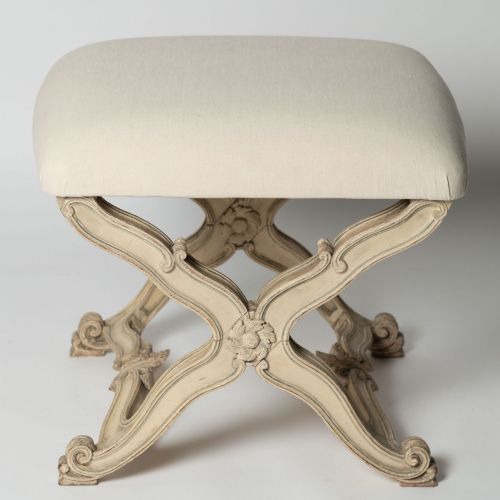


Vintage French Vanity Bench
These vintage french vanity bench pieces bring continental elegance to dressing rooms and bedrooms through classic seating forms.
Vintage French Vanity Bench
A vintage french vanity bench serves as a low seat before a dressing table, taking the form of stools, footstools, and duet stools. These pieces arrive from various periods ranging from the nineteenth century through to the nineteen-thirties.
The aesthetic draws heavily on traditional continental design vocabulary, encompassing styles such as Louis XVI, French Provincial, and Rococo Revival. Most examples encountered here present compact proportions suited to placement beneath a vanity or beside a bed.
Makers utilised diverse decorative approaches, combining carved wooden frames with upholstered tops. Buyers select these items to introduce period character and practical seating into domestic dressing spaces.
How they were made
Wood serves as the primary structural material, with walnut, painted wood, and giltwood appearing across the inventory. Artisans shaped these timbers through hand carving to achieve decorative floral and scroll motifs on the frames.
Upholstery completes the construction, featuring textiles such as linen, velvet, fabric, and tapestry for the seats. Gilt finishes are applied to highlight carved detailing on the wooden structures of more formal examples.
The inventory encompasses French Provincial, Louis XVI, and Baroque styles applied to stools and duet benches.
What varies in quality
The refinement of the hand carving dictates much of the distinction between standard examples and superior pieces. Crisp detailing in the woodwork indicates greater craftsmanship by the original artisan.
Materials also separate tiers of production, particularly the choice between simple painted surfaces and elaborate giltwood finishes. Original upholstery textiles further influence the overall character of the piece.
The Vintage French Vanity Bench Glossary
- Giltwood
- Wood that has been coated with gold leaf or a gold-coloured finish. This technique enhances the decorative appeal of formal seating.
- Duet stool
- A longer seating form designed to accommodate two people. These appear frequently in nineteenth-century musical and dressing contexts.
- Curule stool
- An ancient Roman shape featuring intersecting curved legs. This classical form occasional surfaces in nineteenth-century interpretations.
- Tapestry
- A heavy textile featuring woven pictorial designs. Such fabric is frequently utilised for the upholstered seat tops of period stools.
- Louis XVI style
- A neoclassical aesthetic characterised by straight tapered legs and geometric ornamentation. This look defines many nineteenth-century French pieces.
Vintage French Vanity Bench: Frequently Asked Questions
What is a French vanity bench used for?
These low seats function primarily as seating at a dressing table or vanity desk. They also serve as decorative accents in bedrooms and dressing rooms.
Their compact height allows them to slide neatly underneath dressing tables when not in use. They provide practical utility without occupying excessive floor space.
How do I identify a Louis XVI style stool?
Louis XVI style pieces typically feature straight, fluted legs and neoclassical geometric motifs. This contrasts with the curving lines seen in earlier Rococo designs.
The woodwork often displays restrained carving and symmetry. Painted or gilt finishes frequently complement these classical structural lines.
Can I use these benches in a modern interior?
These antique and vintage pieces integrate well into contemporary bedrooms as dressing seats or accent furniture. Their traditional ornamentation provides a striking contrast against minimalist modern decor.
Placing one before a modern vanity creates an eclectic focal point. The variety of wood and fabric finishes makes matching existing colour schemes straightforward.
What is a duet stool?
A duet stool is an extended seating form designed to hold more than one person at a time. In historical contexts, these were often placed before pianos or large double dressing tables.
They offer a wider seating surface than standard single stools while maintaining the same low profile. Their elongated proportions suit placement at the foot of a bed.