






Vintage Circular Breakfast Table
A vintage circular breakfast table gathers people close in a room, offering a generous round top for morning coffee or evening supper.
Vintage Circular Breakfast Table
A vintage circular breakfast table spans several eras, from William IV rosewood and mahogany designs to Victorian pine and satin birch pieces. These items serve as dining tables, centre tables, and occasional tables across various historical styles.
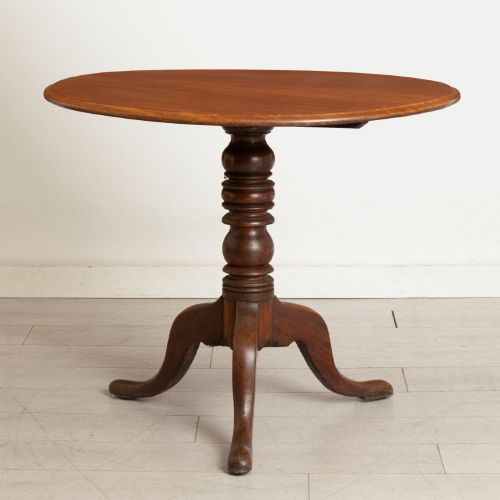
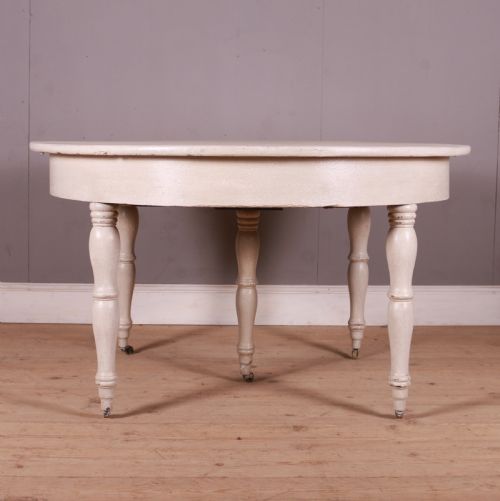
The version most commonly met on this page is the nineteenth-century tilt-top design in rosewood or mahogany, often featuring a stout central pillar. Buyers also encounter painted wooden tables from Austrian or French country traditions alongside rustic farmhouse pine.
Makers shaped these surfaces to suit morning meals and parlour gatherings alike, creating versatile furniture that anchors a room. The circular format encourages conversation, making each piece both practical and sociable.
How they were made
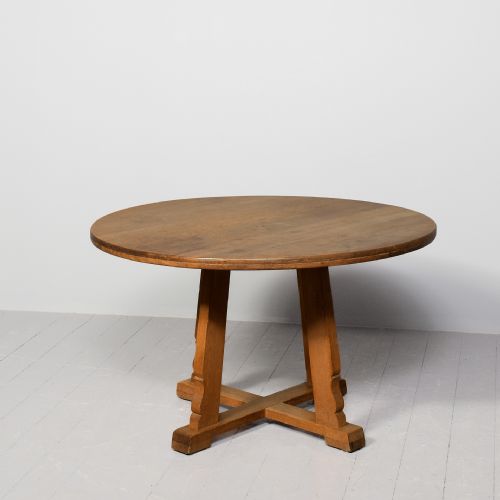
Cabinetmakers utilised dense timbers such as rosewood, figured mahogany, and satin birch, often selecting boards with striking grain patterns for the top. Carpenters also worked with oak and pine, applying paint finishes to Austrian and French country examples.
Many nineteenth-century examples incorporate a tilt-top mechanism, allowing the round surface to fold vertically when not in use to save space. Pillars take octagonal or triform shapes, anchoring the heavy tops securely to the floor.
Listings feature woods such as rosewood, satin birch, mahogany, oak, and pine across nineteenth-century and early twentieth-century periods.
What varies in quality
The distinction between ordinary and exceptional work lies in the choice of timber and the depth of its figure. Highly figured rosewood and satin birch elevate a piece, whereas standard pine or basic timber sits at the simpler end of the scale.
Proportion and structural harmony separate superior forms from standard utility items. A well-balanced octagonal pillar and a solid triform base demonstrate greater skill than basic four-legged frames.
The Vintage Circular Breakfast Table Glossary
- Tilt top
- A hinged tabletop mechanism that allows the surface to rotate and lock into a vertical position. This clever design lets the furniture stand flat against a wall when not in use.
- Triform base
- A three-sided pedestal support beneath the central pillar. Cabinetmakers favoured this configuration for stability on nineteenth-century tables.
- Figured mahogany
- Timber cut to reveal distinctive grain patterns such as flame or ripple. Craftsmen reserved these choice boards for the most prominent surfaces.
- Centre table
- A piece finished on all sides to stand in the middle of a room rather than against a wall. These versatile items functioned in halls, libraries, and parlours.
- William IV period
- A British design era spanning the 1830s characterised by robust classical proportions and dark timbers. Furniture from this time often displays bold pedestals and rich polish.
Vintage Circular Breakfast Table: Frequently Asked Questions
How do I style a circular table?
A circular table works well in the centre of a room or as a focal point in a kitchen. Its round shape softens angular room layouts and improves traffic flow.
Place a single ceramic bowl or a lamp in the middle to maintain the balanced proportions.
What woods were used for these tables?
Cabinetmakers built these tables from a variety of woods including rosewood, mahogany, satin birch, oak, and pine. Exotic timbers like rosewood and mahogany appeared on formal nineteenth-century pieces.
Country and farmhouse versions typically utilised local woods such as pine and oak.
How can I tell a Victorian table from earlier pieces?
Victorian tables often display heavier proportions and simpler lines compared to earlier nineteenth-century styles. William IV pieces from the 1830s frequently feature bolder triform bases and rich rosewood veneers.
Later Victorian examples lean towards practical pine construction and everyday utility.