
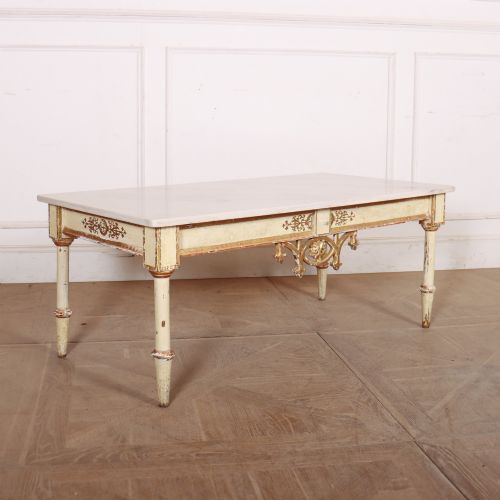
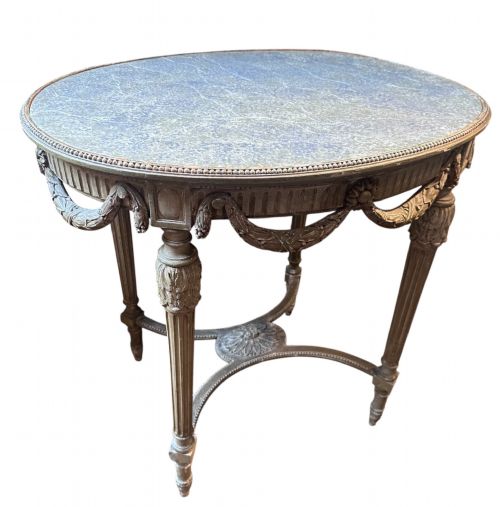


French Painted Centre Table
A French painted centre table brings architectural proportion and decorative flourish to a room, standing freely to anchor the space.
French Painted Centre Table
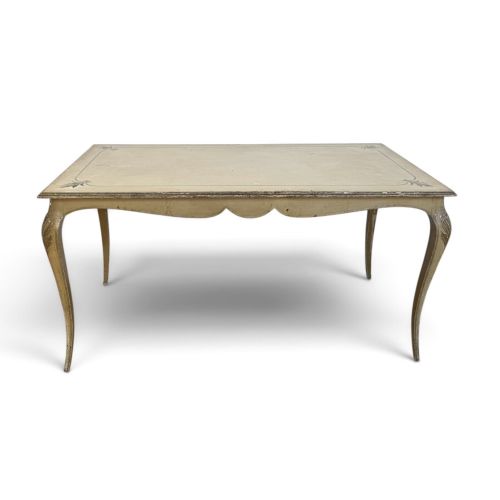
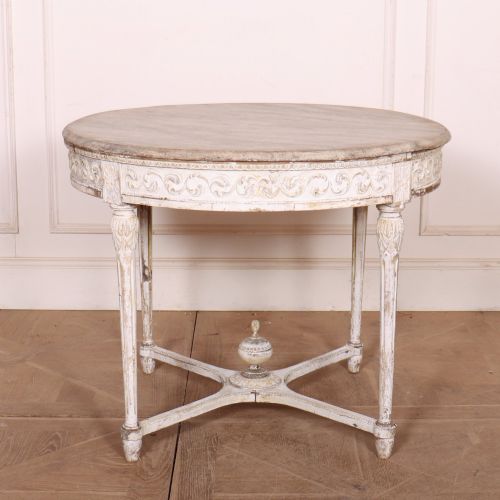
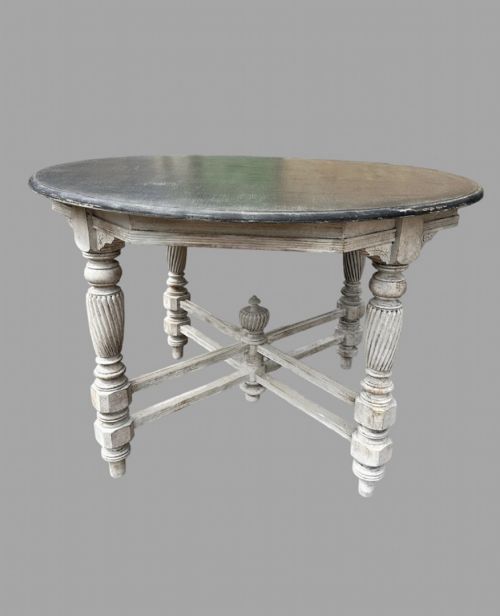
A french painted centre table sits independently in a room, designed to be viewed from all sides rather than pushed against a wall. The pieces appearing here span the nineteenth century into the early twentieth century, taking the form of round guerdons, occasional tables and dining formats.
The aesthetic draws heavily on revived classical idioms, notably Louis XV and Empire styles, executed with painted and parcel-gilt or parcel-silvered surfaces. Surviving examples frequently incorporate inset marble tops and carved wooden frames reflecting provincial workshops and grander urban commissions alike.
Materials and Construction
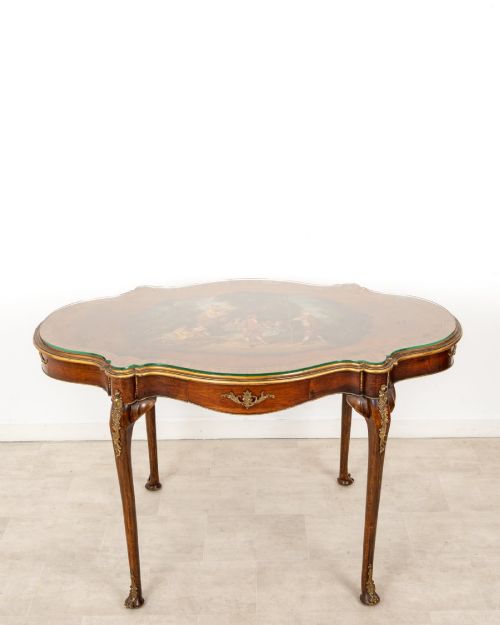
Makers shaped these tables from solid and veneered wood, applying layered paint finishes alongside gold leaf and ormolu mounts. Structural elements often involve carved wood supports, cabriole legs or column pedestals.
Heavy marble tops feature prominently, resting directly upon wooden frames or recessed aprons. Artisans utilised decorative techniques such as gilding, silvering and detailed brushwork to embellish the wooden carcasses.
Distinctions in Quality
Quality rests upon the crispness of the timber carving and the application of the painted and gilded surface. Superior execution shows refined detailing in the mounts, balanced proportions and the retention of original decorative layers.
The choice and thickness of the inset marble top, alongside the integrity of the underlying wooden frame, separates standard utility pieces from finer decorative works.
Eugene Clauss of Paris
The French Painted Centre Table Glossary
- Gueridon
- A small French table, often round and supported by a central pillar or three legs. These forms became popular for holding lamps or decorative objects.
- Ormolu
- Gilded bronze mounts applied to furniture. This technique adds metallic warmth and ornamental relief to the wooden structure.
- Vernis Martin
- A type of simulated Japanese lacquer developed in France during the eighteenth century. It employs multi-layered varnishes to create a glossy, decorative finish.
- Parcel-gilt
- A method where only specific carved details or raised ornaments receive a coating of gold leaf. This creates contrast against the painted wooden background.
French Painted Centre Table: Frequently Asked Questions
Where should I place a centre table?
These tables are designed to stand in the middle of a room, functioning as a focal point for lamps, flowers or decorative objects.
Because they are finished on all sides, they allow for unobstructed movement around them while defining the layout of the space.
How do I clean a painted wooden table?
Dust the surface gently with a soft, dry cloth to prevent accumulation without disturbing the painted or gilded finish.
Avoid chemical polishes and moisture, which can damage aged paint layers and delicate metal leaf.
Are marble tops original to these tables?
Many surviving tables retain their original heavy marble inserts, which were chosen for their durability and decorative contrast against the painted woodwork.
When assessing a piece, examine how the marble sits within the wooden rebate to check for period consistency.
What distinguishes an Empire style table?
Empire style pieces display classical architectural motifs, often featuring parcel-silvered or gilded accents, column supports and formal symmetry.
This aesthetic contrasts with the more fluid, curving lines of earlier Rococo and Louis XV revivals found in similar tables.