


Vintage Chart Recording Barometer
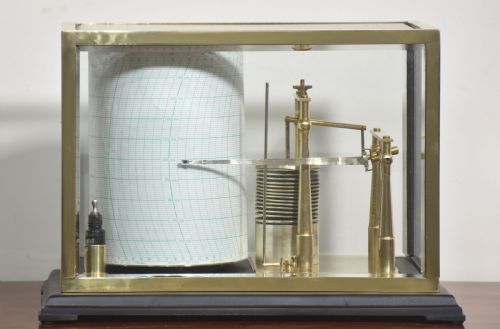
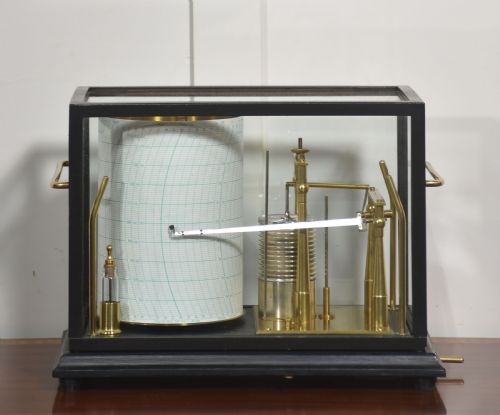
A vintage chart recording barometer, known as a barograph, plots atmospheric pressure on paper week by week.
Vintage Chart Recording Barometer
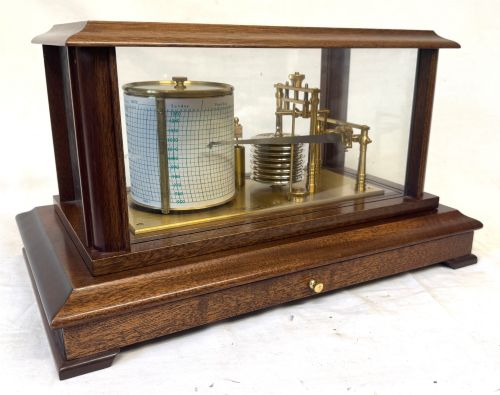
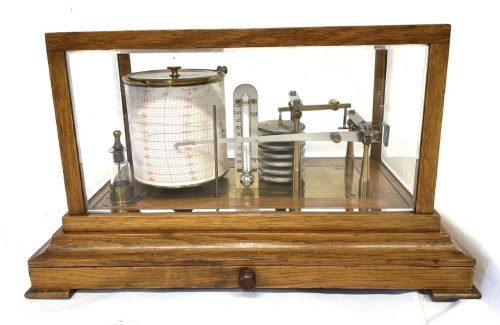
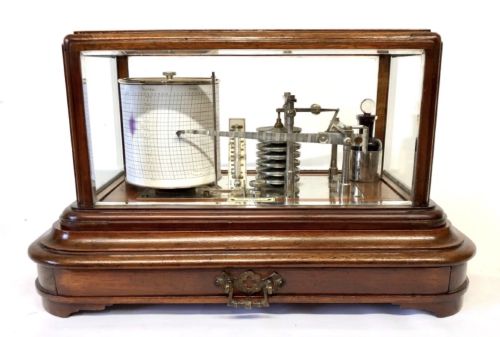
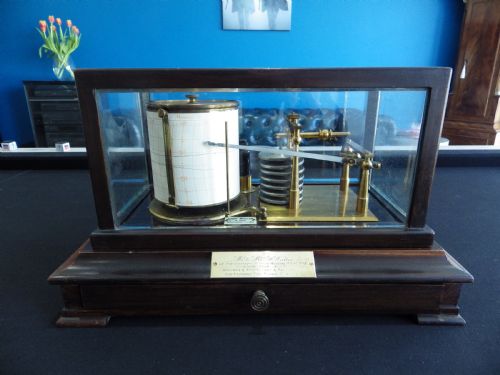
A vintage chart recording barometer, commonly known as a barograph, is a scientific instrument designed to continuously record atmospheric pressure onto a paper chart. These instruments typically reside inside a glazed wooden case fitted with a chart drawer for spare paper rolls and ink bottles. The core mechanism houses an aneroid drum linked to a recording arm that holds an ink nib.
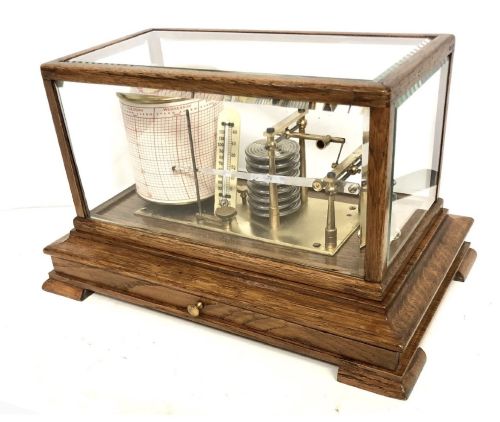
The pieces listed span from the Victorian period through the Edwardian era, the interwar period, and into the mid-twentieth century. Oak and mahogany serve as the primary woods for the protective cases, whilst brass and steel comprise the internal movements and levers. Bevelled glass panels often protect the delicate mechanism while allowing a clear view of the recording drum in motion.
Makers represented include prominent British and European scientific instrument manufacturers and retailers such as Short & Mason, Negretti & Zambra, and Casella London. Certain examples incorporate thermometers mounted on the wooden base alongside the main drum, whilst others combine the barograph with an independent aneroid barometer dial.
Materials and construction
Cases are constructed from solid oak or mahogany, joined with traditional cabinetmaking techniques and fitted with hinged lids or five-glass panels. Many incorporate a dedicated base drawer designed specifically to store unused paper charts and spare ink supplies.
Internal movements combine brass plates, steel springs, and delicate linkages connected to stacked aneroid metal vacuum chambers. The revolving drum contains a small clockwork mechanism that rotates the paper chart precisely once every week.
Some models squeeze an entire weather station into a miniature case, proving that serious meteorology sometimes comes in pint-sized wooden boxes.
Factors of quality
Quality rests upon the precision and reputation of the maker, with established scientific houses commanding greater regard for their refined movements and accurate timekeeping clockwork. The choice of cabinet timber and the clarity of heavy bevelled glass panels further distinguish finer examples from standard production pieces.
The integrity of the internal brass linkage and the presence of original components, such as matching thermometers and intact chart drawers, elevate the standing of an instrument. Finely fitted mahogany and oak cases with polished brass fittings demonstrate superior workshop execution.
Short And Mason·Negretti And Zambra·Casella London·Jules Richard·Russell Norwich
The Vintage Chart Recording Barometer Glossary
- Barograph
- A recording barometer that traces atmospheric pressure onto a rotating paper chart over a set period, usually seven days. This mechanical instrument removes the need for manual hourly readings.
- Aneroid drum
- A sealed metallic bellows or capsule that expands and contracts with changes in barometric pressure. These movements drive the lever arm and ink nib across the paper chart.
- Bevelled glass
- Heavy window panes featuring angled edges set into the wooden case to display the internal mechanism. This glazing provides a clear and decorative view from multiple angles.
- Chart drawer
- A small compartment built into the wooden base beneath the main mechanism to hold spare recording paper and ink. It keeps necessary maintenance accessories close to the instrument.
Vintage Chart Recording Barometer: Frequently Asked Questions
How does a barograph work?
Stacked metallic capsules expand and contract as air pressure rises and falls. This physical movement transfers through a series of brass levers to a pen arm that draws a line on a rotating paper chart.
A clockwork drum turns the paper cylinder once every week. This continuous mechanical tracing creates a permanent visual record of weather patterns over time.
What wood was used for cases?
Oak and mahogany form the vast majority of surviving instrument cases. These dense hardwoods provided the structural stability needed to protect the sensitive internal brass mechanisms.
Cabinetmakers finished these woods with polished surfaces and fitted them with bevelled glass panels. Some examples also featured inlaid decoration or attached Fahrenheit thermometers.
Where were these instruments made?
Many examples originated in London workshops operated by specialist scientific instrument makers. Other pieces emerged from regional British makers as well as continental European manufacturers.
Retailers such as high-end department stores also retailed these instruments under their own names. Makers stamped their company details onto the metal beds or paper charts.
How do I read the paper charts?
The vertical axis on the paper chart measures atmospheric pressure in inches of mercury or millibars. The horizontal grid lines divide the chart into days of the week for the seven rotation.
A rising line indicates improving weather, whilst a falling line warns of approaching storms or rain. Traces left by the ink nib show the exact pressure at any given hour.