




Vintage Cartography Globe
A vintage cartography globe brings centuries of geography and exploration into a room, offering tactile maps mounted on hand-turned stands.
Vintage Cartography Globe
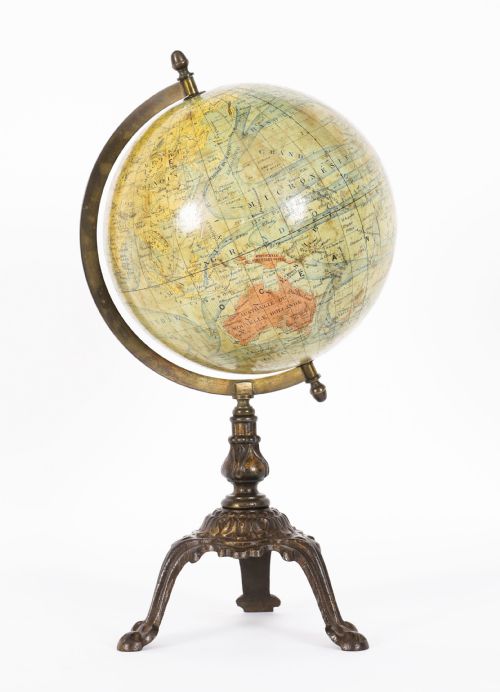
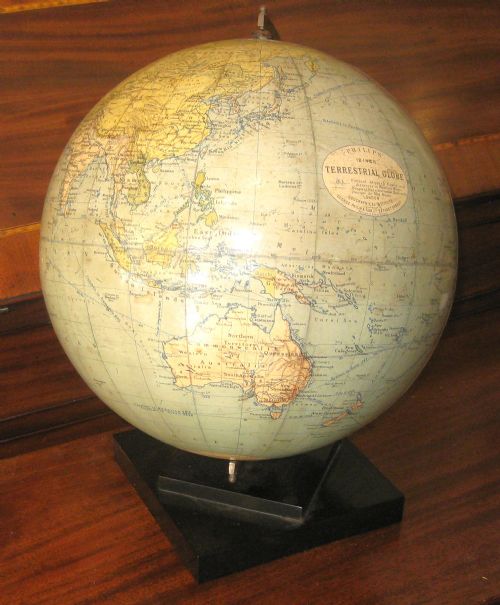
A vintage cartography globe represents terrestrial and celestial spheres produced across several centuries, capturing the changing political borders and geographical discoveries of their respective eras. When buyers search for a vintage cartography globe, they encounter diverse formats ranging from miniature table globes to large floor-standing library pairs.
The pieces listed here span the eighteenth, nineteenth, and early twentieth centuries, encompassing Victorian, Edwardian, and Regency periods. Table globes and desk globes appear frequently alongside floor globes and reference cartography books.
Origin points vary across the inventory, featuring British makers alongside French examples such as those by Lebegue and M.Vivien. Buyers are most likely to meet twelve-inch terrestrial table globes resting on wooden or cast iron stands.
What varies in quality
Quality in these globes rests upon the precision of the paper gores and the clarity of the engraved cartography. Finer examples retain sharp geographical details and original hand-colouring without excessive fading or discoloration.
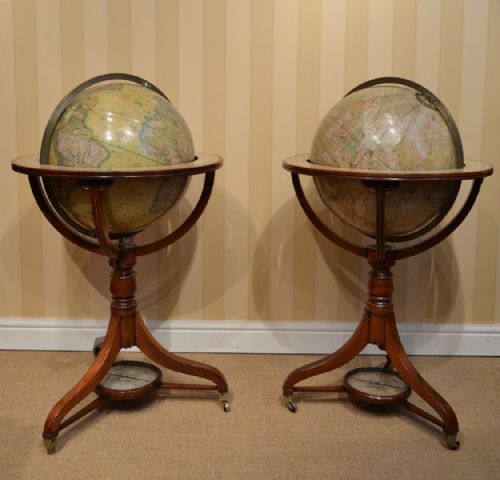
The standard of the supporting stand differentiates pieces, with well-turned mahogany frames and solid brass hardware marking superior manufacture. Pairs of terrestrial and celestial globes command particular attention for their completeness and matched stands.
Early cartographers sometimes left unexplored polar regions blank, trusting that future explorers would fill in the white space.
Lebegue and Cie·Phillips·Malby·Carey·M.Vivien·Bacons·Crunchley·Geographia
The Vintage Cartography Globe Glossary
- Terrestrial globe
- A spherical model of the Earth displaying continents, oceans, and political boundaries. These pieces form the majority of the cartography selections.
- Celestial globe
- A sphere mapping the stars and constellations relative to Earth. They frequently accompany terrestrial globes in matched pairs.
- Gores
- Printed paper strips shaped like lutes that are applied to the sphere to form a continuous map. Accurate alignment of these strips indicates skilled production.
- Meridian
- The brass ring surrounding the globe that holds the poles and allows rotation. It often bears engraved degree markings.
- Table globe
- A smaller spherical map designed to sit on a desk, table, or cabinet. Sizes in the inventory range from miniature formats up to twelve inches.
Vintage Cartography Globe: Frequently Asked Questions
How do I know the date of my globe?
Makers frequently printed updated geopolitical boundaries, railway lines, and sovereign territories directly onto the paper gores. Examining the named capitals and colonies provides a reliable indication of the production decade.
Cartouches on the sphere often record the firm name and publication year. Comparing these details against known operational dates of the workshop confirms the period.
What is the difference between table and floor globes?
Table globes are compact units built to rest upon furniture surfaces such as desks, sideboards, or libraries. They offer portability and smaller diameters suited to domestic rooms.
Floor globes feature tall stands with dedicated wooden or metal frames that rest directly on the floor. These pieces are typically larger and were designed as prominent library furnishings.
Why do some globes come in pairs?
Scientific and educational collections historically paired a terrestrial globe with a celestial globe of matching size. One mapped the Earth while the other charted the night sky.
Displaying them together balanced the room and provided comprehensive geographical and astronomical reference tools for the owner.
Where should I place a globe in my home?
These pieces suit studies, libraries, and living rooms where they sit comfortably on timber desks or dedicated stands. They pair well with antique books and traditional cartography materials.
Direct sunlight should be avoided to protect the paper gores and hand-colouring from fading over time. A stable environment away from extreme temperature shifts keeps the wood and plaster secure.