


Vintage Camelback Sofa
A vintage camelback sofa brings distinctive serpentine lines and traditional upholstery to a room, offering both formal elegance and comfortable seating.
Vintage Camelback Sofa
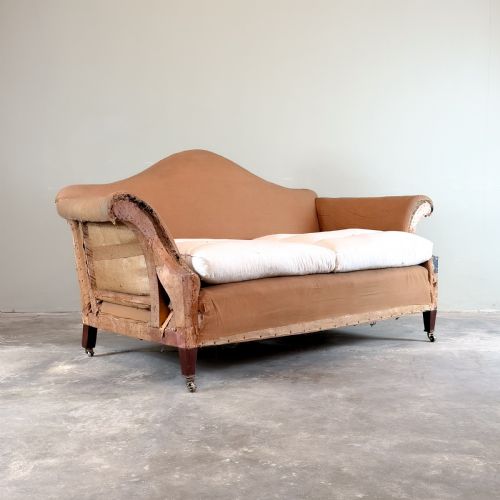
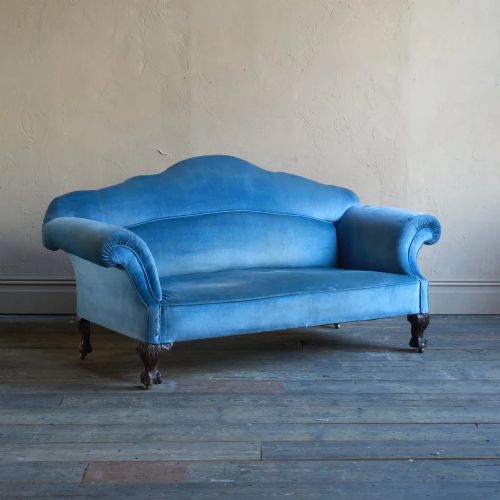
When you search for a vintage camelback sofa, you are looking at upholstered seating defined by the undulating arch of its top rail, which resembles a camel's hump. The examples seen on this page span the nineteenth century, the Edwardian period, and the early twentieth century, drawing heavily on earlier eighteenth-century designs.
Most pieces available lean towards revival aesthetics, including Chippendale, Chinese Chippendale, Queen Anne, and Georgian styles. These range from substantial nineteenth-century serpentine forms to Edwardian two-seater settees and matched pairs.
Makers and retailers of the period, such as Liberty, retailed these refined seats to homes favouring classical proportions and carved woodwork. Selecting one means choosing a piece shaped by historical revivals, whether you require a generous mahogany-framed sofa or a compact Edwardian settee.
Construction and materials
Traditional upholstery methods utilise internal support materials including jute webbing and cotton stuffing, enclosed by high-grade textile coverings. Velvet, velvet fabric, and damask supply the tactile surface textures associated with these formal seats.
Brass detailing occasionally accents the framework or castors, completing the construction of pieces built to endure decades of drawing room use.
Revival styles represented include Chippendale, Chinese Chippendale, Hepplewhite, and Queen Anne forms.
Distinguishing quality
The distinction between ordinary and exceptional examples rests upon the grace of the frame's proportions and the crispness of any carved woodwork. A well-executed serpentine curve along the back rail flows naturally into the arms, whereas lesser pieces display rigid or heavy lines.
The integrity of the internal construction, from the tension of the webbing to the precision of the joinery, separates standard production from superior craftsmanship. Finer iterations exhibit refined timber selection in the exposed legs and precise alignment in the revival styles they emulate.
The Vintage Camelback Sofa Glossary
- Camelback
- An upholstered sofa style featuring a distinctive arched backrest that rises in a gentle curve or multiple humps. This silhouette gained popularity during the eighteenth century and inspired numerous nineteenth and twentieth-century revivals.
- Serpentine
- A line or edge that curves outward in the centre and inward at the sides, resembling the shape of a snake. This profile frequently appears along the front rail or top back of formal seating.
- Cabriole leg
- A furniture leg that curves outward at the knee and inward at the ankle, ending in a pad, claw, or ball and claw foot. The design originates from ancient Chinese furniture and became a staple of eighteenth-century and revival seating.
- Damask
- A reversible figured fabric woven on a jacquard loom, featuring patterns formed by contrasting warp-face and weft-face satins. It provides a durable and formal surface suitable for period upholstery.
- Chippendale revival
- A late nineteenth and early twentieth-century design movement that reinterpreted the mid-eighteenth-century furniture styles of Thomas Chippendale. Pieces in this category often feature elaborate carved woodwork and classic proportions.
Vintage Camelback Sofa: Frequently Asked Questions
What is a camelback sofa?
A camelback sofa is a traditional upholstered seat defined by its distinctive arched backrest, which mimics the humps of a camel in a smooth, continuous curve. These pieces typically feature exposed wooden legs and formal upholstery.
Originating in the eighteenth century, the form saw revivals throughout the nineteenth and early twentieth centuries, resulting in the varied mahogany and walnut frames found today.
How do I date a vintage sofa?
Dating a vintage sofa involves examining the timber species, the style of the carved legs, and the construction methods visible beneath the upholstery. Nineteenth-century examples often display heavier mahogany frames, while Edwardian pieces can be lighter two-seater settees.
Revival styles also offer clues, as cabinetmakers of the Victorian and Edwardian eras consciously imitated Georgian, Queen Anne, and Chippendale aesthetics.
Where should I place a camelback sofa?
A camelback sofa suits formal living rooms, studies, or large hallways where its decorative back profile can be appreciated from multiple angles. Because the undulating top rail creates a strong visual line, placing the sofa away from walls allows the silhouette to stand out.
In traditional interiors, pairing the piece with antique armchairs creates a cohesive conversational grouping.
What fabrics are correct for these sofas?
Velvet, damask, and heavy cotton are traditional coverings that complement the formal character of nineteenth and early twentieth-century camelback sofas. These textiles offer the necessary weight and durability to sit well against exposed hardwood frames.
Many surviving pieces retain later reupholstery, allowing buyers to select historical or contemporary fabrics depending on their interior scheme.