
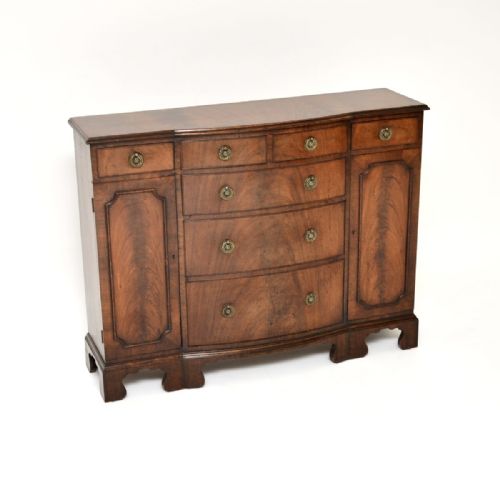
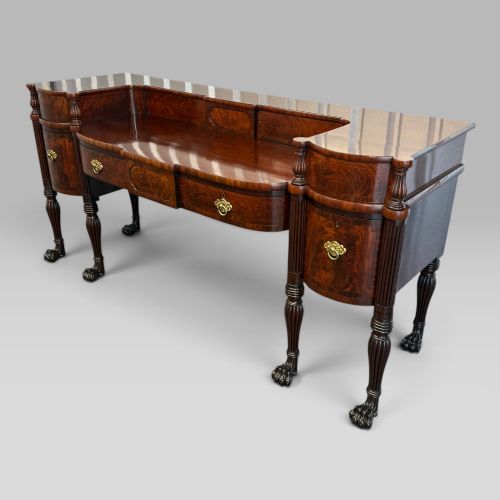
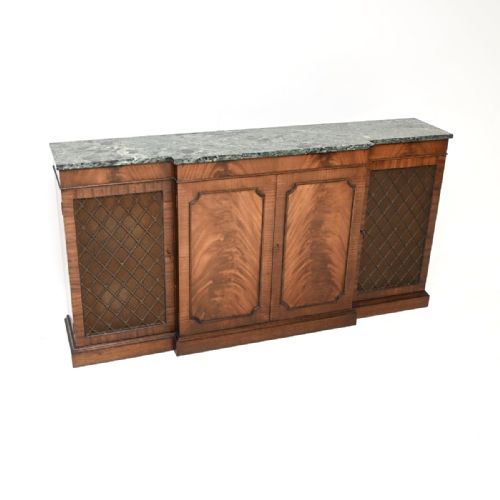
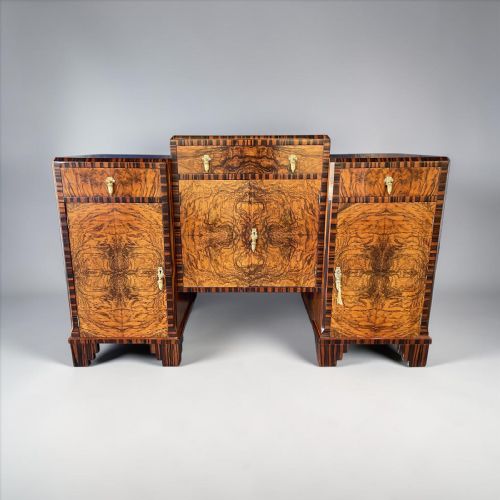



Vintage Breakfront Credenza
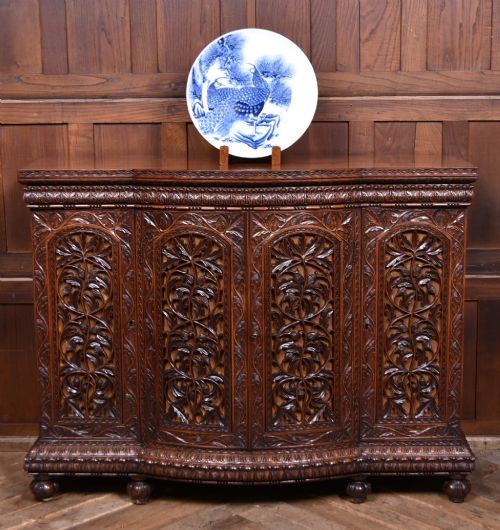
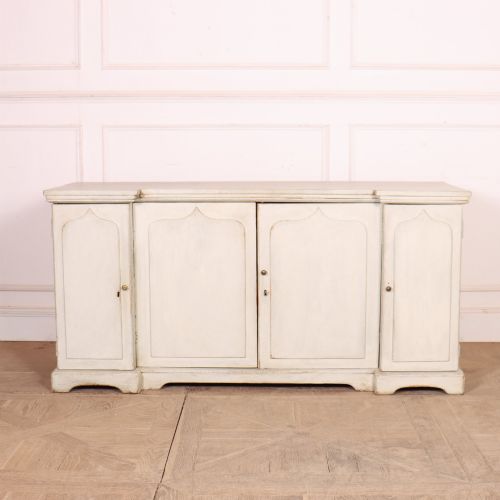
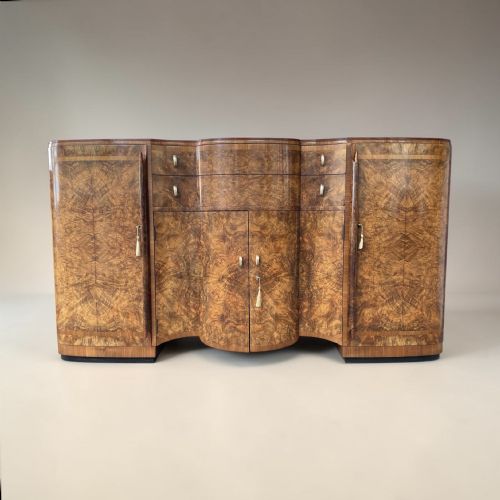
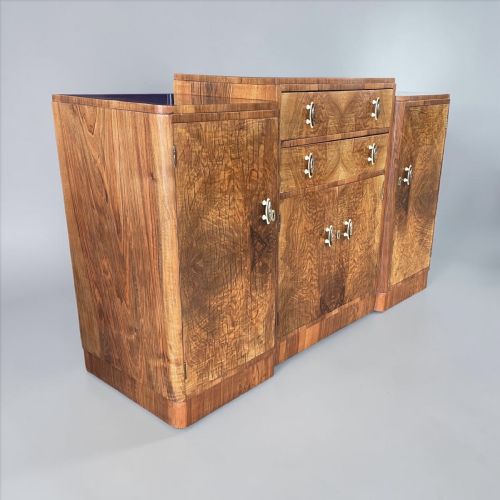
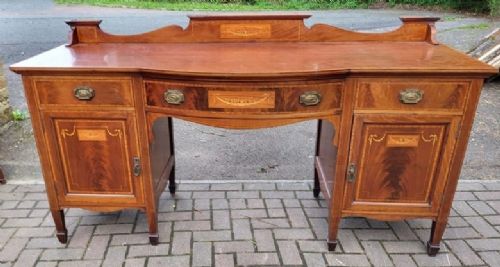
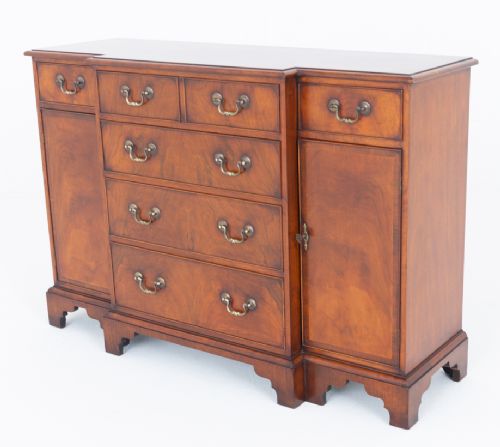
A vintage breakfront credenza offers an imposing architectural silhouette, combining ample concealed storage with a stepped forward central section that commands a room.
Vintage Breakfront Credenza
A vintage breakfront credenza sits within a lineage of large storage furniture, appearing on this page primarily through related forms such as sideboards, bookcases, side cabinets, and dresser bases. The selection spans the nineteenth century, the Edwardian era, and the art deco period, drawing on stylistic revivals like the Regency, Queen Anne, and Louis styles.
Buyers encounter examples fashioned from mahogany, burr walnut, rosewood, and padouk, frequently embellished with marquetry, inlay, or grill fronts. These items originate from English, French, and Anglo-Indian workshops, ranging from modest side cabinets to large library bookcases and pedestal sideboards.
How they were made
Cabinet makers constructed these pieces using dense hardwoods like mahogany, walnut, and rosewood, often applying figured veneers such as burr walnut or flame mahogany to the primary surfaces. Secondary structural elements relied on sturdy timber framing to support the weight of extensive shelving and large door assemblies.
Decorative detailing involved intricate marquetry inlay, brass fittings, gilt accents, and occasional marble tops. Glazed doors utilised individual wooden glazing bars to secure glass panes within the breakfront structure.
The listings on this page span the 19th century through the art deco period, constructed in mahogany, walnut, rosewood, and padouk.
What varies in quality
The distinction between standard execution and superior craftsmanship rests in the selection of timbers and the precision of the joinery. Highly figured veneers like burr walnut or flame mahogany, matched symmetrically across doors and drawer fronts, signal workshop ambition.
Refinement of carved ornamentation, quality of brass or ormolu mounts, and the integrity of structural elements such as lion paw feet or inset grille work separate baseline production from exceptional pieces.
Maurice Adams·Maple & Co.·Goodall of Manchester
The Vintage Breakfront Credenza Glossary
- Breakfront
- A piece of furniture featuring a central section that projects forward from the flanking outer sections. This architectural arrangement creates depth and visual rhythm across the facade.
- Credenza
- A low cabinet or sideboard, frequently fitted with doors and sometimes topped with a mirror or display shelving. Originating in Italy, the form evolved in nineteenth-century Britain to house dining china or display objects.
- Flame mahogany
- Mahogany timber cut to reveal a distinctive flamelike grain pattern. Cabinet makers reserved this highly decorative veneer for principal drawer fronts and cabinet doors.
- Marquetry
- The art of applying small pieces of veneer to a structure to form decorative patterns or pictures. Craftsmen utilised contrasting timbers such as walnut, fruitwoods, and exotic hardwoods.
- Ormolu
- Gilt bronze ornamentation mounted onto furniture surfaces. This decorative technique added metallic lustre to nineteenth-century luxury pieces.
Vintage Breakfront Credenza: Frequently Asked Questions
What is a breakfront design?
A breakfront design refers to a piece of furniture where the central portion projects further forward than the left and right sections. This layout breaks up a flat wall and creates a layered silhouette.
In practice, this configuration allows for deeper central storage while keeping the flanking cabinets shallower. It remains a hallmark of formal nineteenth-century and revival cabinetry.
How do I date these cabinets?
Dating relies on observing timber choices, construction techniques, and stylistic revivals present in the piece. Mid-nineteenth-century examples often display rich burr walnut or rosewood veneers with heavy carving.
Later Edwardian and art deco pieces shift toward lighter inlay work or streamlined geometric forms. Comparing the secondary woods inside drawers also helps confirm the period of manufacture.
Where should I place a credenza?
These substantial pieces anchor a dining room, hallway, or large living space where wall capacity permits their depth. Their flat top surfaces and internal shelving suit the display of ceramics or the storage of dining linens.
Because many examples feature finished side cabinets or bookcases, positioning them against a primary focal wall ensures proper architectural balance in the room.