


Vintage Brass Pricket Stands
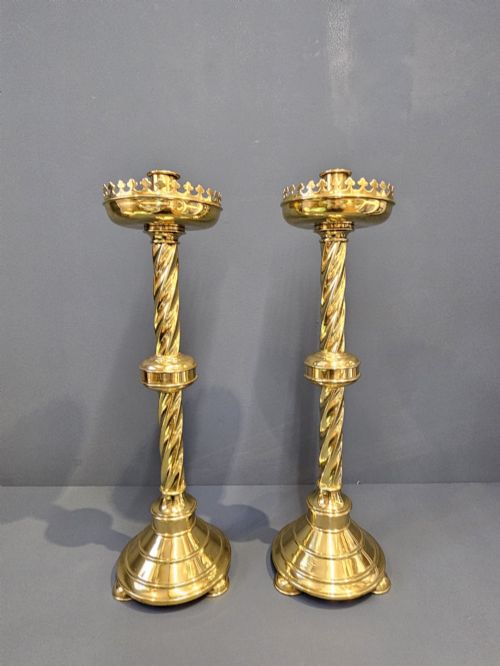
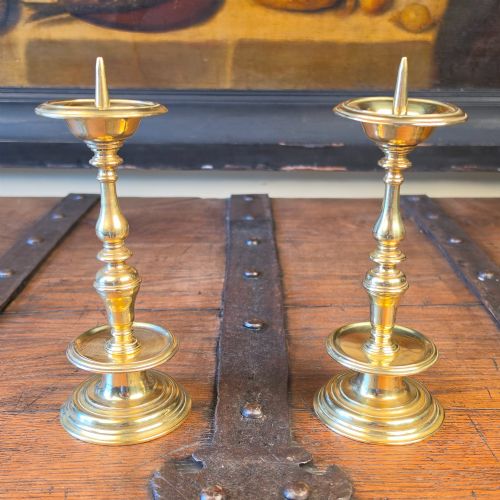
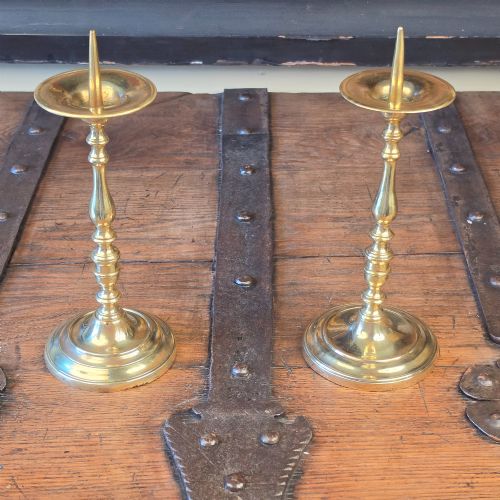
These vintage brass pricket stands bring altar presence to a room, holding candles on a central spike rather than inside a socket.
Vintage Brass Pricket Stands
Vintage brass pricket stands are heavy ecclesiastical or decorative candle holders designed to impale the base of a wax candle upon a sharp metal spike. When buyers search for vintage brass pricket stands, they encounter robust church candle holders and floor-standing pieces originating primarily from the Victorian era and the early twentieth century.
The selection ranges from tall nineteenth-century church candlesticks to ornate pairs in historical revivals and striking Amsterdam School designs. Materials extend beyond brass to include bronze, wrought iron, patinated metal, and hardwood combinations.
Most examples emerge as matched pairs, though individual floor-standing stands and sets of four also appear. The forms channel Gothic Revival grandeur and seventeenth-century baroque influences alongside geometric early twentieth-century aesthetics.
How they were made
These stands combine cast and turned brass components with structural elements of iron and bronze. Heavy metal parts are cast in sections, then joined to form the central shafts and wide drip pans.
Makers applied patinated finishes and combined brass with wrought iron or hardwood to achieve stability in tall floor-standing and altar configurations.
Listings feature brass, bronze, wrought iron, and hardwood spanning the Victorian period through the nineteen-forties.
What varies in quality
Quality rests in the heft of the metal casting and the integrity of the original pricket spike mounted at the top. Substantial weight and clean turning distinguish superior church and floor stands from lighter decorative items.
Design ambition separates standard production from distinctive regional movements like the Amsterdam School or detailed Gothic Revival work. The presence of original patination rather than polished surfaces preserves the character of the metal.
The Vintage Brass Pricket Stands Glossary
- Pricket
- A sharp metal spike atop a candlestick designed to hold a candle in place. This form predates the socket candlestick and remains common in ecclesiastical metalwork.
- Gothic Revival
- A nineteenth-century aesthetic movement drawing inspiration from medieval architecture and design. It manifests in pointed motifs, heavy proportions, and ecclesiastical forms.
- Patinated metal
- Metal surfaces showing natural oxidation and age through time. This finish adds depth and dark tones to the original brass or bronze.
- Floor candlestick
- An oversized candle holder designed to stand directly on the floor rather than on a table or altar. These tall pieces often feature heavy bases for stability.
Vintage Brass Pricket Stands: Frequently Asked Questions
How do I use a pricket stand?
Place a thick candle directly onto the vertical metal spike at the top of the stand. The spike holds the wax pillar steady while it burns down toward the drip pan.
Ensure the candle base is wide enough to sit balanced on the upper plate. Use drip-catching measures if the candle produces significant wax run.
Are these stands suitable for modern rooms?
Their architectural proportions and dark patinated metals work well as sculptural floor pieces or focal points on large tables. They anchor contemporary spaces by introducing historical weight and vertical lines.
Keep them away from busy walkways because their heavy metal construction and height require stable placement.
How do I date a brass pricket stand?
Examine the casting quality, joinery methods, and stylistic cues such as Gothic Revival ornament or Amsterdam School geometry. Victorian church pieces often display heavy turned shafts and distinct patination.
Compare the base construction and metal composition against known nineteenth and early twentieth-century manufacturing techniques.
What is the difference between brass and bronze stands?
Brass is an alloy of copper and zinc, yielding a brighter golden tone when unpolished, whereas bronze contains copper and tin for a darker, heavier finish. Many listings feature patinated metal surfaces that obscure the raw alloy.
Both materials provide the structural rigidity needed to support tall ecclesiastical candle holders.
Can I polish the brass?
Polishing removes the dark patinated finish built up over decades of age. Most collectors prefer leaving the surface undisturbed to retain the historical character.
If you choose to clean the metal, use a mild non-abrasive cloth to avoid altering the underlying cast texture.