


Vintage Brass Cannon
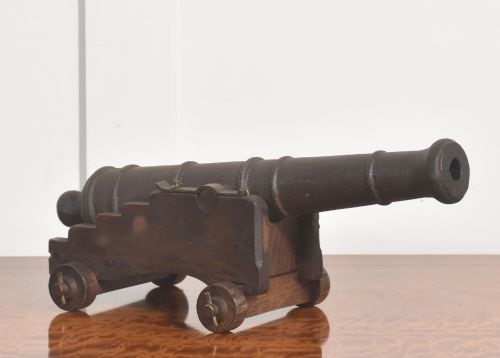
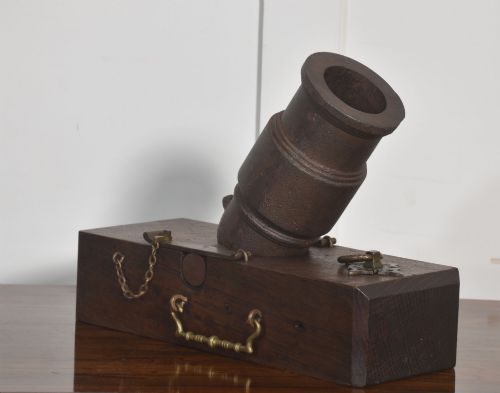
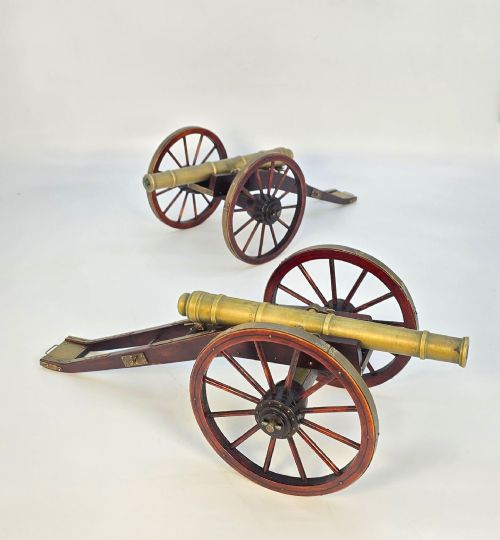
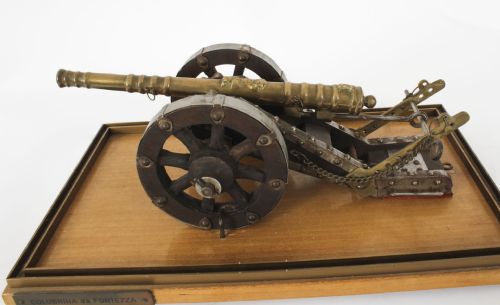
These vintage brass cannon pieces are miniature models and signal pieces built to display maritime history and military engineering in the study.
Vintage Brass Cannon
When you search for vintage brass cannon, you enter a field of scale models, signal pieces, and desk ornaments that recreate historical artillery in miniature. The examples seen here range from small desk cannons to heavier signal pieces mounted on timber carriages, often styled after 18th century field guns or Victorian maritime ordnance.
You are most likely to meet 19th century brass, bronze, and cast iron models mounted on oak or mahogany undercarriages. These span from decorative desk pieces and heavy signal mortars to hand-built models reflecting earlier French, English, and Georgian military designs.
How they were made
The barrels of these pieces are cast in brass, bronze, iron, or copper, utilising metal-working techniques that capture the stepped profiles and reinforcing rings of full-sized artillery. Foundries shaped the metal to replicate ordnance from the 17th century onwards, sometimes incorporating polished steel or iron components for contrast.
Carriages and undercarriages are constructed from hardwoods such as oak, mahogany, and general hardwood, shaped to support the heavy metal barrels. Many of these mountings feature detailed stepped wheels and metal brackets that mirror actual military transport frames of the period.
Some desk cannons doubled as paperweights, ensuring military might kept the quarterly tax returns firmly anchored.
What varies in quality
Quality in these models rests upon the fidelity of the casting and the precision of the metal finishing. Better pieces show crisp definition along the barrel mouldings, trunnions, and bore openings, whereas simpler items exhibit softer edges from worn moulds.
The integration between barrel and carriage dictates the overall character of the piece. Superior examples feature well-seasoned hardwoods fitted accurately to the metalwork, showing careful joinery rather than hasty assembly.
The Vintage Brass Cannon Glossary
- Signal cannon
- A small cannon used historically for firing blank charges to signal times, ships, or estates. They are frequently mounted on timber bases and found as desk ornaments.
- Trunnion
- The cylindrical projections on either side of a cannon barrel that allow it to elevate and depress on its carriage. In models, these anchor the barrel securely to the wooden cheeks.
- Gribeauval
- A standardised system of French artillery developed in the mid-18th century, notable for its lighter, more mobile field guns. Replicas of this style often appear in model form.
- Colubrina
- An early type of long-barreled cannon derived from the culverin, designed for extended range. Model versions capture this slender, tapered profile.
Vintage Brass Cannon: Frequently Asked Questions
What is a signal cannon?
A signal cannon is a small-scale piece designed to be loaded with gunpowder only, creating a loud report for signaling rather than firing a projectile. They were commonly used on estates, yachts, and coastal stations.
In domestic settings, they served as ornamental conversation pieces that combined military aesthetics with a functional capability, often mounted on heavy wooden carriages to absorb the recoil.
How old are these desk cannons?
The pieces available range from 18th century examples to models produced through the Victorian era and into the early 20th century. Many interpret earlier military epochs rather than dating strictly from them.
Maker methods and material patination help distinguish older hand-built models from later commemorative pieces, with Georgian and Victorian examples showing distinct casting textures.
Were these models used by armies?
Most surviving small-scale models were manufactured for display, testing, or private use rather than active military service. Some served as foundry scale models or desk ornaments for military officers.
Heavier signal variants and desk pieces were popular among maritime officers and collectors who appreciated accurate miniature representations of historical ordnance.
What woods were used for carriages?
Carriages are typically constructed from dense, durable hardwoods such as oak, mahogany, and general seasoned timber. These woods provided the necessary weight and stability to support heavy metal barrels.
The choice of timber often reflects the period of manufacture, with Victorian and Edwardian makers utilising polished hardwoods to enhance the display value of the brass and bronze barrels.