



Vintage Bowfront Server Table
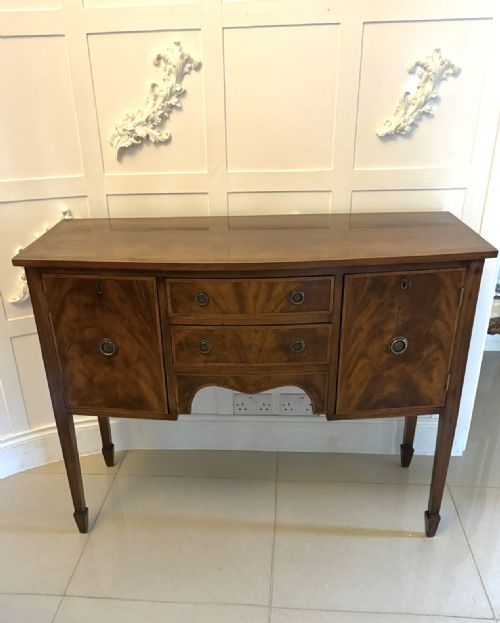
A vintage bowfront server table brings curved elegance and capacious storage to a dining room, uniting Georgian proportion with practical surface space.
Vintage Bowfront Server Table
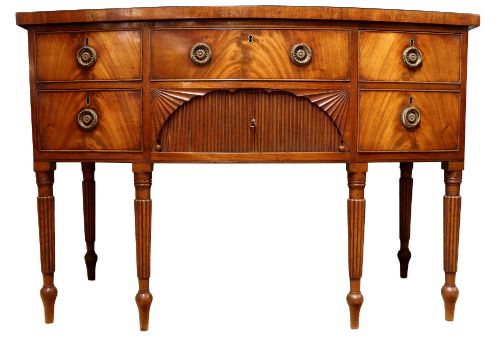
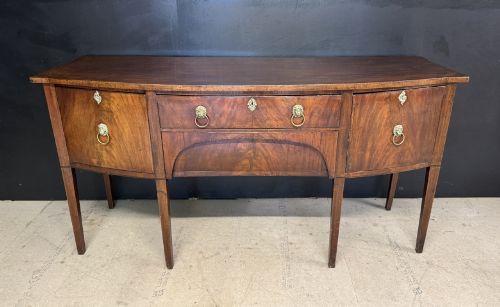
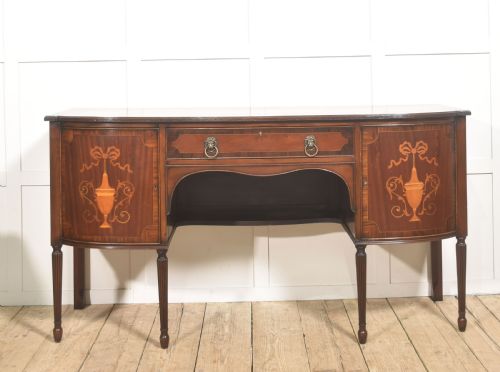
When you search for a vintage bowfront server table, you encounter case furniture designed for dining rooms, most frequently taking the form of sideboards and serving tables with a convex curved front.
The pieces on this page span the 18th century, Georgian, Regency, and Edwardian periods, with Georgian and 19th-century mahogany examples forming the majority of the selection.
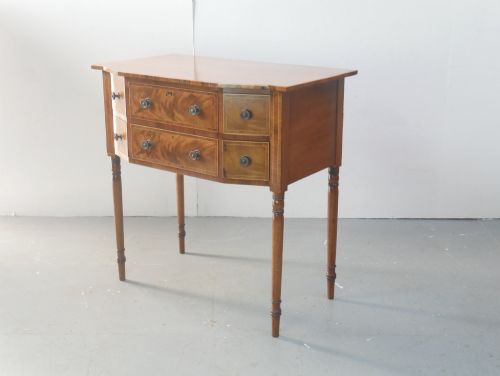
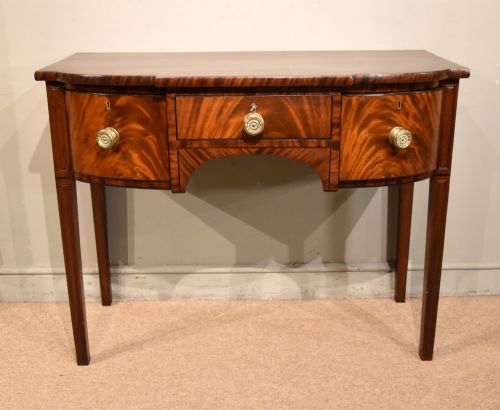
Forms range from small proportions and six-legged variations to grand sideboards and console side tables, offering substantial surface utility alongside deep storage capacity.
What separates the finest examples
Quality rests upon the selection of timber veneers, where intensely figured flame mahogany displays superior visual depth compared to plain stock.
The crispness and symmetry of boxwood and satinwood inlay demonstrate the maker's precision, particularly along complex curved drawer fronts.
Proportion and scale dictate desirability, with smaller proportions and stable six-legged structural designs commanding greater appreciation than standard bulky carcasses.
Some smaller Georgian examples feature six legs instead of four, presumably to reassure owners that the curved front will not tip forward under a heavy tea service.
The Vintage Bowfront Server Table Glossary
- Bowfront
- A convex curved cabinet front that projects outward in a smooth arc. This shape softens the rigid angles of a room.
- Flame mahogany
- A veneer cut from the fork of a mahogany tree where the branch meets the trunk. It creates a distinctive rippled flame pattern.
- Inlay
- A technique where contrasting woods like boxwood or satinwood are inserted into recesses in the primary surface. This forms decorative borders and geometric motifs.
- Server
- A dining room table or sideboard used for holding dishes and serving food. These pieces combine flat top surfaces with drawers or cupboards below.
Vintage Bowfront Server Table: Frequently Asked Questions
Where should I place a bowfront server?
These tables suit dining rooms or grand hallways where their curved profile breaks the linearity of surrounding walls. Their shallow depth allows them to sit comfortably in narrow circulation spaces.
Ensure adequate clearance around the piece so that drawers can open fully without obstruction from nearby furniture.
How do I care for mahogany surfaces?
Dust regularly with a soft, dry cloth and apply a quality beeswax periodically to nourish the timber. Avoid placing these tables in direct sunlight or near heat sources to prevent timber splitting.
Use coasters and felt pads beneath objects placed on the top surface to protect the polished finish from moisture rings and scratches.
Are these tables suitable for small rooms?
Selected listings specifically note small proportions, making them adaptable to compact dining spaces or hallways. The curved front profile reduces sharp corners, easing movement in tight areas.
Measure your available wall space carefully and compare it against the listed dimensions before placing your selection.
What is the difference between a sideboard and a serving table?
Sideboards typically feature integrated cupboards and multiple drawers enclosed within a substantial timber carcass. Serving tables often present a more open framework with fewer enclosed compartments beneath the main surface.
Both forms utilise the curved bowfront silhouette to maximise internal storage while maintaining an elegant exterior profile.