




Antique Black Sofa Table
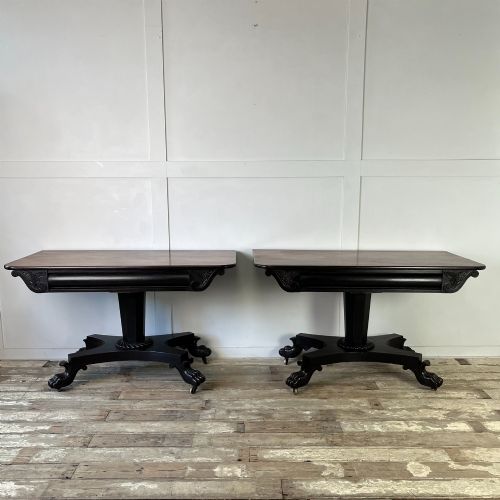
An antique black sofa table brings dark polish and a low, long silhouette to a room, offering a steady surface designed to stand behind a couch.
Antique Black Sofa Table
An antique black sofa table takes the form of console tables, lamp tables, and centre tables originating from the nineteenth century, nineteen twenty, and eighteen hundred. These pieces span styles from Regency and French Empire to Aesthetic Movement, Chinoiserie, and Georgian revival.
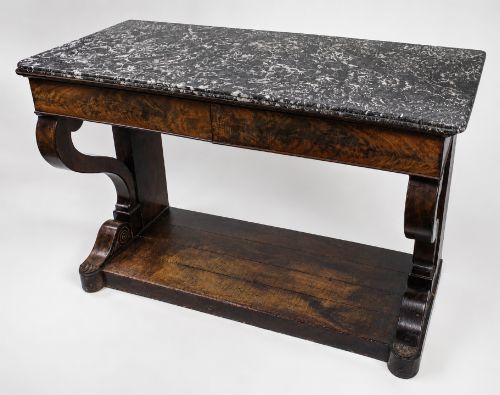
The versions most commonly met on this page utilise ebonised wood, painted wood, and lacquered wood to achieve a dark surface. They often feature functional additions like drop leaves, flaps, or marble tops set upon mahogany, walnut, oak, and beech structures.
Makers and craftsmen of these periods built them as versatile furniture for halls, bedrooms, and drawing rooms. The designs range from simple occasional tables to elaborate gilt-accented console pairs.
How they were made
Carpenters constructed the carcases using traditional hardwoods such as mahogany, walnut, oak, beech, and satinwood, often shaping them with bowfronts or serpentine edges. They applied black finishes through ebonising or painting, sometimes incorporating marquetry inlay and gilt details.
Surfaces frequently integrated contrasting materials, setting marble slabs into the timber tops or adding textile fringe and velvet to occasional tables. Brass mounts, handles, and tripod supports provided structural and decorative stability.
Listings feature pieces spanning the nineteenth century, eighteen hundred, eighteen seventy, eighteen eighty, eighteen ninety, and nineteen twenty, constructed from mahogany, walnut, oak, beech, and satinwood.
What varies in quality
Quality rests upon the selection of the underlying timber and the execution of the ebonised or painted finish. Finer examples display precise marquetry inlay, well-matched flame mahogany grains, and intact gilt highlights rather than simple uniform black paint.
The Antique Black Sofa Table Glossary
- Ebonised Wood
- Timber treated with stain or varnish to resemble heavy, dark ebony. This finish became particularly popular during the nineteenth century.
- Drop Leaf
- A hinged table leaf that folds down when not in use. It allows the surface area to expand or contract according to space requirements.
- Marquetry
- Decorative patterns formed by inserting pieces of wood veneer into a solid wooden base. Makers utilised contrasting tones to create intricate designs.
- Console Table
- A table designed to stand against a wall, frequently supported by ornate legs or brackets. They often featured matching mirror sets in period rooms.
- Aesthetic Movement
- A nineteenth-century design style that emphasised visual beauty over narrative meaning. It drew heavily on Japanese motifs and dark ebonised finishes.
Antique Black Sofa Table: Frequently Asked Questions
What is a black sofa table?
A black sofa table is a low, elongated piece designed to sit behind a sofa or against a wall. The listings include console and lamp tables finished in dark ebonised or painted wood.
These surfaces held lighting, books, and decorative objects in nineteenth-century drawing rooms. Their narrow proportions made them practical for tight spaces behind seating.
How do I date a black table?
Dating relies on stylistic clues like Regency curves, Victorian heft, or Aesthetic Movement ebonising. Materials such as flame mahogany and marble inserts also point to specific decades.
Construction methods inside the drawers and joints help confirm the period. Examining the wear on the black finish reveals age and handling over time.
Where should I place it?
These tables fit naturally behind a sofa, along a hallway wall, or beside a bed. Their compact depths allow them to function as lamp or occasional surfaces without blocking pathways.
In reception rooms, they anchor mirrors or artwork hung above them. Smaller drop-leaf versions adapt easily to changing room layouts.
What woods are underneath?
Cabinetmakers built the frames from sturdy timbers like mahogany, walnut, oak, and beech. These foundational woods provided the weight needed for steady freestanding use.
Surfaces were then ebonised, painted, or veneered with finer grains such as satinwood. The underlying timber quality dictates the structural longevity of the piece.