
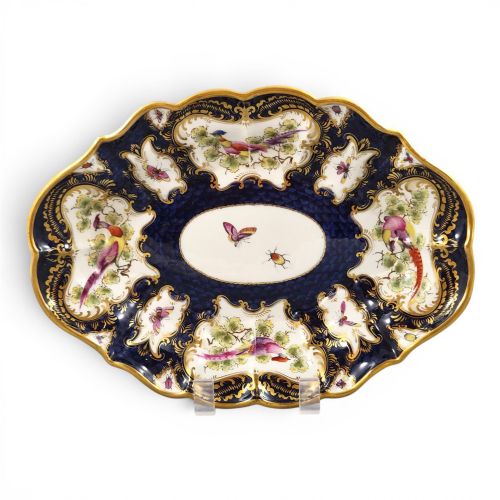


Vintage Blue White Tray
These vintage blue white tray examples bring cobalt decoration and crisp earthenware together for practical service and display.
Vintage Blue White Tray
A vintage blue white tray encompasses a broad selection of serving platters, meat plates, and smaller desk articles spanning the nineteenth and early twentieth centuries. Buyers searching this phrase most frequently encounter substantial transfer-printed meat platters and smaller earthenware dishes decorated in cobalt blue.
The selection extends from Georgian transfer-printed pottery bearing pictorial scenes to Victorian ironstone meat platters and Dutch Delft faience inkstands. Domestic table service and desk organisation account for the majority of forms seen within this group.
Origins range across English potteries, French faience workshops, and Dutch kilns, incorporating styles from Rococo Revival to Art Deco. Each piece relies on the contrast between white ceramic bodies and dark blue pigment.
How they were made
Potters shaped earthenware, ironstone, and porcelain bodies before applying cobalt decoration beneath or over a clear glaze. Transfer printing allowed intricate landscapes such as the Bridge of Lucano or elephant patterns to transfer accurately onto large meat platters.
Faience and tin-glazed earthenware pieces received hand-painted cobalt designs directly onto an opaque white tin enamel before a final kiln firing. Brass mounts occasionally accompanied ceramic inkstands to support desk accessories.
Firing temperatures determined the vitrification of ironstone and porcelain, resulting in durable surfaces capable of withstanding daily dining use.
Functional forms range from large dining meat platters and cheese dishes to desktop inkstands and cigarette strikers.
What varies in quality
Quality rests primarily in the crispness of the transfer print or the precision of the hand-painted brushwork. Deep cobalt saturation and clear definition in pictorial scenes elevate a piece above simpler commercial wares.
The weight and resonance of ironstone or porcelain bodies dictate structural integrity, particularly on large serving platters meant to hold substantial joints of meat. Finer pieces maintain smooth glazes free from excessive kiln pitting.
Royal Worcester·Minton·Spode·John Rogers and Son
The Vintage Blue White Tray Glossary
- Transfer printing
- A method of decorating ceramics by engraving a design upon a copper plate, pulling it on tissue paper, and pressing it onto the biscuited clay body before glazing. This technique enabled complex pictorial scenes to be produced in volume.
- Ironstone
- A dense, durable type of earthenware patented in the nineteenth century to rival true porcelain. It provides a sturdy white body well suited for heavy meat platters.
- Vide-poche
- A small shallow dish designed for emptying pockets of small items. These catch-all trays appear frequently in nineteenth-century French ceramics.
- Imari
- A style of Japanese export ceramics featuring underglaze blue combined with iron red and gilt highlights. Pieces show traditional East Asian motifs adapted for international markets.
Vintage Blue White Tray: Frequently Asked Questions
Can I use these platters for serving food?
Most nineteenth-century earthenware and ironstone platters remain robust enough for serving dry foods. Inspect the glaze for stability before presenting items directly on the surface.
Historic crazing can absorb liquids over time, so hand washing is essential after any culinary use. Displaying them on walls or dressers keeps delicate surfaces safe.
How do I tell transfer printing from hand painting?
Examine the blue lines closely through a magnifying glass to check for tiny stippled dots or continuous ink lines. Transfer-printed patterns display uniform dot matrices, whereas hand-painted brushwork shows variable pigment pooling.
Transfer-printed designs also align precisely with engraved outlines. Hand-painted examples reveal subtle brush strokes unique to the decorator.
What is the difference between earthenware and ironstone?
Earthenware uses porous clay fired at lower temperatures, making it lighter but more susceptible to moisture absorption. Ironstone incorporates feldspar and slag, creating a heavy, vitreous body.
Ironstone platters ring when tapped lightly and resist chipping far better than standard earthenware. Both materials accept cobalt blue decoration effectively.