
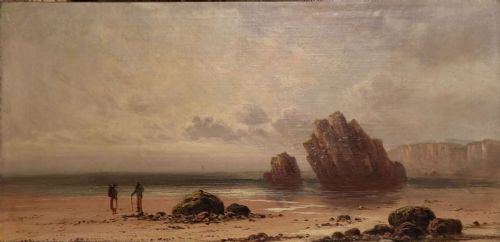



Vintage Beach Scene Painting
A vintage beach scene painting brings the restorative atmosphere of the coast into a room through varied brushwork and coastal light.
Vintage Beach Scene Painting
A vintage beach scene painting captures coastal life, shorelines and maritime views created across the nineteenth and twentieth centuries. These works range from traditional Victorian watercolours of harbours to bolder twentieth-century impressions of figures on the sand.
Buyers encounter subjects spanning British fishing ports, French bays and Welsh coastal expanses. The most common examples on this page unite land, sea and sky within oil or watercolour mediums.
Materials and methods
Artists painted primarily with oil on canvas or board, and watercolour on paper, often housed within wood and sometimes gold leaf or ebonised frames. Glass frequently protects the delicate surface of paper watercolours.
Pigments were applied with varied brushwork, from the tight precision of nineteenth-century realism to the looser, expressive strokes characteristic of impressionist and modernist schools.
The listings span the nineteenth and twentieth centuries, featuring oil on canvas, watercolour and wood.
Judging quality
Quality rests upon the artist's handling of light, atmosphere and spatial depth rather than the mere subject matter. Superior works demonstrate confident mark-making that evokes the movement of water and the openness of coastal air.
The relationship between the painting and its original frame also influences merit, particularly when hand-enamelled polychrome or period wooden mouldings remain intact.
William Banks Fortescue·George Hamilton Constantine·Sir William Russell Flint·Sir David Murray·Owen Bowen·GM de L'Aubiniere·Daniel Sherrin·Yves Brayer·Charles McAuley·Thomas Bush Hardy·Henri Cadiou·Alfred Egerton Cooper·Harry John Pearson
The Vintage Beach Scene Painting Glossary
- Oil on canvas
- Pigment suspended in drying oil applied to a woven fabric support stretched over a wooden frame. This medium allowed artists to build rich surface texture.
- Watercolour
- Paint consisting of colour pigment suspended in a water-soluble binder, traditionally applied to paper. It yields translucent washes of colour.
- Impressionism
- A style of painting that focuses on the visual impression of the moment, especially regarding shifting light and colour. Practitioners avoided meticulous detail in favour of rapid brushstrokes.
- Seascape
- A work of art depicting the sea, coastal views or marine subjects. These compositions frequently balance shorelines, boats and expansive skies.
- Ebonised frame
- Wood treated with a finish to imitate ebony wood. This dark border creates a sharp visual boundary for watercolours and oil paintings.
Vintage Beach Scene Painting: Frequently Asked Questions
How do I hang a watercolour painting safely?
Keep watercolours away from direct sunlight to prevent the pigments and paper from fading over time. Glazing with protective glass helps shield the delicate surface from moisture and atmospheric dust.
Use sturdy picture wire attached securely to the wooden frame rather than relying on the moulding alone. Ensure the wall surface is dry before hanging.
What is the difference between oil and watercolour beach scenes?
Oil paintings utilise pigments bound in oil on canvas or board, offering heavy texture and deep, saturated colours. Watercolours employ water-soluble pigments on paper, producing lighter, translucent effects.
Oils generally require a sturdy stretcher frame, whereas watercolours need framing behind glass to protect the paper.
How do I identify the period of a coastal painting?
Examine the clothing of any figures depicted, the style of the brushwork, and the framing materials. Victorian works often show meticulous realism, while mid-twentieth-century pieces adopt looser impressionist or modernist techniques.
Signatures, dates written on the reverse, and exhibition labels provide reliable chronological clues.
Where should I display a marine landscape?
Place marine landscapes in rooms with stable temperature and humidity levels to protect canvas and paper supports. Living rooms and studies benefit from natural indirect light that highlights the artist's brushwork.
Allow enough surrounding wall space for the frame and subject matter to breathe without competing with other furnishings.