
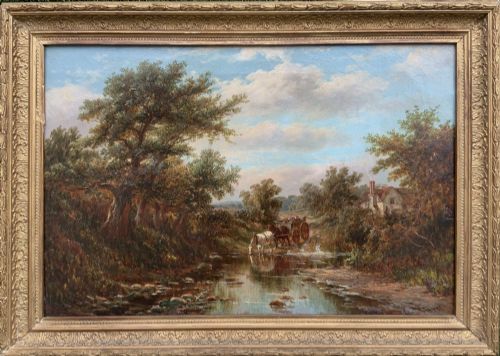


Horse and Cart Artwork
Horse and cart artwork captures rural labour and transport through paintings and drawings spanning the nineteenth and early twentieth centuries.
Horse and Cart Artwork
Collectors seeking horse and cart artwork encounter original watercolours, oil paintings on canvas, and chalk drawings depicting rural scenes, harvests, and coastal work. These pieces emerge predominantly from the nineteenth century through to the nineteen thirties, encompassing Victorian and Edwardian pastoral subjects.
The depictions range from detailed studies of haycarts and logging wagons to coastal scenes featuring seaweed and kelp collection. Works appear framed in wood and giltwood, reflecting the domestic display standards of their respective periods.
Materials and artistic techniques
Artists working in this genre relied on watercolour pigments on paper and oil paint on canvas, applying techniques that capture natural light and atmospheric conditions. Support materials include traditional wood and giltwood frames that house the paintings, etchings, and chalk drawings.
Makers utilised canvas and heavy paper surfaces to build composition through brushwork and pigment washes, documenting rural trades and landscapes with direct observation.
Listings feature paper, canvas, and wood materials utilised across Victorian and Edwardian artistic traditions.
Distinctions in execution and condition
Quality rests upon the artist's ability to render anatomical accuracy in the horses and structural detail in the carts, alongside harmonious management of light and landscape. Works by established named painters demonstrate superior brush control and compositional balance compared to anonymous or simpler decorative studies.
The preservation of the pigment and the integrity of the original paper or canvas support also determine distinction, with fresh, unblemished watercolours and stable oil surfaces holding greater visual clarity.
Cecil Charles Windsor Aldin·James William Booth·Léon Joseph Voirin·John Augustus Atkinson·Edward Brice Stanley Montefiore·George Hamilton Constantine·Charles H Poingdestre·Herbert Royle·Frederick William Jackson·Walter Duncan·George Smith·Frank Saltfleet·Henry H Parker·William Kay Blacklock·Alfred George Stevens·Fred Lawson·John Baragwanath King·Reginald Mills·Robert Thorne Waite·James Edwin Meadows
The Horse and Cart Artwork Glossary
- Watercolour
- A painting method where fine pigment is suspended in a water-based solution, applied to paper. This technique yields transparent washes of colour that capture light effectively.
- Oil on Canvas
- Pigment bound in an oil medium and applied to a stretched woven fabric support. This combination permits rich colour blending and textured brushwork.
- Giltwood
- Wood carved and coated with gold leaf or a gold-coloured metallic finish for framing. It provides an ornate border for traditional paintings.
- Etching
- A printmaking process where lines are incised into a metal plate with acid before ink is applied and transferred to paper. This creates sharp, linear detail.
- Gouache
- An opaque water-based paint featuring pigment mixed with a binding agent and white filler. It produces flat, solid areas of colour with a matte finish.
Horse and Cart Artwork: Frequently Asked Questions
What periods do these paintings represent?
The works span from the nineteenth century through the Edwardian era up to nineteen thirty. They capture changing artistic styles across several decades of rural documentation.
Most pieces reflect Victorian and Edwardian pastoral traditions, showing agricultural and transport scenes from those specific times.
How should I hang these framed works?
Display the paintings away from direct sunlight to protect watercolours and oil pigments from fading. Stable indoor humidity prevents damage to the paper and wooden frames.
Ensure sturdy wall fixings are used, particularly for heavier oil paintings on canvas housed in giltwood frames.
Are these works original paintings or prints?
The selection consists primarily of original watercolours, oil paintings on canvas, and chalk or gouache drawings. Each piece is a unique hand-drawn or hand-painted creation.
A small number of original prints also appear alongside the unique paintings.
What subjects feature in these scenes?
The artwork focuses on rural and coastal labour involving horses and various carts. Common themes include hay carts, logging transport, and coastal seaweed gathering.
These depictions offer a visual record of traditional trades, farming practices, and rural landscapes of past centuries.