



Traditional English Coastal Landscape
Traditional English coastal landscape watercolours and oil paintings capture historic seaside harbours, chalk cliffs and fishing communities along our shores.
Traditional English Coastal Landscape
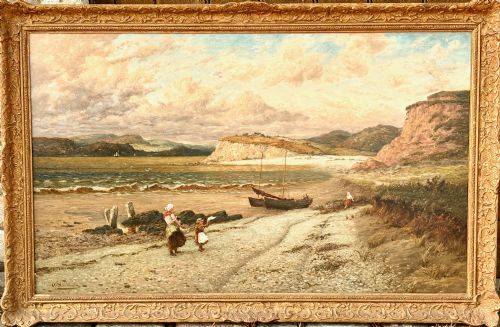
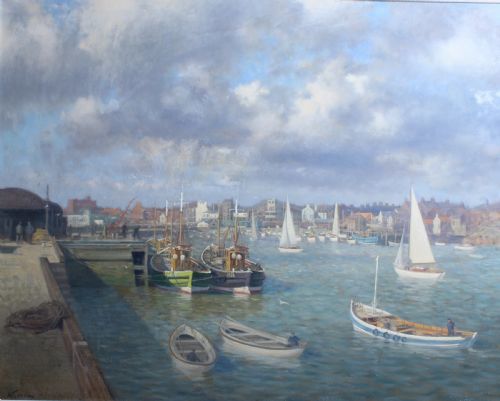
When you search for traditional english coastal landscape, you encounter framed paintings depicting marine scenes, harbours and chalk cliffs from the nineteenth and twentieth centuries. These works record historic fishing ports such as St Ives, Whitby and Bridlington through the eyes of regional artists.
The most common examples on this page are watercolours on paper and oil paintings on canvas or board dating from the Victorian era through to the mid-twentieth century. They range from intimate village street scenes to expansive views across estuaries and bays.
How they were made
Artists painted these coastal views using oil paint on canvas and board or watercolour pigment on paper, framed behind glass where works on paper required protection. The physical support often dictates the texture and scale, with oils allowing thick impasto for choppy seas and watercolours offering delicate washes for skies.
Wooden frames complete these pieces, enclosing the painted surface and preserving the paper or canvas from atmospheric damage. The choice of medium reflects the prevailing artistic practices of the nineteenth and twentieth centuries.
Listings span from the nineteenth century through the 1950s, featuring watercolours on paper and oil paintings on canvas and wood.
What varies in quality
The strength of a traditional english coastal landscape lies in the artist's handling of light, atmosphere and local topography, distinguishing hurried sketches from finished exhibition pieces. Skilled brushwork captures the movement of water and the specific quality of light along the coast.
Provenance and condition also separate works within this range, particularly the preservation of the original pigment and the integrity of the frame. Stronger compositions demonstrate careful observation of maritime life and geological formations.
William Banks Fortescue·Walter Goodin·William Edward Webb·Arthur Tucker·Herbert Royle·George Hamilton Constantine·Frederick Williamson·Albert Robert Quinton·Rowland Henry Hill·Walter Henry Sweet·William Sidney Cooper·William Shayer·Walter Meegan·George Marks
The Traditional English Coastal Landscape Glossary
- Watercolour
- A paint consisting of colour suspended in a water-soluble binder, traditionally applied to paper to achieve translucent washes of light.
- Oil paint
- A slow-drying paint made by mixing pigments with oils, offering rich colour depth and a textured finish on canvas or wood.
- Impasto
- A technique where paint is laid on an area of the surface in very thick layers, standing out from the canvas to create texture.
- Provenance
- The chronology of the ownership, custody or location of a historical artwork, establishing its authenticity and history.
Traditional English Coastal Landscape: Frequently Asked Questions
How do I date a coastal landscape painting?
Dating relies on the style of clothing worn by figures in the scene, the framing materials and any signature or documentation left by the artist.
Comparison with documented works from known periods helps narrow down the decade of creation.
Where were these coastal scenes painted?
Locations span popular English coastal destinations, including Yorkshire harbours, Devon villages and Kentish chalk cliffs.
Artists frequently set up their easels in bustling fishing ports and quiet bays along the coastline.
Should watercolours be kept out of direct sunlight?
Watercolour pigments on paper remain sensitive to ultraviolet light and fade permanently when exposed to bright sunshine over long periods.
Displaying them away from direct windows preserves the intensity of the original hues.
What is the difference between oil and watercolour?
Oil paintings utilise slow-drying pigment mixed with oil on canvas or wood, creating robust surfaces suited to dramatic marine weather.
Watercolours employ water-soluble pigments on paper, producing lighter, more transparent compositions.