




Victorian Walnut Stationery Box
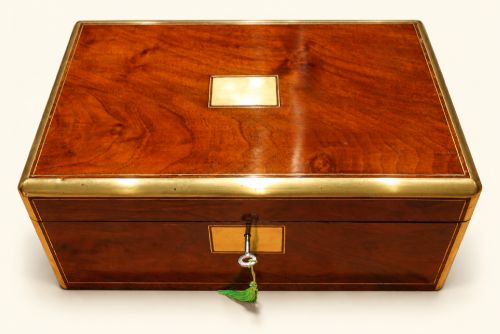
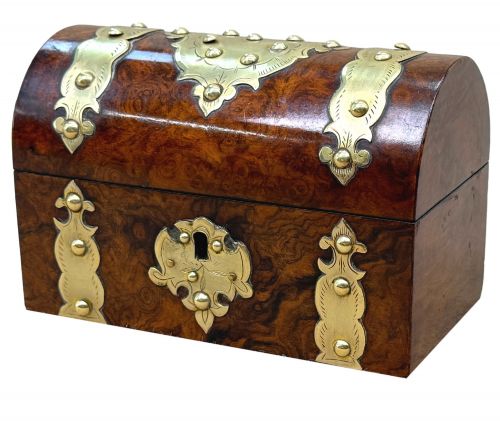
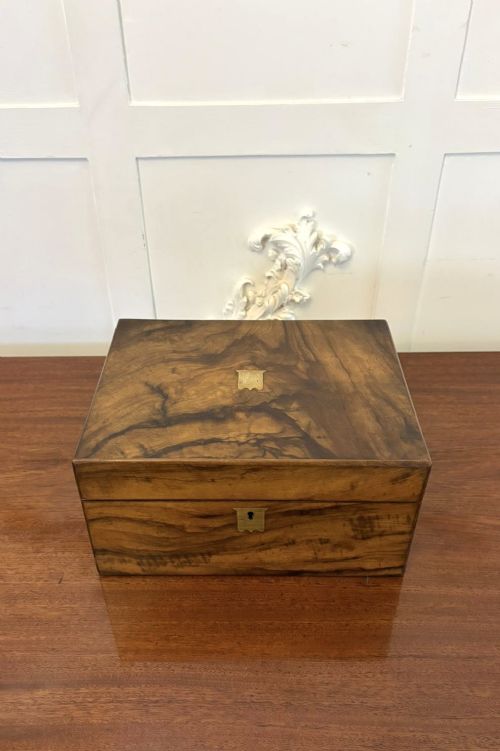
A victorian walnut stationery box organises correspondence with the rich grain and polished brass typical of nineteenth-century writing desks.
Victorian Walnut Stationery Box
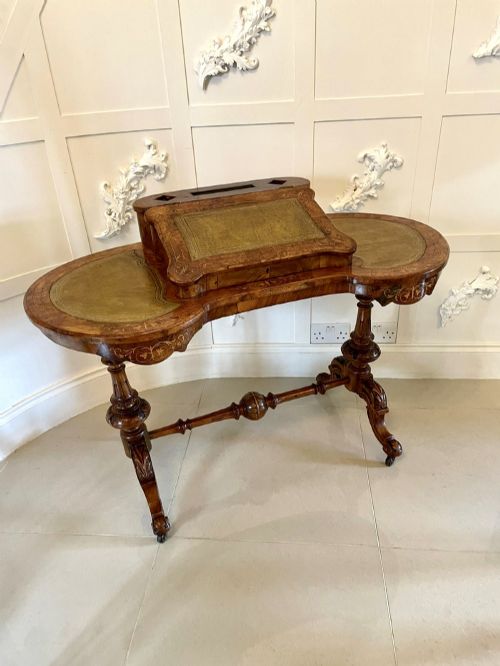
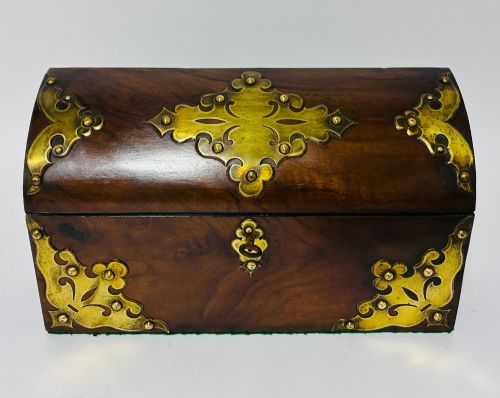
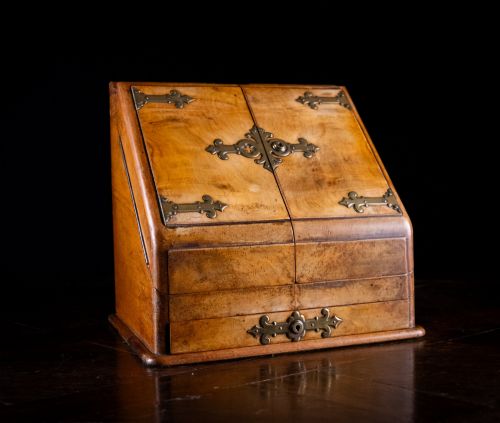
A victorian walnut stationery box serves as a desk accessory designed to house envelopes, letters, and paper neatly within compartments. The most frequent versions on this page are upright cabinets, domed caskets, and slant-front correspondence boxes created during the nineteenth century.
Makers produced these containers from solid or veneered walnut, frequently combining them with writing slopes and lap desks into unified desk sets. Pieces span several decades from the mid-Victorian era through to the late nineteenth century, reflecting evolving desk habits.
Materials and Construction
Craftsmen utilised plain, figured, or burr walnut veneers over secondary timbers to achieve striking decorative grain patterns across the exterior surfaces. Brass straps, recessed handles, and corner mounts provided structural reinforcement and contrast to the dark timber.
Specialised workshops incorporated mother-of-pearl, porcelain plaques, glass inserts, and intricate Tunbridge ware mosaic inlays to elevate the decorative scheme. Interiors often featured fitted partitions, secret drawers, and velvet-lined ledges constructed by skilled cabinetmakers.
Victorian Walnut Stationery Box Retail Price Guide 2026
Typical asking prices for victorian walnut stationery box among the pieces listed under this phrase on Sellingantiques today, from the lower quarter to the upper quarter. They describe what is for sale here now, not the wider market.
Hidden spring-loaded secret drawers often require locating a concealed internal peg just to open them.
The Spectrum of Quality
Superior examples display dense, richly figured burr walnut veneers selected and matched symmetrically across the lid and front panels. Lesser pieces rely on plain timber veneers with simpler, less dynamic grain patterns.
Hardware selection dictates distinction, with top-tier boxes housing robust Bramah locks and heavy, flush-fitting brass mounts rather than standard commercial latches. Interior complexity, such as multiple concealed drawers and hand-painted porcelain inserts, also separates standard items from exceptional ones.
Edmund Nye·Trussell Brighton·Mappin & Webb
The Victorian Walnut Stationery Box Glossary
- Burr walnut
- A highly prized timber veneer harvested from the gnarled growths of walnut trees, yielding intricate swirling grain patterns. It forms the primary decorative exterior on many Victorian desk accessories.
- Stationery box
- A desk-top container featuring tiered partitions or slots specifically scaled for holding envelopes and folded letter paper upright. They often include hinged lids or drop fronts.
- Writing slope
- A portable slant-front box that opens to reveal a velvet or leather-lined writing surface alongside inkwell recesses and pen trays. Many examples combine this function with stationery storage.
- Tunbridge ware
- A meticulous form of woodworking originating in Kent involving mosaic patterns built from thousands of tiny coloured wood blocks. Artisans applied these geometric scenes to box lids and panels.
- Bramah lock
- A high-security patented cylindrical lock invented by Joseph Bramah in the late eighteenth century, frequently fitted to better-quality Victorian boxes. It requires a tubular slotted key to operate.
Victorian Walnut Stationery Box: Frequently Asked Questions
What is a stationery box?
A stationery box is a desk accessory created in the nineteenth century to organise writing paper, envelopes, and letters. These containers usually feature internal vertical divisions to keep correspondence sorted.
Cabinetmakers housed these partitions inside hinged domed boxes, upright cabinets, or drop-front chests built from walnut timbers.
Were they used at desks?
These boxes sat upon writing tables and library desks in affluent Victorian homes to maintain order among personal correspondence. Their portable nature allowed owners to move them between rooms or pack them for travel.
Many incorporated integrated writing slopes or lap desks, combining letter storage with a stable writing surface.
What is burr walnut?
Burr walnut is a decorative wood veneer harvested from the deformed growth anomalies found on walnut trees. This timber produces dense, swirling patterns that cabinetmakers prized for surface ornamentation.
Victorian craftsmen frequently applied this figured veneer to the main exterior panels of high-status correspondence boxes and writing slopes.