
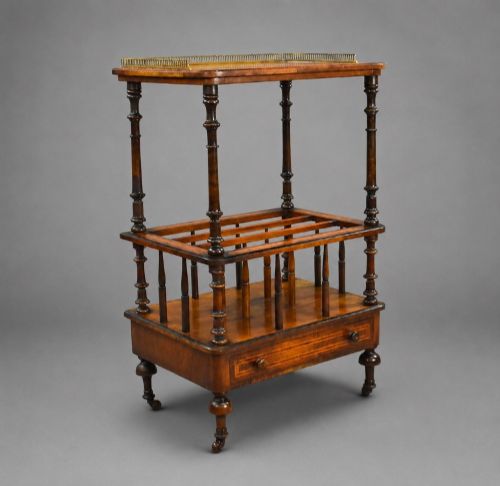
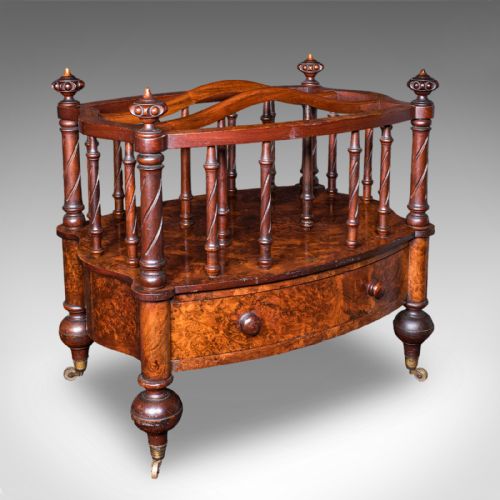


Victorian Walnut Music Table
A victorian walnut music table brings refined utility to a room, offering clever compartments for scores or adjustable seating for musicians.
Victorian Walnut Music Table
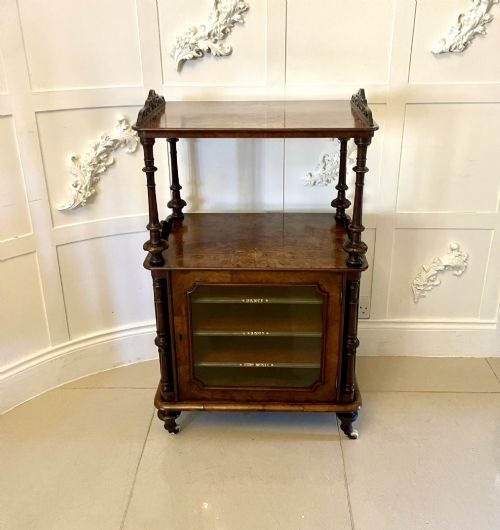
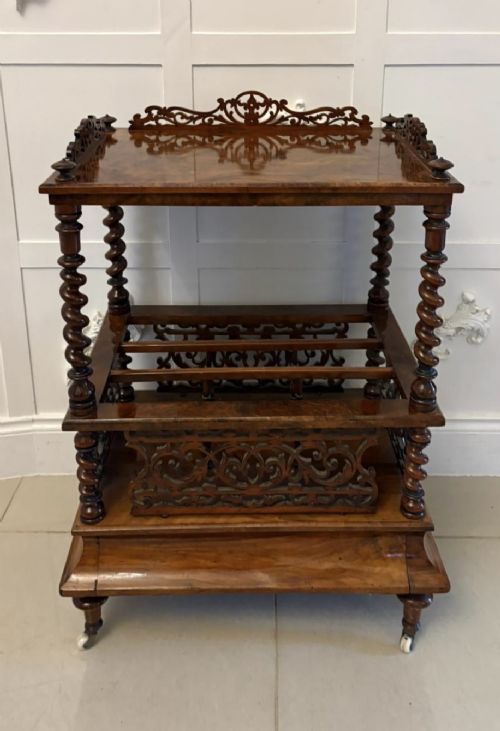
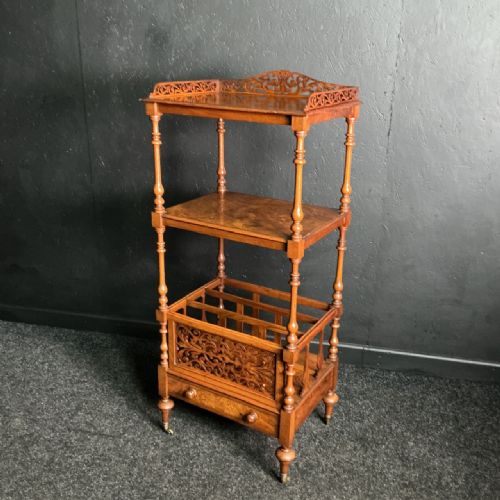
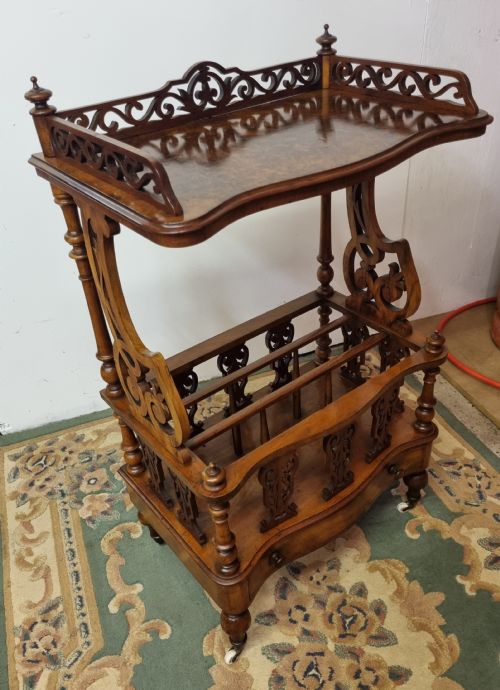
A victorian walnut music table encompasses several distinct forms designed to house scores or support performance, most notably canterburys, whatnots, and adjustable piano stools. The evidence shows these pieces span the nineteenth century, including specific dates in the eighteen sixties, seventies, and eighties, alongside earlier Regency examples.
Canterburys and whatnot combinations dominate the selections, frequently incorporating dividers for sheet music or newspapers alongside tiers for display. Occasional tables, side tables, and specialised music stands also appear, demonstrating the versatility of walnut furniture intended for domestic musical entertainments.
Materials and construction
Makers utilised walnut and burr walnut as the primary timber, valued for its rich grain and warm tone, often enhanced with contrasting inlays of boxwood and ebonised wood. Brass hardware, ceramic details, leather surfaces, and porcelain elements appear across the pieces to provide structural movement, handles, or decorative accents.
Joinery methods supported complex functions, seen in mechanical rising mechanisms for piano stools and tiered shelving for combined whatnot and canterbury designs. The incorporation of drawers and partitions required precise woodworking to maintain stability while housing paper collections.
The documented periods span the Regency era through the nineteenth century, including specific dates in the eighteen sixties, seventies, and eighties.
Assessing craftsmanship and finish
The distinction between standard and superior pieces rests on the choice of timber veneer, where richly figured burr walnut demonstrates greater skill in selection and bookmatching than plain walnut boards. Finer examples display meticulous marquetry and boxwood stringing integrated smoothly into the primary timber rather than applied superficially.
Mechanical integrity defines the standard of adjustable music stands and piano stools, where smooth rising actions and robust brass fittings indicate superior original engineering. The crispness of carved details and the integration of drawers or tiers show whether a workshop invested time in refined finishing.
B A Bremond·Brooks
The Victorian Walnut Music Table Glossary
- Canterbury
- A low stand featuring vertical partitions for holding sheet music, newspapers, or magazines, often combined with a drawer or lower shelf. It frequently serves as an occasional table in a parlour.
- Whatnot
- A set of open shelves supported by slender columns, used for displaying ornaments or holding books and music. In these listings, it regularly pairs with the canterbury form.
- Burr walnut
- A prized timber harvested from the gnarled growth of a walnut tree, yielding highly decorative swirling grain patterns. It forms the primary visual surface on superior Victorian cabinetwork.
- Ebonised wood
- Timber treated to imitate the deep black colour of ebony, utilised for contrast on mouldings and inlay work. This technique highlights the lighter tones of the surrounding walnut.
- Rise and fall
- A mechanical mechanism allowing furniture such as piano stools and music stands to adjust in height. It relies on internal screws or ratchets operated by turning the seat or adjusting a lever.
Victorian Walnut Music Table: Frequently Asked Questions
What is a victorian walnut music table used for?
These pieces served practical domestic roles in nineteenth century parlours, organising sheet music, periodicals, and reading materials while providing stable surfaces for lamps or instruments.
Many examples doubled as display furniture or seating, combining storage compartments with adjustable mechanisms to support musicians during recitals.
How do I identify a victorian piece?
Look for characteristic timber choices such as burr walnut combined with boxwood inlay, ebonised accents, and brass hardware typical of nineteenth century cabinetmaking.
Form also guides identification, as canterbury combinations and revolving music stools reflect the specific domestic requirements of the period.
Are music tables and canterburys the same thing?
They belong to related categories of nineteenth century musical furniture, though a canterbury specifically incorporates vertical partitions for storing scores.
Many listings combine these functions into a single item, pairing music storage shelves with table tops or whatnot tiers.
How should I care for walnut furniture?
Keep these pieces away from direct sunlight and fluctuating heat sources to protect the delicate burr walnut veneers from drying and splitting.
Maintain the wood with appropriate traditional waxes, avoiding synthetic polishes that can build up and dull the grain over time.