
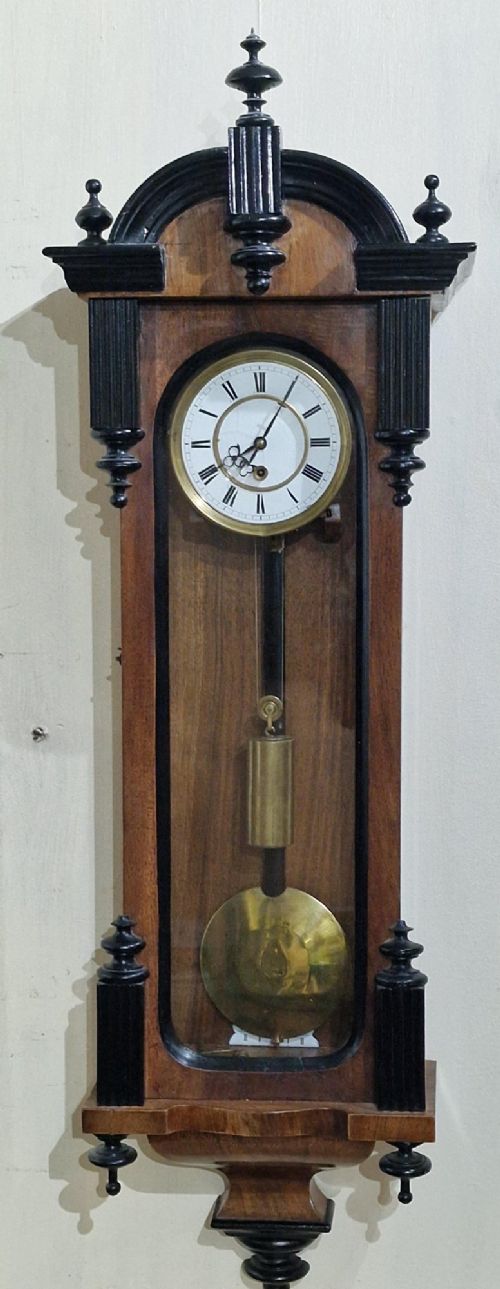


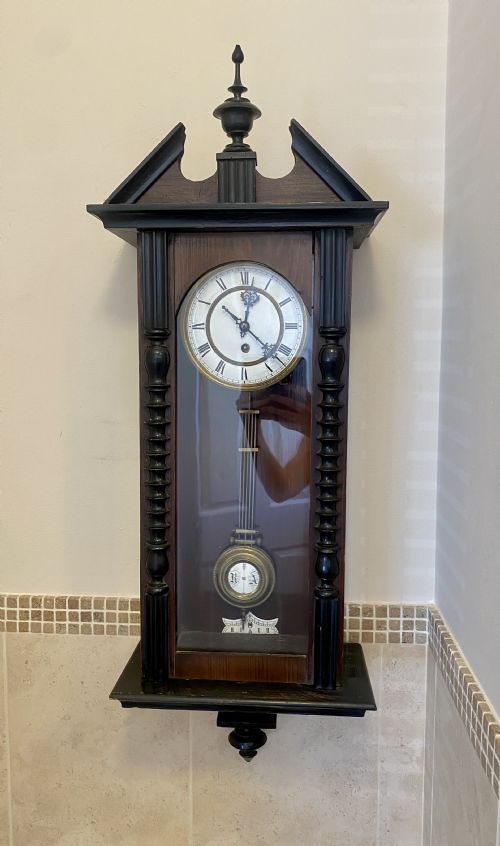


Victorian Walnut Clock Case
These Victorian walnut clock cases offer rich timber grain and classic dial work, bringing distinct nineteenth-century presence to any interior wall or desk.
Victorian Walnut Clock Case
A victorian walnut clock case primarily houses wall-mounted Vienna regulators, fusee dial clocks, and smaller desk models produced during the nineteenth century. These housings span distinct periods from eighteen-sixty through to the late Victorian era, appearing in both standard walnut and figured burr timber.
Most examples function as complete wall clocks featuring glass viewing panels, brass weights, and enamel dials. Collectors also encounter specialised forms like miniature longcase clocks and display domes used alongside desk clocks.
The regional origins on this page stretch from Austrian workshops to English makers, reflecting diverse nineteenth-century cabinet-making traditions. Buyers will find that wall clocks dominate the selection, often retaining original ebonised details or marquetry highlights.
How they were made
Cabinet-makers utilised solid walnut and decorative burr walnut veneers applied to secondary woods, often accentuating the cases with ebonised wood mouldings and intricate marquetry. These surfaces were polished to highlight the natural grain patterns inherent to Victorian timber selection.
Listings feature Victorian wall clocks and desk clocks primarily dated between eighteen-sixty and eighteen-ninety, constructed from walnut, burr walnut, and ebonised wood.
What varies in quality
The distinction between standard production and superior examples lies in the selection of figured burr walnut veneers and the depth of hand-carved ornamentation on the case. Finer pieces display meticulous timber matching across the door frames and backboards, whereas simpler housings utilise plain grain walnut.
Construction refinement also separates output, seen in the precision of the mitred joints, the quality of the ebonised detailing, and the crispness of any applied marquetry. Superior clock cases incorporate robust brass fittings and well-preserved enamel dials that remain clear and undamaged.
Baldwin of Loughborough·AG Lenzkirch
The Victorian Walnut Clock Case Glossary
- Vienna Regulator
- A high-precision pendulum clock originating from Austria, housed in a long glass-fronted case designed to display the movement and weights.
- Fusee
- A conical pulley mechanism inside certain clock cases that equalises the driving force of the mainspring as it winds down, ensuring accurate timekeeping.
- Burr Walnut
- A specialised veneer taken from the knotted growth of a walnut tree, prized for its swirling, highly decorative grain patterns on Victorian furniture.
- Ebonised Wood
- Timber treated with a dark finish to imitate expensive ebony, frequently utilised for contrasting mouldings and architectural details on nineteenth-century clock cases.
- Marquetry
- Decorative veneer work arranged in pictorial or geometric patterns using various woods, often enhancing the front panels of finer Victorian clock housings.
Victorian Walnut Clock Case: Frequently Asked Questions
How do I wind a Victorian wall clock?
Most eight-day or month-duration wall clocks require a specialised key inserted into the winding holes on the enamel dial. Turn the key gently until resistance confirms the springs are fully tensioned or the weights are raised.
Take care not to overwind the mechanism, as this can strain the internal brass gears. Ensuring the clock hangs completely plumb on the wall prevents the pendulum from catching.
Where should I hang a Vienna regulator?
Select an interior wall free from dampness, direct sunlight, and excessive vibrations from heavy foot traffic. Solid masonry or sturdy stud walls provide the best support for the substantial weight of these timber cases.
Position the clock at eye level so the swinging pendulum and weights can operate without obstruction. Adequate clearance also makes routine winding and setting straightforward.
What is the difference between a fusee and a weight-driven clock?
Weight-driven wall clocks rely on hanging brass weights suspended by cords or chains to power the movement. They require vertical drop space inside the case beneath the dial.
Fusee clocks operate via a mainspring connected to a conical pulley, eliminating the need for hanging weights. This compact system allows the movement to fit inside shallower dial clock cases.
How do I care for walnut veneer?
Dust the timber case regularly with a soft, dry cloth to prevent dirt accumulation in the grain and carved recesses. Avoid applying modern silicone polishes, which can build up and degrade the antique finish over time.
Maintain a stable room temperature and humidity level to prevent the walnut veneer from drying out or lifting. An occasional application of traditional beeswax helps nourish the historic timber surface.