


Victorian Staffordshire Wally Dogs
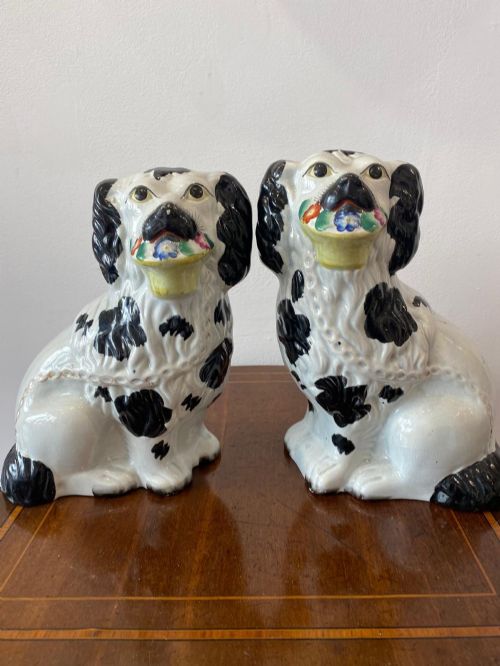
Victorian Staffordshire wally dogs are the quintessential mantelpiece spaniels that sat guarding nineteenth-century hearths.
Victorian Staffordshire Wally Dogs
Victorian Staffordshire wally dogs are ceramic figurines modeled as seated spaniels, most frequently encountered as matching pairs meant for fireplace mantels. The evidence shows these decorative objects spanning the nineteenth century, with specific dates clustering around eighteen sixty and eighteen eighty.
Buyers meet these pieces in various colorways, including plain white, white with gilt accents, red and white, copper lustre, and black and white. Formats range from standard pairs to larger examples, sets of four or five, and versions featuring separate legs or glass eyes.
Materials and methods
Potters shaped these figures from earthenware and ceramic, applying a glaze over the clay body before firing. Many examples incorporate enamel paint for markings, alongside gold leaf or gilt details to highlight collars, chains, and lockets.
Listings demonstrate that earthenware body types and glaze finishes dominate these nineteenth-century Staffordshire figures.
Quality differences
The distinction between standard figures and superior pieces rests on the crispness of the moulding and the precision of the hand painting. Finer examples display carefully detailed enamel work on the faces and coats rather than hasty brushstrokes.
Scale and presence also dictate the hierarchy of these figures, with grander pairs and those possessing unusual attributes like glass eyes or separate legs commanding greater attention than simpler white iterations.
Beswick
The Victorian Staffordshire Wally Dogs Glossary
- Earthenware
- Porous pottery fired at lower temperatures, forming the basic body of these figures before glazing. It requires a protective glaze layer to hold liquids or resist moisture.
- Comforter spaniel
- A nineteenth-century term for these Staffordshire dog figurines, reflecting their role as domestic hearth ornaments. They were traditionally displayed facing inward toward each other on the mantelpiece.
- Copper lustre
- A metallic glaze technique producing a reflective, coppery sheen across the ceramic surface. This finish appears on specific Staffordshire dog pairs from the mid-nineteenth century.
- Enamel paint
- Vitreous colours applied over the fired glaze and refired to bond with the surface. It accounts for the black patches, red markings, and facial expressions on the spaniels.
Victorian Staffordshire Wally Dogs: Frequently Asked Questions
What are wally dogs?
Wally dogs are nineteenth-century ceramic spaniel figures made in Staffordshire potteries for domestic display. People placed them on mantelpieces across Britain during the Victorian era.
They served as decorative ornaments rather than toys, often arranged as symmetrical pairs facing one another. The term remains a traditional regional name for these ceramic spaniels.
How were they displayed?
Owners traditionally positioned pairs of spaniels at either end of a fireplace mantelpiece. They faced inward toward the centre of the hearth.
Larger pairs stood directly on the floor or on sturdy hearthboards beneath the mantel. Collectors today follow similar traditional arrangements in period interiors.
Are they all pairs?
Most surviving Staffordshire dogs appear as matching pairs intended for symmetrical mantelpiece display. The evidence also records occasional larger collections of four or five figures.
Single dogs do exist, but pairs represent the standard format produced by nineteenth-century potteries. Matching left and right orientations were deliberate design choices for balance.