
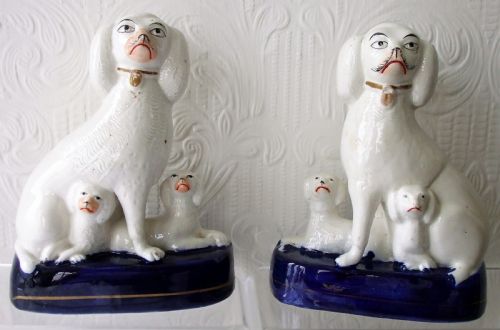
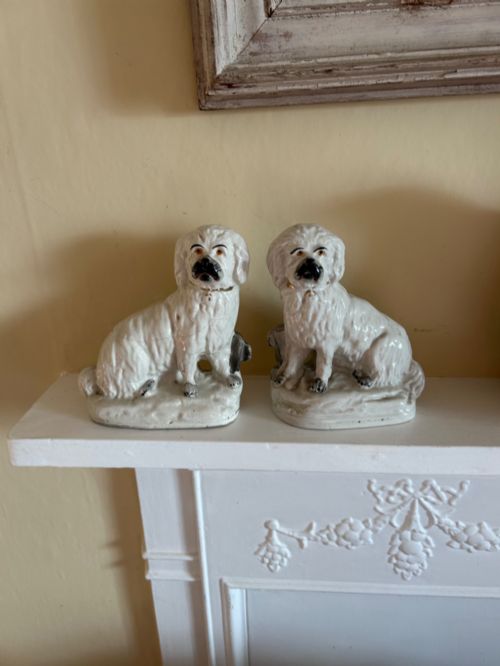


Victorian White Spaniel Statues
Victorian white spaniel statues are classic Staffordshire shelf ornaments depicting seated dogs, prized for their traditional hearthside charm and characteristic gold leaf highlights.
Victorian White Spaniel Statues
When you search for victorian white spaniel statues, you encounter earthenware decorative figures created during the nineteenth century. These ornamental pairs were modelled to sit upon mantelpieces across English homes, offering a comforting domestic presence.
The pieces on this page primarily take the form of seated spaniels, often accented with gilt highlights or paint. They appear both as single figures and balanced pairs, sometimes decorated with blue cushions or fine surface detail.
Dating ranges across the 1860s, 1880s, and into 1900, capturing a specific era of Staffordshire pottery production. Collectors find dogs rendered in plain white glaze as well as versions featuring black markings or metallic leaf.
Methods of manufacture
Current listings feature earthenware materials, white glazes, and gold leaf highlights applied across nineteenth-century Victorian figures.
Distinctions in quality
The refinement of the hand-painted enamel work largely separates standard Staffordshire figures from superior examples. Crisp detailing on the eyes, muzzle, and gilt collars indicates a more skilled hand during decoration.
The crispness of the earthenware moulding and the smooth application of the glaze define the baseline structure. Pairs that retain vibrant gold leaf and clean white surfaces without excessive firing flaws command greater appreciation from collectors.
Beswick
The Victorian White Spaniel Statues Glossary
- Earthenware
- Porous pottery fired at lower temperatures, commonly used for nineteenth-century Staffordshire figures. This body material required a complete glaze to ensure it remained sealed.
- Enamel
- Vitreous paint applied over the fired glaze to add colour and facial expressions. Artisans used these mineral pigments for the eyes, noses, and painted markings.
- Staffordshire pottery
- Earthenware produced in the industrial pottery towns of England during the Victorian period. These kilns manufactured the vast majority of decorative mantle dogs and animal figures.
- Glaze
- A glassy coating fused to the ceramic body through kiln firing. It provides the smooth, protective white finish characteristic of these nineteenth-century statues.
Victorian White Spaniel Statues: Frequently Asked Questions
What are Victorian white spaniel statues?
These pieces are earthenware decorative figurines modelled as seated dogs during the nineteenth century. Potters in England produced them in pairs to display upon mantelpieces and hearths.
They reflect traditional domestic styles of the period, often featuring white glaze decorated with gold leaf or painted enamel details.
How were these ceramic dogs used?
Victorian households placed these figures on fireplace mantelpieces as symmetrical pairs facing one another. They served purely as decorative ornaments to bring warmth and character to the Victorian parlour.
People also collected various breeds, including poodles and terriers, to arrange across living spaces.
How do I date Staffordshire dog statues?
Dating relies on examining the characteristics of the earthenware body, the style of the glaze, and the application of any paint or gilt. Pieces from the 1860s often display specific modelling styles compared to later nineteenth-century output.
Factory marks, where present, can also narrow down the production period toward the end of the century.
How should I clean my Staffordshire figures?
Careful dusting with a soft, dry brush is the best method to remove everyday surface dirt without disturbing fragile enamels. Avoid using water or chemical cleaners that might damage the antique glaze or gold leaf.
Handle the figures gently by their bases rather than by protruding ears or painted details.
Are these figures always found in pairs?
Many Staffordshire dogs were manufactured and sold as symmetrical pairs designed to sit at either end of a mantelpiece. However, individual figures and collections of four do occasionally appear.
Pairs generally show opposing orientations so the dogs face inward toward each other when displayed.