


Victorian Silver Christening Mug
When you handle a victorian silver christening mug, you hold a small, enduring piece of nineteenth-century family history.
Victorian Silver Christening Mug
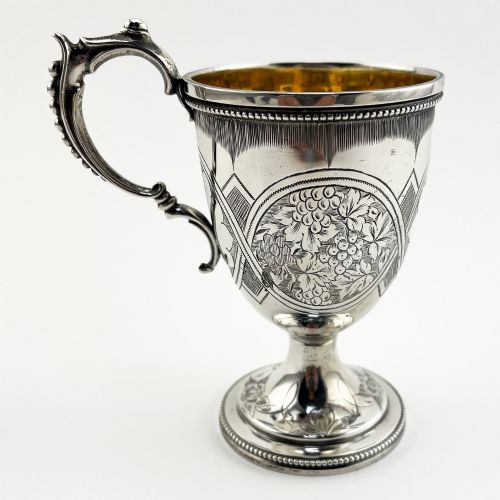
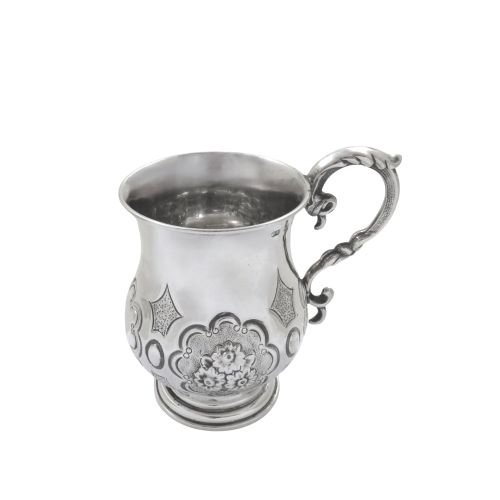
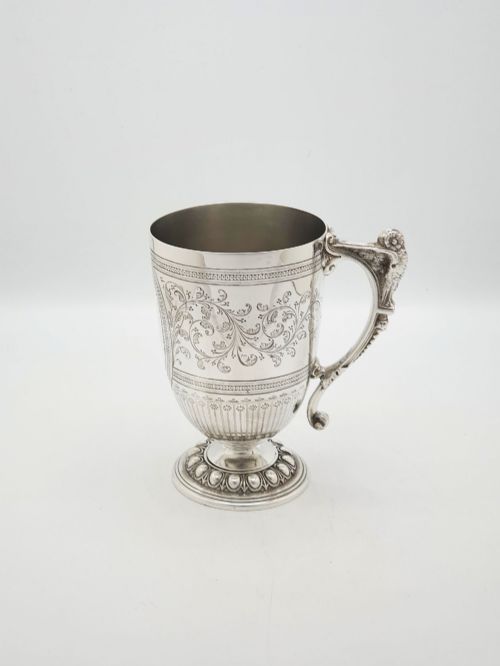
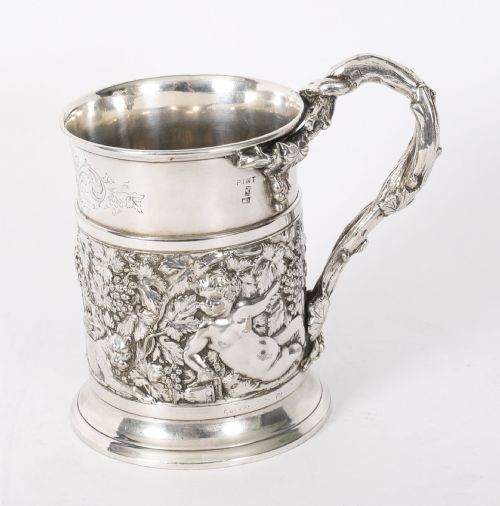
A victorian silver christening mug is a small vessel traditionally given to mark an infant's baptism, appearing in forms such as baluster, barrel-shaped, and cylindrical tankards. Most examples met on this page date from the nineteenth century, spanning periods from early Victorian years through to the Edwardian era.
Makers shaped these small vessels from sterling silver, silver gilt, and silver plate, often pairing them with leather and velvet lined presentation cases. Styles range from plain surfaces to floral engraved motifs, birds, and Rococo scroll handles.
The objects served primarily as keepsake gifts rather than everyday tableware, which accounts for the survival of intricate detailing and fine embossing across the category.
Distinctions in Execution and Weight
Quality rests significantly on the gauge of silver utilised in the body, separating substantial, heavy-walled vessels from lighter plated alternatives. Thicker metal supports deeper, crisper hand-engraving and embossing that resists denting.
Design complexity and maker reputation set further boundaries, distinguishing standard cylindrical bodies from baluster forms with cast scroll handles, specialised bird motifs, or fitted presentation cases.
Listings feature sterling silver and silver plate pieces spanning the early Victorian period through the Edwardian era, incorporating regional British assay marks.
G R Collis·Fenton Brothers·Thomas Bradbury And Sons·George Unite·Atkin Bros·Thomas Prime And Son·Josiah Williams And Sons
The Victorian Silver Christening Mug Glossary
- Baluster
- A vertical architectural shape featuring a rounded lower swelling tapering to a narrow neck and flared rim. This profile gives many traditional drinking vessels their classic silhouette.
- Silver Gilt
- Sterling silver that has been coated with a thin layer of gold on the interior surface. This technique provides a rich contrast and prevents tarnishing from liquids.
- Embossing
- A decorative metalworking technique where a design is raised from the reverse side by hammering. It creates tactile, three-dimensional patterns across the exterior wall.
- Hallmark
- A series of official marks stamped into precious metals indicating the standard of purity, the assay office, and the date of manufacture. These symbols authenticate the piece.
- Chasing
- Working metal from the front by sinking the material with punches rather than removing it. This process refines embossed details and sharpens surface lines.
Victorian Silver Christening Mug: Frequently Asked Questions
How do I read silver hallmarks?
Hallmarks consist of small stamped symbols that reveal the assay office, the purity of the metal, and the specific year of production. By locating these tiny marks, usually on the rim or base, you can trace the exact origin of the vessel.
Different towns like London, Birmingham, and Sheffield utilised distinct date letters and town marks. This system allows collectors to date pieces accurately to specific decades.
Were these mugs actually used?
Most christening mugs functioned primarily as decorative keepsakes or display pieces rather than practical tableware for infants. Their survival in pristine condition often stems from careful storage in fitted leather and velvet cases.
When gilt interiors are present, they served to protect the silver from wear caused by liquids. Many retain crisp engraving because they spent decades untouched in family drawers.
How do I care for silver?
Silver requires gentle cleaning with specialised cloths to remove natural tarnish without abrading the surface details or engravings. Avoid harsh chemical dips that strip away the aged patina accumulated over generations.
Store the pieces in dry environments, and utilise lined presentation cases if available. Proper handling preserves both the metal integrity and the historical character of the object.