



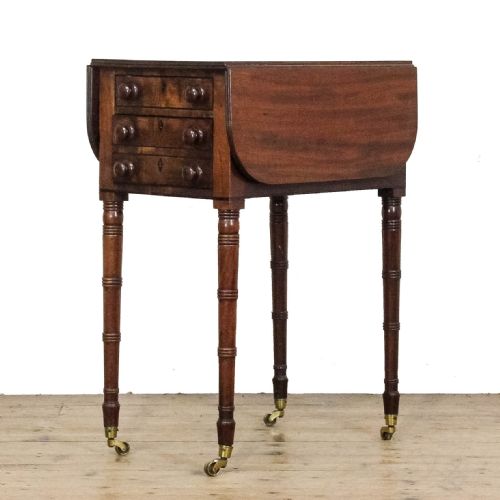


Victorian Sewing Worktable
A victorian sewing worktable brings ingenuity and timber grain to a room, housing needlework within fitted compartments beneath a useful top.
Victorian Sewing Worktable
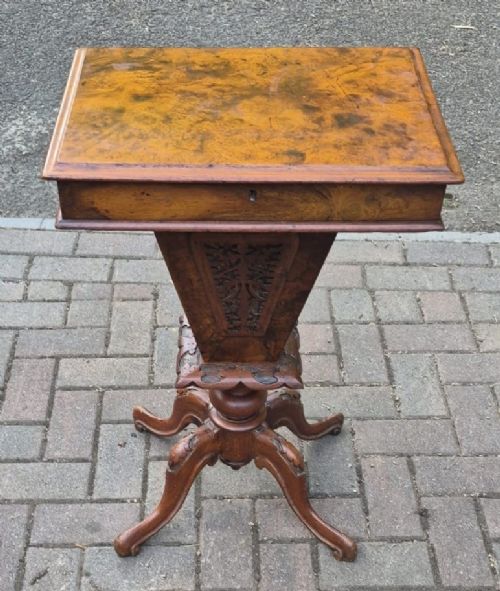
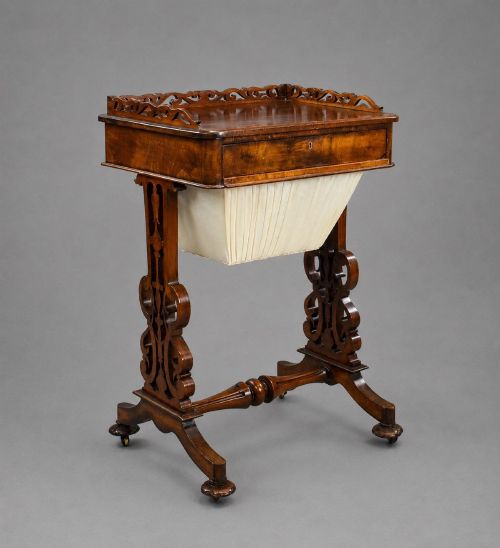
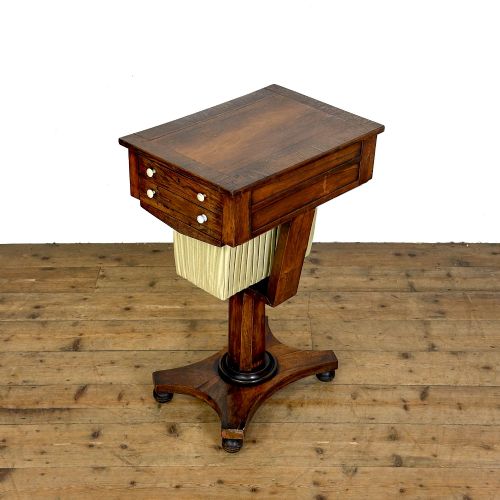
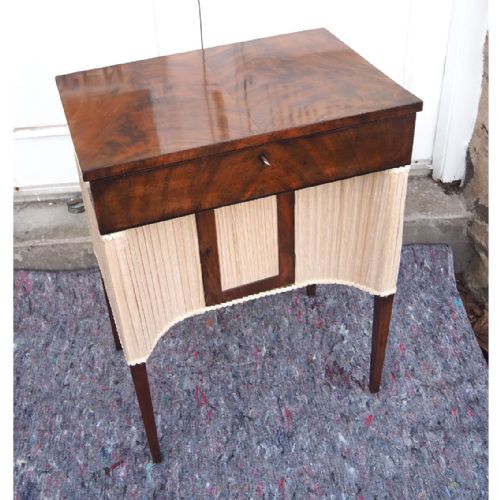
A victorian sewing worktable is a multi-functional piece designed for needlework, correspondence, and dressing, combining a workbox with a stable table surface. These items appear across the nineteenth century in walnut, burr walnut, mahogany, and rosewood, often featuring fitted internal compartments for cottons and tools. Many examples double as games tables, writing desks, or occasional side tables, demonstrating the versatile furniture design of the period.
The pieces on this page span the Victorian era alongside earlier Regency and William IV influences, stretching from mid-century productions to later nineteenth-century interpretations. Forms vary from trumpet-shaped boxes on pedestal bases to rectangular tables with drop leaves, drawers, and suspended fabric bags. Walnut and mahogany dominate the selection, appearing alongside inlaid fruitwood, rosewood, and pollard oak.
Makers and retailers such as Boothroyd Sons & Rimmer and Holland & Son occasionally mark these pieces, though most survive unsigned. Buyers encounter standard work tables alongside specialised Poudreuse dressing tables, metamorphic designs, and reading tables. Each variation reflects the domestic pursuits and refined interior requirements of nineteenth-century households.
How they were made
Cabinetmakers constructed these tables using solid timber frames paired with decorative veneers, notably burr walnut and flame mahogany, applied to create striking symmetrical grain patterns. Wood inlay, brass detailing, and delicate marquetry frequently ornament the tops and friezes, displaying accomplished woodworking techniques. Carved and turned supports, pedestals, and tripod bases provide structural stability while maintaining slender proportions.
Internal storage relied on cedar or pine carcases lined with silk, velvet, or compartments carved from solid wood to house sewing accessories securely. Hinged lids, sliding trays, and suspended fabric workbags required precise joinery to ensure smooth daily operation. Secondary timbers like mahogany or oak were utilised for drawer linings and internal divisions.
Listings feature walnut, mahogany, and rosewood tables spanning from the early nineteenth century through to the Victorian era and mid-century revivals.
What varies in quality
Quality rests primarily in the selection of timbers and the precision of the cabinetwork, from plain mahogany boards to highly figured burr walnut with intricate fruitwood inlay. The crispness of carved wooden supports and the complexity of internal fittings separate standard production items from finer workshop pieces. Superior examples integrate multiple functions, such as combined writing surfaces, leather inserts, and chess boards, without compromising structural elegance.
Condition and originality dictate lasting merit, particularly the survival of fitted interior trays, original brass hardware, and intact fabric workbags. Tables retaining rich, warm patination to the timber grain demonstrate careful maintenance and high-grade finishing. The stability of pedestals and the smooth alignment of drawers indicate the original standard of craftsmanship.
Boothroyd Sons & Rimmer·Holland & Son
The Victorian Sewing Worktable Glossary
- Burr walnut
- A highly figured timber veneer taken from the burl growths of walnut trees, prized for its swirling, organic patterns. It frequently covers the top surfaces of finer nineteenth-century tables.
- Poudreuse
- A small dressing table featuring folding compartments, mirrors, and storage wells for cosmetics and personal items. In nineteenth-century interiors, these often doubled as compact writing or sewing desks.
- Trumpet workbox
- A sewing table characterised by an octagonal or cone-shaped body widening towards the base, supported on a carved pillar and tripod feet. The flared compartment typically conceals a fabric storage bag.
- Marquetry
- The art of forming decorative patterns using thin veneers of different coloured woods, ivory, or shell. It appears on table tops to create floral or geometric designs.
- Metamorphic
- Furniture engineered to transform between distinct uses, such as a sewing table converting into a writing desk or reading stand. These pieces utilise clever pivoting mechanisms and concealed drawers.
Victorian Sewing Worktable: Frequently Asked Questions
What is a victorian sewing worktable used for?
These tables served as dedicated stations for needlework, embroidery, and household accounts, keeping materials organised within fitted compartments.
Today, buyers use them as decorative occasional tables, bedside stands, or compact desks in living spaces.
Are sewing tables and work tables the same?
The terms are often used interchangeably, though specific work tables might focus more on writing or general tasks rather than sewing.
Many incorporate sliding bags, partitioned drawers, or drop leaves suited to various needlecrafts and hobbies.
How do I care for antique walnut furniture?
Keep wooden surfaces away from direct sunlight and radiators to prevent the veneers from drying out or splitting.
Apply traditional beeswax polish occasionally and buff gently with a soft cloth to maintain the natural sheen.