


Victorian Sepia Watercolour
These Victorian sepia watercolour works on paper offer tonal depth and monochrome atmosphere, capturing maritime scenes, architecture and landscapes through subtle washes.
Victorian Sepia Watercolour
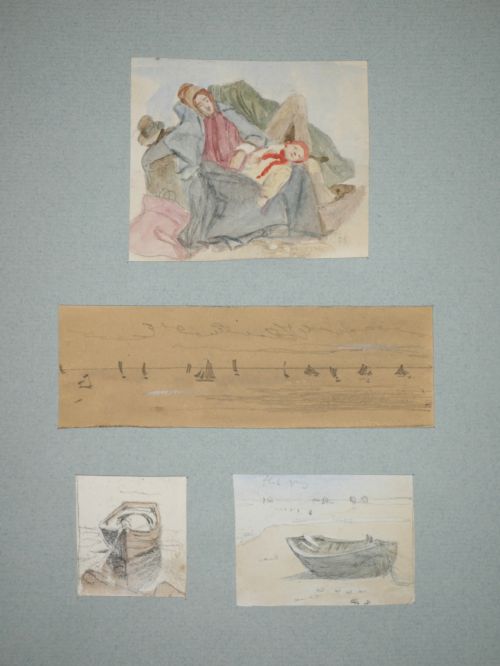
A victorian sepia watercolour brings together monochrome pigment and paper to depict maritime views, architectural studies and quiet rural landscapes. These works on paper span the nineteenth century and into the early twentieth century, showing subjects from coastal harbours to historic town streets.
Most pieces encountered on this page belong to the nineteenth century, often framed behind glass in wood mouldings. They range from intimate sketchbook leaves to large signed exhibition pieces by named artists and regional British schools.
Materials and technique
Artists painted these works using watercolour pigment and ink on paper sheets, sometimes augmented with bodycolour or gouache for highlights. The sepia tone relied on natural brown pigments derived from walnut or cuttlefish ink, creating warm monochromatic gradations.
Works are typically presented framed behind glass within wood surrounds, occasionally complemented by gold leaf accents on the inner mounts. The paper support forms the primary light source through exposed reserved areas.
A notable number of these coastal views depict Whitby, where nineteenth-century artists clearly loved painting rainy harbour streets and abbey ruins.
Gradations of quality
Quality rests on the certainty of the brushwork and the skillful handling of tonal washes to build depth without muddying the paper. Strong draughtsmanship in the underlying ink sketch distinguishes a confident composition from a hesitant study.
The preservation of the paper support and the vibrancy of the monochrome pigment shape the visual impact of each piece. Superior works retain their tonal contrast and delicate gradations without excessive fading from light exposure.
James Smetham·William Frederick Settle·George Arthur Fripp·Frederick William Booty·William Wyld·Henry Barlow Carter·Hercules Brabazon Brabazon·Samuel Palmer·Harry Wanless·Thomas Clavering Alder·Walter Emsley·Arthur Netherwood·Tom Dudley·George De Paris·George Cattermole·Thomas Lound
The Victorian Sepia Watercolour Glossary
- Sepia
- A brown pigment traditionally derived from the ink sac of the cuttlefish, widely used for monochrome tonal painting. It produces warm brownish-grey hues characteristic of nineteenth-century sketches.
- Gouache
- An opaque watercolour paint mixed with a binding agent and white pigment to create solid areas of colour. It is often applied for highlights in mixed media works on paper.
- Wash
- A thin, fluid layer of diluted watercolour pigment spread evenly across paper to create skies, water or shadow. Controlled washes form the foundation of atmospheric depth in these paintings.
- Works on paper
- A collective term for art created on a paper support, including watercolours, drawings, ink sketches and prints. This category forms the core of nineteenth-century graphic output.
- British School
- A designation for artists working within British artistic traditions rather than identifying a specific academy. It groups together regional painters and unnamed hands from the period.
Victorian Sepia Watercolour: Frequently Asked Questions
What is sepia watercolour?
Sepia watercolour uses a monochrome brown pigment derived from cuttlefish ink to build tonal depth and shadow across a paper surface.
Artists favoured this medium for sketching tonal studies and capturing atmospheric landscapes without the distraction of full colour.
How should I frame them?
These works on paper require framing behind glass to protect the delicate pigment and paper support from dust and atmospheric moisture.
Acid-free mounts prevent chemical damage and keep the paper from touching the glass surface directly.
How do I date a piece?
Dating relies on visible artist signatures, dated inscriptions on the mount or reverse, paper watermarks and stylistic conventions of the period.
Subject matter such as architectural landmarks or shipping types also helps narrow down the decade of creation.
Where were they displayed?
Original watercolours were typically framed for domestic display in parlours and drawing rooms throughout the nineteenth century.
Smaller sketches often remained bound in portable artist sketchbooks before being removed for individual framing later.