
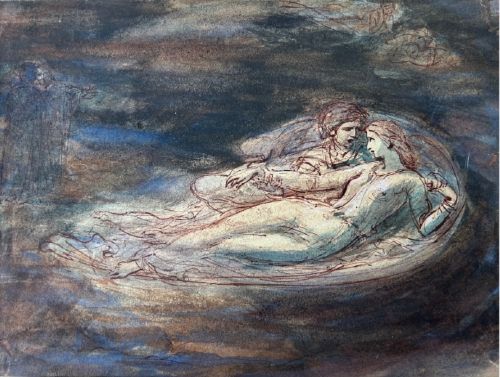


19th Century Watercolour Wash
These 19th century watercolour wash paintings combine fluid pigment with ink and paper to capture landscapes, portraits, and narrative scenes.
19th Century Watercolour Wash
A 19th century watercolour wash consists of original paintings and drawings created using diluted pigments on paper. Buyers seeking this style will encounter works ranging from early Victorian and Georgian pieces to late Victorian and Regency examples.
The subjects span British landscapes, Irish genre art, military portraits, and maritime views, alongside international subjects such as Indian temples and Japanese scenes. These works offer a direct link to the period's diverse artistic output.
Most pieces on offer are framed behind glass, often in gilt or gilded wood frames that complement the delicate nature of the paper beneath. Original paintings frequently incorporate ink or sepia elements alongside the primary pigment.
Materials and construction
Artists of the period applied watercolour pigment and sepia ink onto paper supports using a distinct wash technique to build tone and depth. This method allowed creators to achieve subtle gradients, particularly in skies, water, and architectural elements.
Works are preserved behind glass to protect the absorbent paper and water-soluble pigments from atmospheric damage. Many surviving pieces retain their original gilt wood or gilded wood frames, adding structural support and period context.
Listings feature works created across the 19th century, incorporating periods such as Georgian, Regency, Victorian, and late Victorian eras.
Qualities that distinguish the works
The standard of a 19th century watercolour wash rests upon the artist's handling of pigment fluidity and tonal control. Superior works display confident brushwork and deliberate use of wash to define light and shadow.
Context and attribution also influence the standing of a piece, with documented artists commanding greater interest than anonymous school works. The preservation of the paper and the clarity of the ink lines further separate standard examples from finer ones.
Robert Richard Scanlan·William Wyld·Henry Barlow Carter·Thomas Pyne·William J Hodgson·Thomas Lound·Thomas Brabazon Aylmer·J Washington
The 19th Century Watercolour Wash Glossary
- Wash
- A technique of diluting watercolour pigment with water to create a semi-transparent layer of colour on paper. This method allows artists to build up large areas of tone smoothly.
- Sepia ink
- A brown ink derived from the cuttlefish, frequently utilised during the period for monochrome drawings and foundational lines. It provides a warm, stable tone.
- Gilt wood
- Wood coated with a thin layer of gold leaf or gold paint, commonly used for framing artworks of this era. It protects and enhances the presentation of the painting.
- Genre art
- Paintings that depict scenes from everyday life, ordinary people, and familiar settings. These works offer insight into social history.
19th Century Watercolour Wash: Frequently Asked Questions
How should I display a watercolour wash?
Watercolours require protection from direct sunlight to prevent the pigments from fading over time. Keep them away from damp environments to protect the paper and the frame.
Hang your piece on an interior wall using proper picture-hanging hardware. Ensure the glass does not touch the surface of the painting itself.
How do I identify a wash technique?
A wash technique involves diluted pigment applied evenly across the paper to create smooth backgrounds or skies. You will see translucent layers where the white of the paper shows through.
Unlike opaque gouache, a wash relies on the luminosity of the underlying paper support for its brightness.
What is the difference between ink and wash?
Ink provides the sharp, linear details and foundational outlines in a drawing or painting. Wash supplies the tonal areas, shading, and atmospheric depth.
Many 19th century works combine both mediums to achieve finished compositions.
Are these works original?
The pieces listed are original hand-painted works created on paper during the 19th century. They are unique artistic creations rather than modern reproductions.
Artists used watercolour pigment, ink, and occasionally sepia to produce these one-of-a-kind images.