




Victorian Sarcophagus Box
A Victorian sarcophagus box brings architectural dignity to domestic storage, housing tea, documents, or jewellery with monumental poise.
Victorian Sarcophagus Box
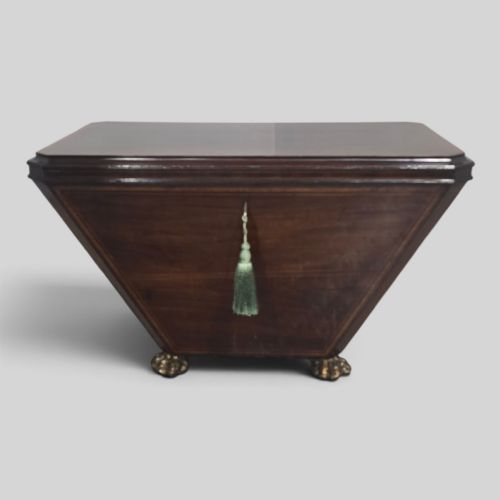
The Victorian sarcophagus box takes its name from classical monumental tombs, adopting a heavy, inverted-pyramid profile with a raised, domed or stepped lid. These substantial lidded containers serve diverse domestic functions, appearing most frequently on this page as tea caddies, cellarettes, wine coolers, and jewellery chests. Most pieces encountered here stem from the nineteenth century, reflecting Regency and Victorian design idioms.
Makers adapted the grand architectural shape for intimate tabletop use, employing rich cabinet woods to give small boxes the gravitas of larger furniture. Alongside standard tea caddies and sewing boxes, buyers encounter larger cellarettes and wine coolers designed to stand on the floor or on low pedestals. The silhouette remains consistent across these forms, characterised by deep bevels, rounded shoulders, and often resting on bun feet.
The geographical origins span British workshops, with specific regional variations such as Tunbridge Ware Tunbridge Wells production and Anglo-Indian carving traditions. While some items date to the early nineteenth century under Regency influence, the majority align with the Victorian era proper, particularly around the eighteen-eighties. This mixture of formal tea containers and personal storage chests provides a representative cross-section of nineteenth-century luxury woodwork.
Materials and Technique
Cabinetmakers constructed the primary carcase of a Victorian sarcophagus box from dense hardwoods like rosewood and mahogany, frequently applying figured veneers to the exterior. Walnut also appears regularly, offering deep grain patterns that complement the sweeping curves of the sarcophagus profile. These timbers were selected for stability and visual warmth, providing an ideal canvas for decorative treatments.
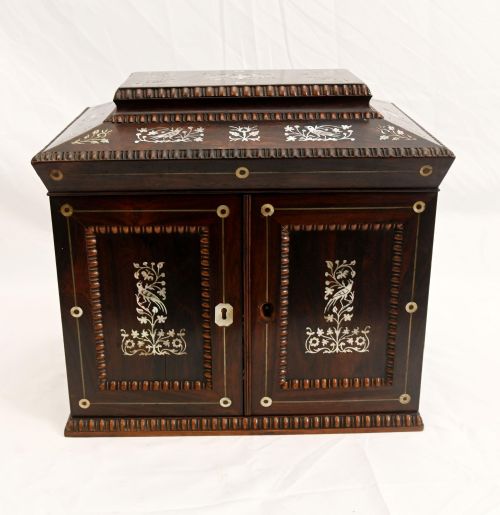
Decoration relied on contrasting inlays, with brass, mother-of-pearl, and boxwood set flush into the wooden surfaces to create geometric or floral motifs. Specialised regional techniques, such as the minute mosaic wood-tiling known as Tunbridge Ware, adorn specific examples from makers like Henry Hollamby. Interiors were typically lined with velvet, silk, or fitted with secondary compartments in scented woods to protect delicate contents.
Several boxes feature tiny secret drawers tucked beneath tea canisters, designed to keep household gossip just as secure as the family silver.
Judging Quality
Quality in a Victorian sarcophagus box rests on the precision of the mitred joints and the selection of the timber veneer. Superior examples display book-matched grain patterns that flow seamlessly across the lid and sides, maintaining visual harmony despite the complex compound angles. Lesser pieces rely on plain timber planks with less attention paid to grain continuity.
The refinement of the interior fittings and secondary materials dictates the upper tier of craftsmanship. Finer boxes retain original silk linings, working locks with matching keys, and intricately turned ivory or bone pulls within internal compartments. The crispness of inlaid brass or mother-of-pearl work, free from excessive filler, separates standard workshop production from master cabinetmaker output.
Edwards and Roberts·Henry Hollamby·Freemans of Norwich
The Victorian Sarcophagus Box Glossary
- Sarcophagus form
- A container design featuring a sloping, pedestal-like base and a raised lid modelled after ancient stone tombs. This shape gained immense popularity in British cabinetmaking during the early nineteenth century.
- Cellarette
- A lockable container used for storing wine bottles or decanters near the dining table. In sarcophagus form, these are often larger floor-standing pieces lined with metal or lead.
- Tunbridge Ware
- A type of decorative woodwork produced in Kent featuring minute mosaic pictorial or geometric tesserae. Artisans glued thousands of tiny wood blocks together to form intricate surface patterns.
- Teapoy
- A small table or large caddy designed to hold tea canisters, usually supported on a central pillar with tripod feet. The upper storage compartment often adopts the sarcophagus silhouette.
- Book-matched
- A veneer technique where adjacent slices of wood are opened like a page to mirror each other's grain pattern. This creates symmetrical and highly decorative visual effects across the box lid.
Victorian Sarcophagus Box: Frequently Asked Questions
What was a sarcophagus box used for?
These containers were primarily manufactured to store high-value commodities like loose tea leaves, which required protection from light, moisture, and air. They also served as secure repositories for jewellery, documents, and sewing implements on parlour tables.
Larger variations functioned as cellarettes or wine coolers to hold bottles close to the dining room table. Their imposing architectural appearance meant they were meant to be displayed prominently in public rooms rather than hidden away.
How do I tell Regency from Victorian pieces?
Regency-era boxes generally exhibit leaner, more severe classical proportions with restrained brass mounts and architectural stringing. They often date from the early decades of the nineteenth century.
Victorian examples tend towards heavier, more florid carving, bulbous feet, and elaborate mother-of-pearl or Tunbridge Ware inlay. The later nineteenth-century pieces embrace bolder decorative statements and more complex internal compartmentalisation.
Are the interior fittings usually original?
Many surviving boxes retain their original fitted trays, velvet or silk linings, and small lidded canisters for green and black tea. However, due to centuries of domestic use, delicate textile interiors were frequently replaced by later owners.
Original working locks and matching decorative escutcheons remain strong indicators of untouched condition. Partial fittings are common, so buyers should examine internal photographs closely to verify what survives.
How should I care for a rosewood box?
Rosewood requires stable environmental conditions away from direct sunlight and central heating sources to prevent timber shrinkage and veneer splitting. Periodic application of a microcrystalline wax helps nourish the timber and protect the polished surface without building up residue.
Avoid using liquid polishes or modern silicon-based sprays, which can penetrate old finishes and damage delicate inlays like mother-of-pearl or brass stringing. Gentle dusting with a dry, soft cloth is sufficient for routine maintenance.