




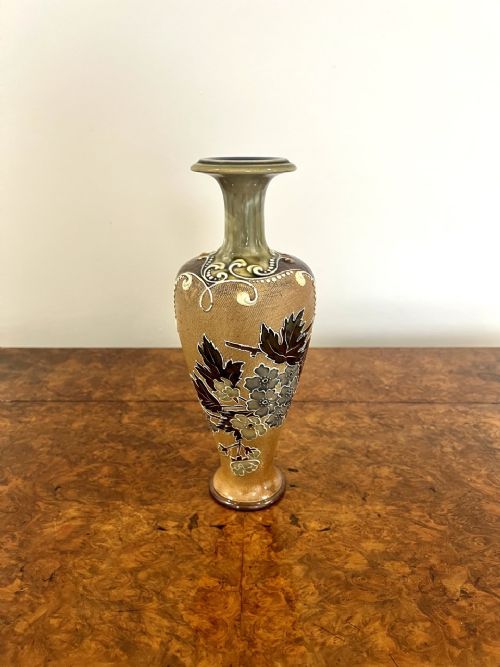


Victorian Royal Doulton Urn
These Victorian royal doulton urn pieces combine robust ceramic bodies with striking decorative finishes, offering a tangible piece of late nineteenth century craftsmanship.
Victorian Royal Doulton Urn
A victorian royal doulton urn represents the height of British ceramic production, spanning the nineteenth and early twentieth centuries. The selection on this page includes various forms such as vases, jardinieres, and planters.
Most examples originate from the 1880 to 1910 period, showcasing the aesthetic shifts from traditional Victorian decorative styles to Art Nouveau and Arts and Crafts movements. Buyers frequently encounter diverse shapes ranging from simple beaker forms to large baluster vases and jardinieres.
Makers such as Doulton Burslem and Doulton Lambeth produced these distinctive ceramic works, occasionally featuring the hand of specific artists like Emily Stormer. The forms vary from intimate cabinet pieces to substantial decorative vessels.
How they were made
Potters utilised stoneware and porcelain bodies, applying specialised glazes and enamel to achieve rich surface textures. Techniques such as hand painting brought intricate detail to the ceramic surface.
Many items incorporate applied gold leaf and gilding to accentuate moulded details and borders. Slaterware methods introduced unique textured backgrounds reminiscent of woven lace pressed into the clay.
Victorian Royal Doulton Urn Retail Price Guide 2026
Typical asking prices for victorian royal doulton urn among the pieces listed under this phrase on Sellingantiques today, from the lower quarter to the upper quarter. They describe what is for sale here now, not the wider market.
Listings feature ceramics spanning the late nineteenth century to 1910, executed in stoneware, porcelain, and glazed stoneware.
What varies in quality
The distinction between standard production items and superior pieces rests largely on the complexity of the hand painting and the ambition of the form. Elaborate three dimensional additions, such as dolphin bases, set finer examples apart from simple vessels.
Signed works by named artists carry distinct artistic merit that elevates them above anonymous factory output. The precision of the gilding and the depth of the glaze application further distinguish the finer tiers of production.
Royal Doulton·Doulton Burslem·Doulton Lambeth·Emily Stormer
The Victorian Royal Doulton Urn Glossary
- Stonerware
- A dense, hard ceramic fired at high temperatures until vitrified. This impermeable material forms the durable body for many nineteenth century vases and jardinieres.
- Slaterware
- A distinctive Doulton technique where real lace or fabric is pressed into damp clay before firing to create a textured, cloth-like pattern.
- Jandiniere
- A large ornamental pot designed to hold a live plant or floral display. These ceramic vessels often match the decorative schemes of contemporary vases.
- Gilding
- The application of gold leaf or gold paint to ceramic surfaces. This decorative touch highlights rims, handles, and raised motifs.
- Baluster
- A vertical architectural form with a swelling lower portion tapering towards the top. Several tall vases on this page utilise this classic proportion.
Victorian Royal Doulton Urn: Frequently Asked Questions
How do I date a Doulton piece?
Dating relies on stylistic clues like the transition from Victorian decorative motifs to Art Nouveau curves, alongside specific production eras represented in the evidence from 1880 to 1910.
Makers' marks and stylistic markers such as Slaterware or specific artist signatures help narrow down the decade of manufacture within the late nineteenth and early twentieth centuries.
What is Slaterware?
Slaterware is a distinctive Doulton ceramic finish created by pressing real lace or woven fabrics into the wet clay body before firing.
This process leaves a permanent textured impression that was often highlighted with colour and gold leaf to resemble patterned textiles.
Were these vessels used for plants?
Many larger forms, particularly jardinieres and planters, were specifically designed to house potted indoor plants in Victorian and Edwardian drawing rooms.
Smaller examples served strictly as decorative mantel or table vases intended to display cut flowers or simply stand alone as ornamental art.
How do I identify Art Nouveau examples?
Art Nouveau pieces feature characteristic whiplash lines, stylised floral motifs, and organic forms that break away from rigid Victorian symmetry.
These designs often utilise muted glazes and flowing contours that reflect the artistic shifts occurring around the turn of the twentieth century.