
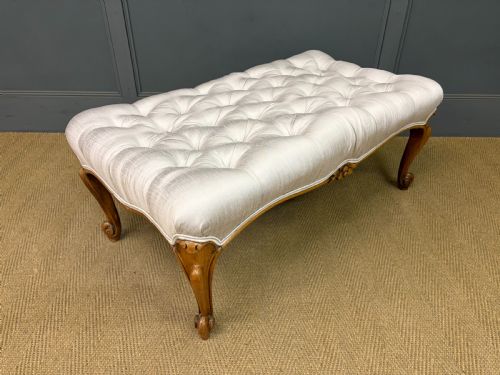
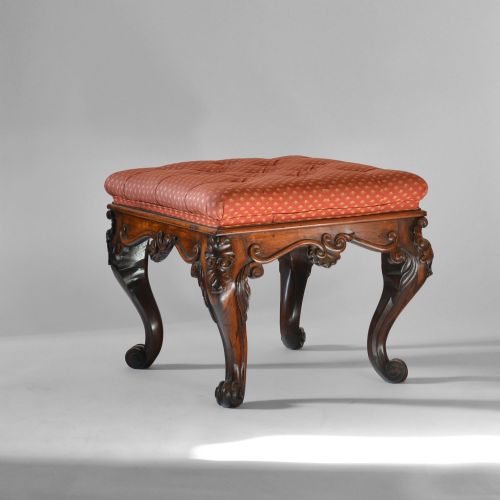
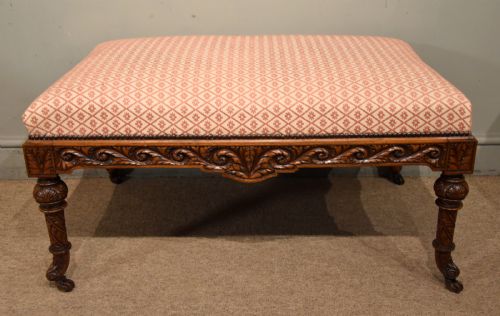
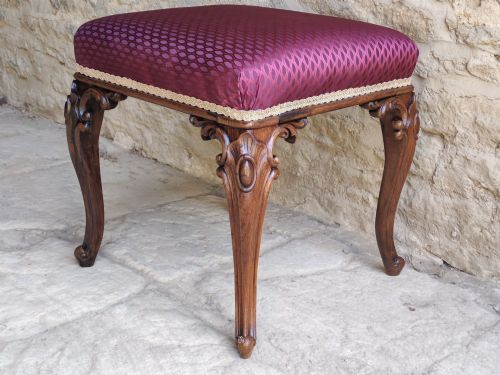
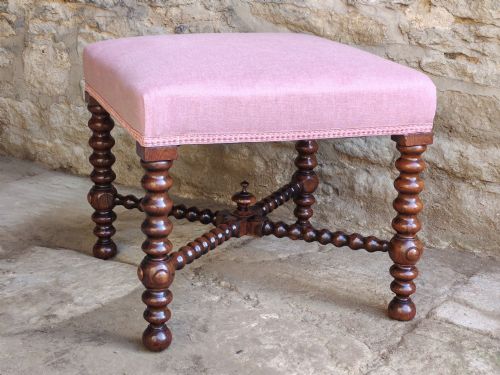
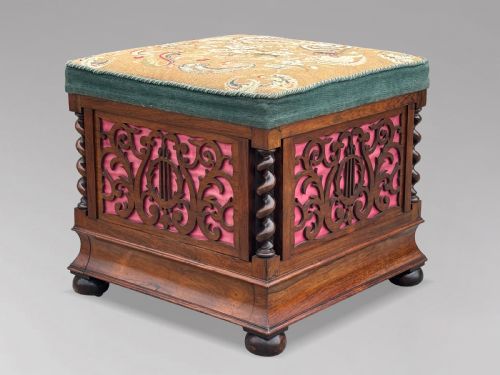
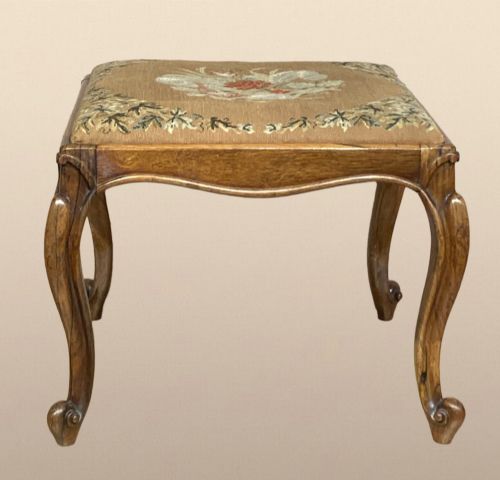
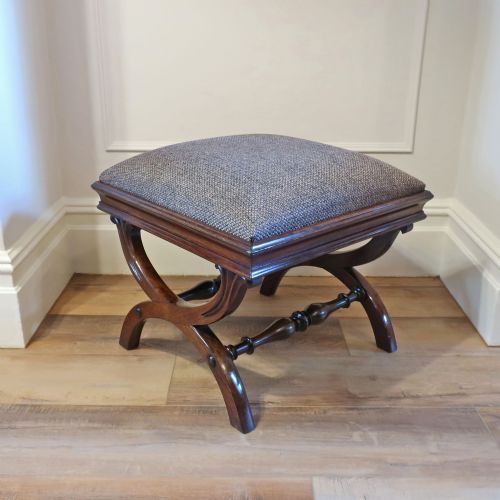

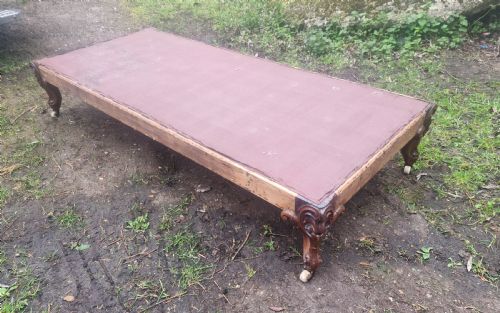
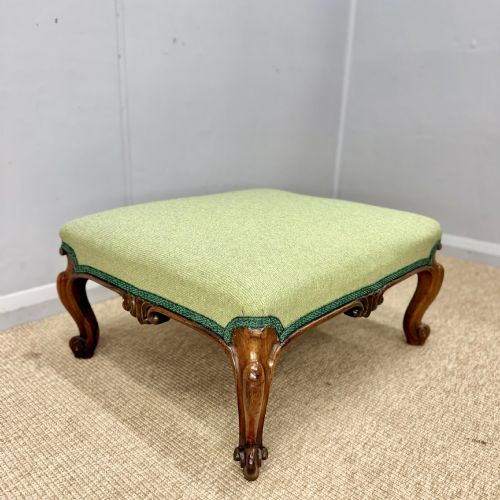


Victorian Rosewood Footstool
These Victorian rosewood footstools combine dense tropical timber with rich upholstery to anchor a room.
What you are looking at
A victorian rosewood footstool brings nineteenth-century seating into modern rooms, taking forms from dressing stools to low ottomans. The listings show pieces spanning the nineteenth century, with dates including eighteen-forty, eighteen-sixty, eighteen-seventy and eighteen-eighty.
Most examples rest on cabriole legs, offering curved wooden frames beneath textile covers. Oval and shaped variants appear alongside standard rectangular forms, often featuring carved wooden details on the show wood.
How they were made
Maker's workshops built these frames using dense rosewood, often shaping the timber into cabriole supports and carving decorative motifs directly into the wood. Brass fittings appear occasionally as structural or decorative elements.
The upper sections rely on textile upholstery, utilising wool, tapestry, and various upholstery fabrics secured with braid. Many surviving pieces retain newly applied fabric covers while keeping their antique timber frames intact.
Retail Price Guide 2026
Typical UK retail prices for victorian rosewood footstool, calculated from the Sellingantiques database of over a million retail prices indexed since 2003. This retail price guide relies exclusively on Sellingantiques data; no external sources or auction records are used, so the figures do not describe the wider market.
Recorded periods span the Victorian era, specifically covering the nineteenth century with dates from eighteen-forty to eighteen-eighty.
What varies in quality
The distinction between ordinary and exceptional pieces rests on the crispness of the timber carving and the elegance of the cabriole leg profile. Heavier carving and balanced proportions separate the finest examples from simpler turned or plain frames.
Condition of the rosewood timber and the historical integrity of the frame structure determine the standing of each piece. Finer items display careful joinery and well-preserved grain beneath the polish.
The Victorian Rosewood Footstool Glossary
- Cabriole leg
- A furniture leg that bends outward in a convex curve and tapers inward to a foot, typical of nineteenth-century seating frames.
- Rosewood
- A dense, heavy tropical timber valued for its dark grain and smooth finish, commonly utilised in Victorian cabinetwork.
- Tapestry
- A thick woven textile often employed for the upper upholstery of period stools and footrests.
- Braid
- A narrow woven band used to trim and secure the edges of upholstery fabric on antique stools.
Frequently Asked Questions
What is a Victorian rosewood footstool?
It is a low nineteenth-century seat constructed from dense rosewood timber with a textile-covered top.
These pieces were designed for drawing rooms and dressing rooms to support seated individuals.
How were these stools used?
Victorian households placed them near armchairs and sofas to rest feet during long evenings.
Some variants served as dressing or music stools alongside matching tables and pianos.
How do I date a rosewood stool?
Dating relies on stylistic markers such as cabriole leg shapes, carved wooden details, and recorded production dates.
Evidence from nineteenth-century pieces points to decades spanning from eighteen-forty to eighteen-eighty.
Are the upholstery fabrics original?
Many surviving examples feature newly upholstered surfaces using modern or period-appropriate textiles.
Original fabric rarely survives intact after more than a century of domestic use.