



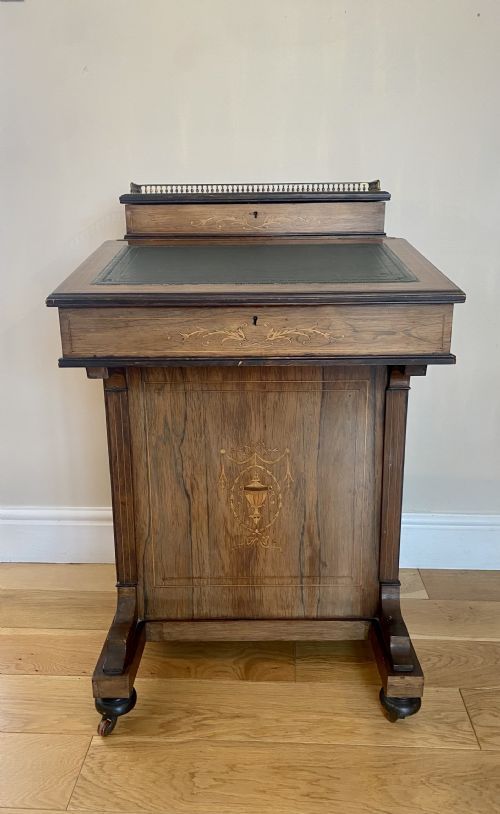


Victorian Rosewood Davenport
These robust victorian rosewood davenport pieces offer compact writing spaces with fitted drawers, bringing rich timbers and practical desks into studies.
Victorian Rosewood Davenport
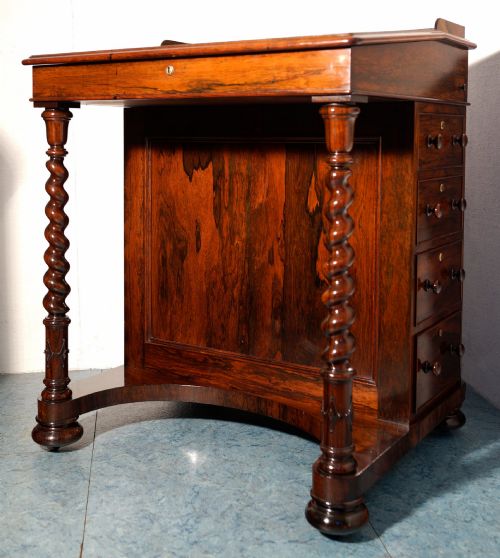
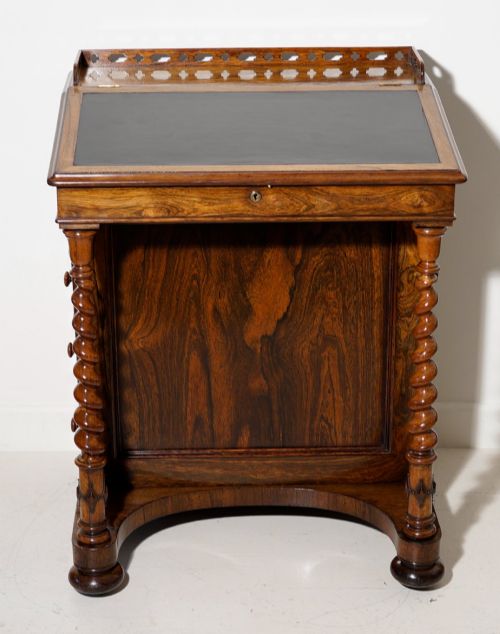
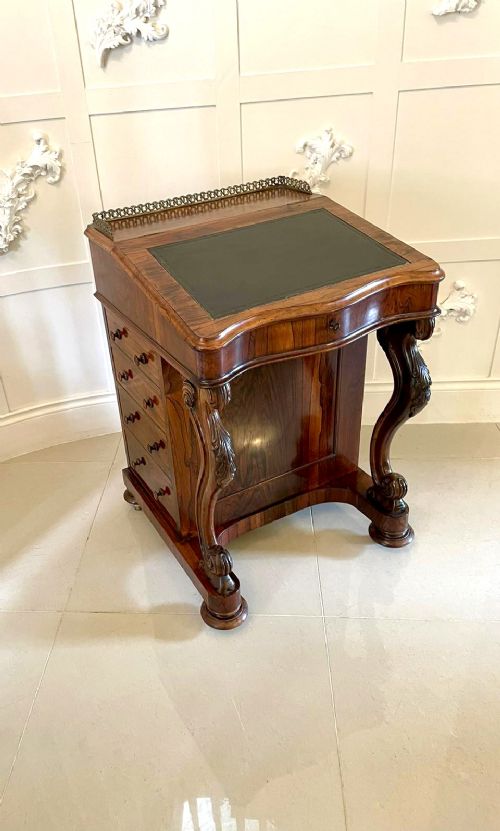
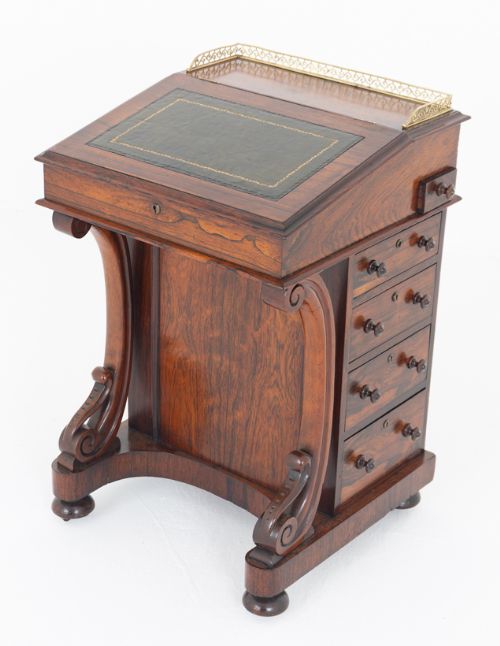
A victorian rosewood davenport functions as a compact writing desk, combining a sloping writing surface with a pedestal of side drawers. Most examples found here originate from the nineteenth century, spanning early, mid, and late Victorian periods.
The form appears in several distinct styles, including William IV, Regency, and Sheraton Revival variants. Buyers encounter standard freestanding models alongside slide top designs and pop up writing desks featuring adjustable tops.
Makers constructed these desks primarily as ladies writing desks, utilising the compact footprint for domestic parlours and boudoirs. The evidence shows frequent use of fine timber matched with clever internal stationery compartments.
Materials and Construction
Cabinet makers built the primary carcass using dense rosewood, occasionally noted as palisander, which provides a dark and heavily figured grain. Secondary woods like maple and birds eye maple often line the interior drawer boxes.
Surface decoration relies heavily on contrasting stringing and pictorial motifs, incorporating satinwood inlay, boxwood inlay, and intricate marquetry. Brass hardware, including original handles and casters, completes the structural assembly alongside fitted leather writing surfaces.
The archive reveals surviving desks spanning early, mid, and late Victorian periods, alongside William IV and Sheraton Revival interpretations.
Quality and Craftsmanship
The calibre of a desk rests upon the selection of the rosewood veneers and the precision of the contrasting inlay work. Finer examples display crisp boxwood and satinwood details that integrate seamlessly into the figured dark timber.
Internal engineering distinguishes standard pieces from superior variations, particularly in pop up compartments and slide top mechanisms. The integration of freestanding finished backs and original brass hardware further elevates the status of a piece.
The Victorian Rosewood Davenport Glossary
- Davenport
- A compact pedestal desk featuring a sloping, hinged writing surface and side drawers. The design became popular during the nineteenth century for home correspondence.
- Marquetry
- The art of applying decorative pieces of veneer to a structure to form intricate patterns or pictures. Craftsmen used boxwood and satinwood for this purpose.
- Palisander
- A term historically applied to richly grained dark timbers, often synonymous with rosewood. It provides the heavy figuring seen on nineteenth-century desks.
- Serpentine
- A curved outline shape featuring alternating convex and concave sections. This profile occasionally appears on the desktop or front sections of refined writing desks.
Victorian Rosewood Davenport: Frequently Asked Questions
What is a davenport desk used for?
A davenport provides a dedicated surface for writing letters and storing stationery within a compact footprint. The sloping top supports paperwork while drawers hold pens and ink.
Interior compartments organise small documents, making the form practical for sitting rooms and bedrooms.
Are davenport desks comfortable to write at?
The sloping lid creates an inclined surface designed for upright sitting rather than sprawling paperwork. Most models include leather inserts to prevent papers from sliding.
Because these desks were originally scaled for ladies writing desks, chair clearance beneath the pedestal requires careful measurement.
What is a pop up davenport?
A pop up davenport incorporates an internal superstructure that rises from the back of the desk when unlocked. This mechanism reveals hidden stationery slots and small drawers.
Such mechanical additions represent higher tier manufacturing during the mid to late nineteenth century.