
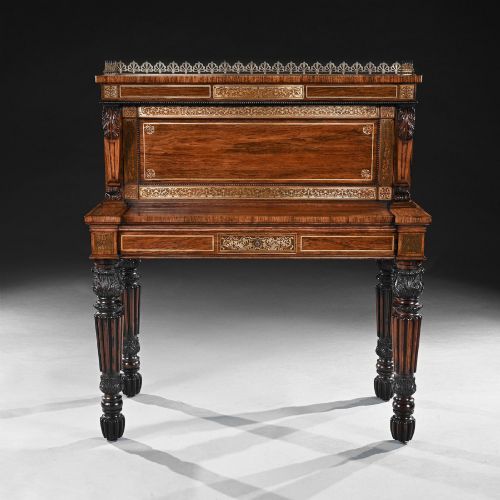
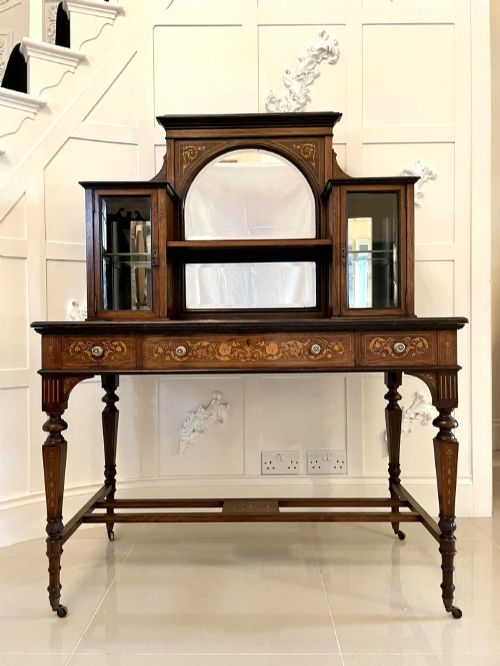
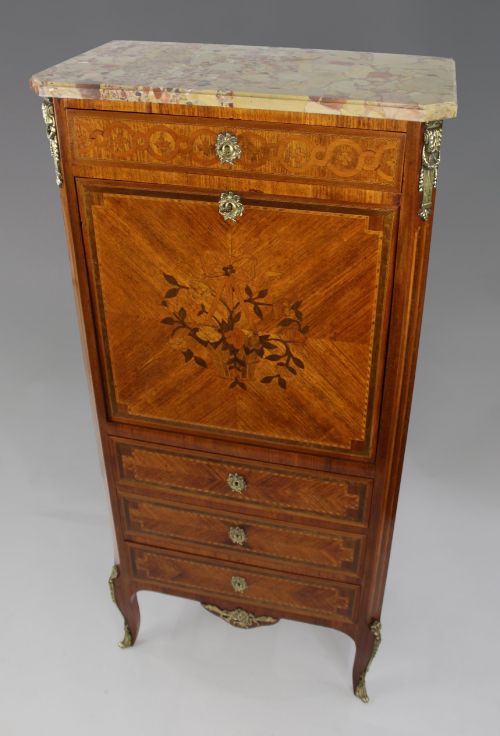
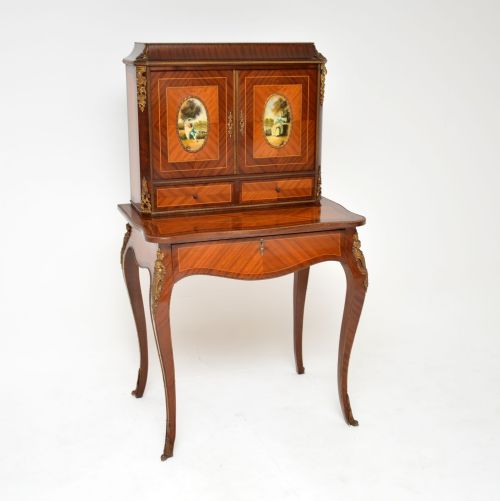


Rosewood Escritoire Bureau
These rosewood escritoire bureau pieces combine rich grain with drop-front writing surfaces, offering refined storage and a dedicated workspace for the home.
Rosewood Escritoire Bureau
A rosewood escritoire bureau brings together fine cabinetwork and practical writing compartments, often taking the form of a secretaire cabinet or a compact bureau de dame. These pieces span the nineteenth century into the early twentieth century, drawing on Regency and revival aesthetics.
Regency examples emphasise clean lines with brass inlay, whilst nineteenth-century French pieces lean towards Louis XV and Rococo revival styles with elaborate mounts. Buyers encounter everything from simple ladies' writing desks to elaborate secretaire cabinets with secret drawers.
Materials and construction methods
Cabinetmakers built these pieces using dense tropical hardwoods, applying rosewood veneers over stable secondary timbers to display rich grain patterns. Kingwood and walnut also appear as contrasting inlay materials within intricate marquetry designs.
Metal ornamentation played a central role, with ormolu, gilt bronze, and brass mounted to corners, handles, and escutcheons. Marble tops provide heavy, polished surfaces on French cabinets, whilst leather inserts frequently line the writing flaps.
Listings feature pieces spanning the Regency period through to the 1930s, utilising rosewood, kingwood, ormolu, and marble.
Distinctions in execution and design
Quality rests in the precision of the marquetry and the crispness of the bronze or ormolu mounts, where finer pieces display hand-chiselled detail rather than cast uniformity. The grain selection in the rosewood veneer also marks the ambition of the original workshop.
Interior architecture reveals the hand of the maker through secret compartments, dovetailed drawer construction, and fitted stationery nests. Surviving original hardware and matching marble slabs elevate the integrity of the piece.
Gillows Oxford Street Workshop·John MaClean
The Rosewood Escritoire Bureau Glossary
- Escritoire
- A writing cabinet featuring a hinged drop-front that conceals small drawers and pigeonholes. This form provides both concealed storage and an upright work surface.
- Marquetry
- The art of applying pieces of veneer to a structure to form decorative patterns and pictorial scenes. Craftsmen used various exotic woods to achieve naturalistic shading.
- Ormolu
- Gilded bronze mounts applied to furniture edges and feet for decorative contrast. This technique was widely employed in French cabinetmaking during the nineteenth century.
- Bonheur du jour
- A light lady's writing desk featuring a small cabinet or superstructure on the top. The form gained popularity in the eighteenth century and continued through the Regency and Victorian periods.
- Secretaire a abattant
- A tall upright desk with a fall-front writing panel that drops down for use. It typically conceals a fitted interior of internal drawers behind the main facade.
Rosewood Escritoire Bureau: Frequently Asked Questions
What is a rosewood escritoire bureau?
A rosewood escritoire bureau is a writing cabinet or desk characterised by a drop-front panel and dark, figured timber. These pieces range from compact French ladies' writing desks to taller English secretaire cabinets.
They were designed for private correspondence and record-keeping, combining a display surface with concealed storage for stationery and valuables.
How do I date a nineteenth-century bureau?
Dating relies on stylistic shifts between Regency restraint and later Victorian or French revival ornament. Brass inlay and clean architectural lines typically point to earlier Regency dates.
Heavier marquetry, ormolu mounts, and marble tops are more commonly associated with mid-to-late nineteenth-century French production and revival periods.
Where were these desks used?
These pieces suited formal drawing rooms, private libraries, and boudoirs where writing correspondence formed part of daily social life. Their finished backs and decorative veneers allowed them to sit away from walls.
Drop-front designs kept writing materials tidy and out of sight when not in use, maintaining a clean room interior.
How do I care for rosewood furniture?
Rosewood benefits from stable room humidity and protection from direct sunlight to prevent the timber and veneers from drying out. Periodic dusting with a soft cloth preserves the polished finish.
Avoid placing damp items directly on the wood or leather surfaces to protect the original finish and underlying veneers.