



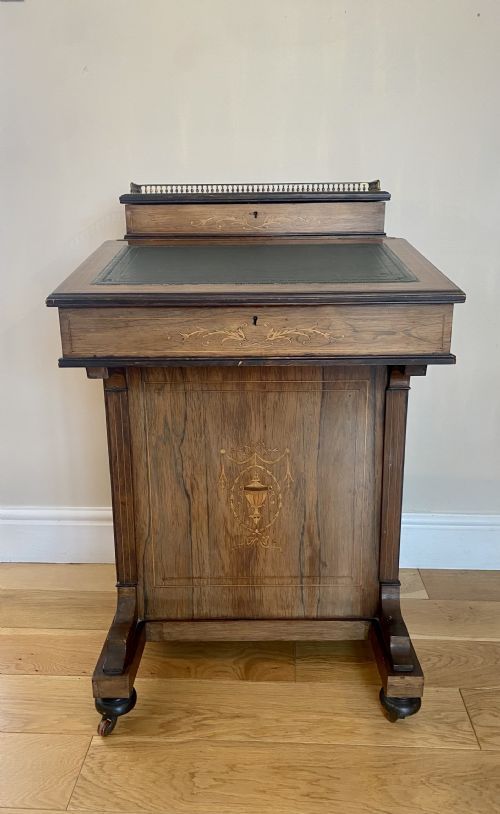


Compact Rosewood Desk
A compact rosewood desk offers clever writing storage in richly grained timber, bringing refined proportion to a study.
Compact Rosewood Desk
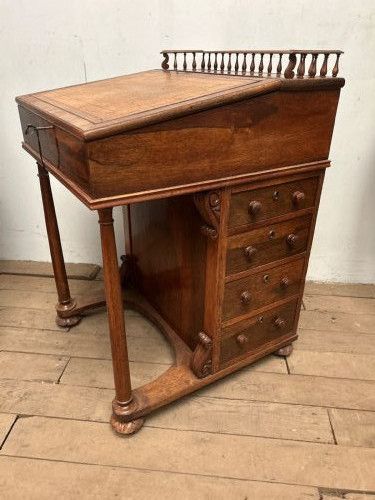
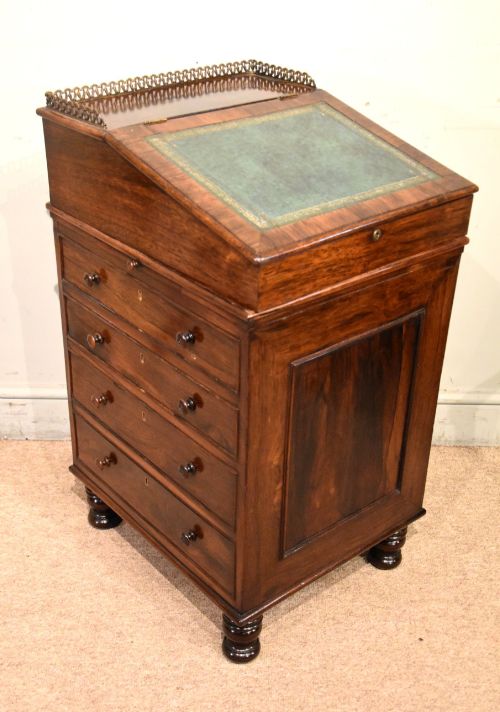
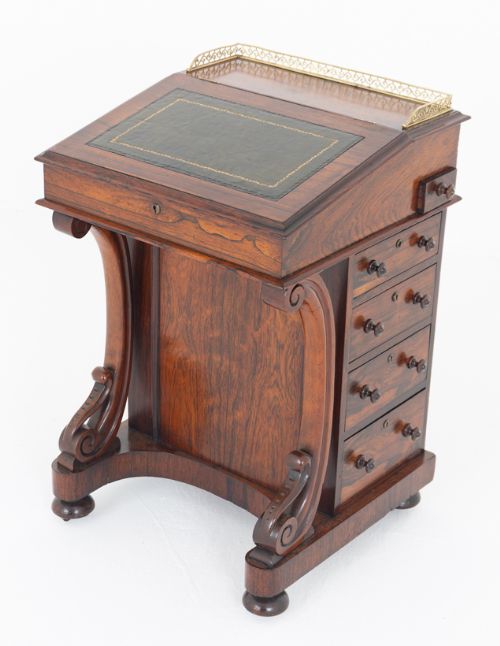
When you search for a compact rosewood desk, you encounter pieces designed for private correspondence and household accounts in smaller rooms. The Davenport is the most frequent form on this page, providing a sloped writing surface above a bank of drawers.
The selection spans the Regency, William IV, and Victorian periods, alongside specific dates from eighteen-fifty to nineteen-twenty. Alongside Davenport desks, the listings include writing cabinets, Wellington chests, and bonheur du jour forms.
These items originate primarily from nineteenth-century English workshops, utilising dense tropical timbers shaped for domestic utility. Buyers find freestanding examples that finish neatly in the centre of a room as well as pieces designed to sit against a wall.
How they were made
Cabinet makers constructed these pieces using solid and veneered rosewood over secondary timbers, often incorporating contrasting boxwood inlay or satinwood stringing. Writing surfaces frequently integrate fitted leather panels tooled with gold leaf to provide a smooth writing plane.
Internal mechanisms employ brass hardware, from sliding tops and pop-up stationery compartments to pivoting inkwell drawers. Secondary woods like maple appear in drawer linings, while marquetry inlay decorates selected writing cabinets and Davenport desks.
Pop-up stationery boxes let a desk hide your pens until you turn the key.
What varies in quality
The distinction between standard workshop production and superior cabinet work lies in the handling of the grain and the execution of the timber inlay. Finer examples display carefully matched rosewood veneers across the fall-front and drawer fronts, maintaining a continuous pattern.
Mechanical complexity also separates the tiers of production, seen in the smooth operation of sliding tops and concealed stationery pop-up mechanisms. The integration of secondary timbers such as maple in the interior drawers indicates the tier of the original commission.
Gillows
The Compact Rosewood Desk Glossary
- Davenport
- A small desk featuring a sloped, hinged writing lid above a pedestal of drawers. This form became popular during the Regency period for boudoir and parlour use.
- Wellington chest
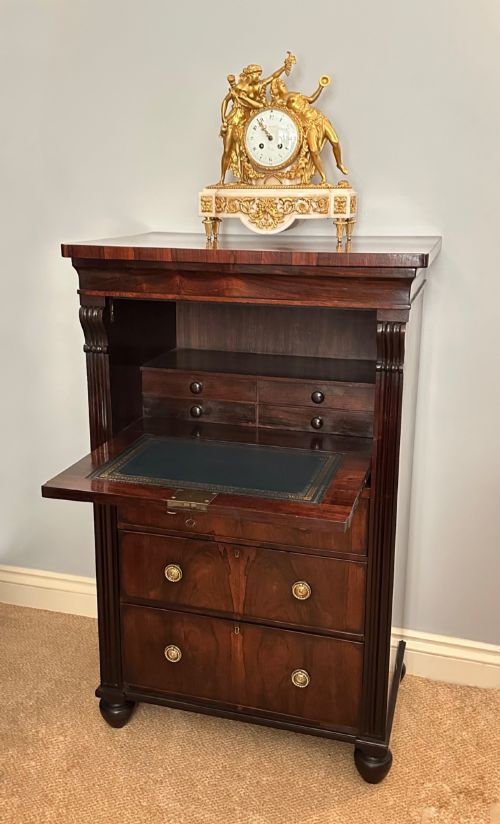
- A tall, narrow chest of drawers secured by a locking side bar hinged to one pilaster. Makers often combined this storage form with secretaire drawers.
- Bonheur du jour
- A light lady's writing desk featuring a small set of drawers and compartments on top of the main writing surface. It emerged in the nineteenth century for informal correspondence.
- Palisander
- A term applied to various richly figured dark timbers including rosewood. Cabinet makers valued it for its deep colour and prominent grain patterns.
- Marquetry inlay
- Decorative patterns formed by fitting contrasting pieces of wood veneer into a prepared ground. It appears on Victorian writing desks and cabinets.
Compact Rosewood Desk: Frequently Asked Questions
What is a Davenport desk?
A Davenport desk is a compact form of writing furniture featuring a sloping desk lid above a pedestal of side drawers. It was designed to occupy minimal floor space while offering secure storage for stationery and correspondence.
Most examples include a small compartment at the back for pens and inkwells, sometimes hidden beneath a sliding or pop-up top.
How do I date a rosewood desk?
Dating relies on architectural details, hardware, and structural proportions associated with periods like the Regency or Victorian eras. Regency pieces often feature saber legs or classical brass mounts, while Victorian versions show heavier proportions or elaborate marquetry.
Secondary woods inside the drawers and the style of the brass locks also offer reliable chronological clues.
Where should I place a Davenport in a room?
Because many Davenports are finished on all sides, they can stand away from the wall in the centre of a study or drawing room. Freestanding placement shows off the grained rosewood panels on the rear and sides.
Ensure adequate natural light falls across the sloped writing surface from the side for comfortable daily use.
What is the difference between a Davenport and a Wellington chest?
A Davenport is primarily designed for writing, combining a sloped desk surface with a set of pedestal drawers. A Wellington chest is a tall, narrow set of drawers secured by a vertical locking stile on the right edge.
Some hybrid pieces integrate a secretaire drawer within a Wellington chest format to serve both storage and writing functions.