




Victorian Rent Table
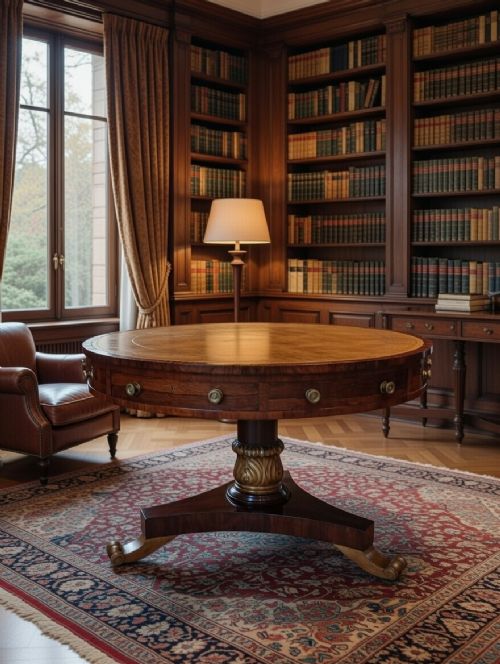
A victorian rent table is a substantial circular library piece designed for estate management, prized by collectors for its revolving top and concealed compartment drawers.
Victorian Rent Table
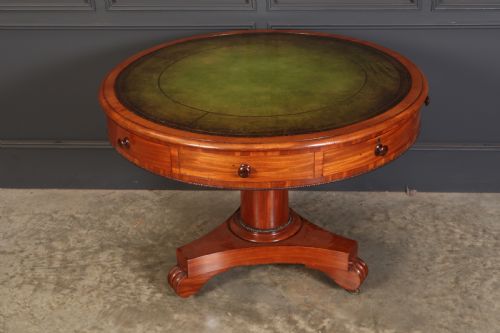
A victorian rent table is primarily encountered as a large drum or library table dating from the nineteenth century, including specific periods such as the William IV and early Victorian eras. These circular forms stand upon central pillar supports, frequently housing a revolving top fitted with wedge-shaped drawers labelled alphabetically for tenants' accounts.
Materials and construction
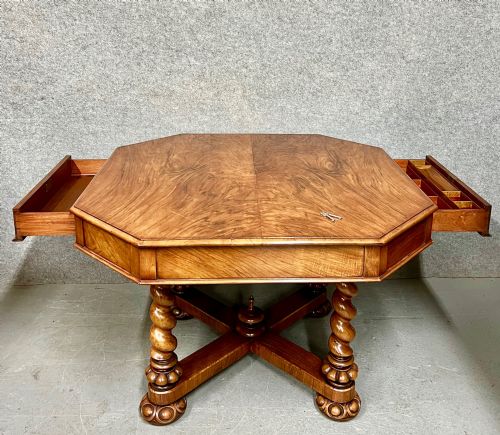
Makers utilised dense timbers such as flame mahogany, rosewood, oak, and walnut, often selecting figured veneers to create dramatic circular grain patterns across the broad tops. These wooden surfaces are routinely inset with contrasting tooled leather writing panels.
Internal construction relies on robust joinery to support the revolving mechanism and the weight of multiple graduated drawers arranged around the circular frieze. Subsidiary details incorporate brass drawer pulls and occasionally cast iron or heavy timber pedestal bases.
Land agents once spun these tables like giant wooden compasses to meet every tenant without ever leaving their leather armchairs.
Judging quality
Superior examples display exceptional selection in wood figure, particularly symmetrical flame mahogany or richly figured walnut veneers across the rotating drum top. The crispness of the cockbeading around the drawers and the smooth operation of the internal pivot mechanism separate finer pieces from heavier, utilitarian variants.
The integration of original tooled leather inserts and well-cast brass hardware contributes significantly to the integrity of a piece. Finer workshops ensured that the frieze drawers fit flush within the curved frame while maintaining proper depth for ledger storage.
The Victorian Rent Table Glossary
- Drum table
- A circular library table with a deep frieze containing drawers, resembling the shape of a drum. They often revolve upon a central pillar and platform base.
- Rent table
- A specialised variant of the drum table featuring multiple labelled drawers used historically by land agents to collect tenant rents. The divisions inside helped organise accounts by day or alphabet.
- Flame mahogany
- A distinct veneer cut from the fork of the mahogany tree where branches join the trunk. It creates a fiery, feather-like pattern prized by cabinet makers.
- Cockbeading
- A narrow rounded moulding projecting around the edges of drawer fronts. It protects the drawer edges and adds a refined decorative finish.
- Frieze
- The horizontal band beneath the top of a table. In these circular pieces, the frieze houses the revolving ring of drawers.
Victorian Rent Table: Frequently Asked Questions
What is a rent table used for?
Historically, estate managers used these circular tables to collect and record payments from tenants. The revolving top allowed the agent to remain seated while accessing individual wedge-shaped drawers labelled for different accounts.
Today, they function primarily as large centre tables or library desks in traditional interiors. The numerous drawers provide practical concealed storage for papers and small items.
How do I identify a Victorian rent table?
Look for a circular revolving top mounted on a central pillar, usually with a ring of graduated frieze drawers beneath the surface. The presence of leather writing inserts and rich timber veneers such as mahogany or oak is typical of nineteenth-century examples.
Examine the construction of the drawers and the interior pivot mechanism to confirm period manufacture. Nineteenth-century pieces utilise traditional hand-cut dovetails and solid secondary timbers.
Do all rent tables revolve?
Most traditional drum and rent tables feature a pivoting mechanism that allows the entire upper section to turn smoothly on the central pedestal. This practical design enabled an estate steward to reach every drawer without moving from the chair.
Some related library tables or centre tables do not rotate, so checking the frieze and underframe construction is essential to confirm whether the top is fixed.
Where should I place a rent table?
Because these pieces are finished on all sides and designed to be viewed from every angle, they sit best as free-standing centre tables in large studies, libraries, or entrance halls. Their circular footprint requires adequate surrounding floor space to allow movement and access to the drawers.
Keep them away from direct heat sources and strong sunlight to protect the polished timber surfaces and the leather writing panels from drying out.