


Victorian Red Glass Vase
A victorian red glass vase brings intense crimson colour and rich nineteenth-century craftsmanship directly into a room.
Victorian Red Glass Vase
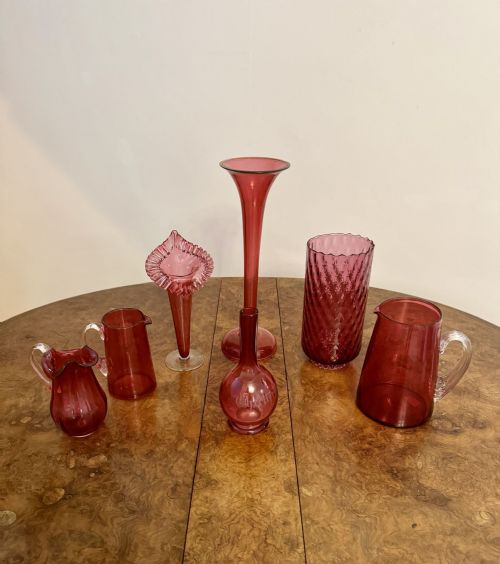
A victorian red glass vase captures the deep, saturated tones produced by nineteenth-century glassmakers working in rich ruby and cranberry shades. These pieces range from tall trumpet forms and floor vases to mantel lustres and delicate table items.
The selection includes English and Bohemian examples spanning from the 1860s through to the turn of the twentieth century. Many showcase contrasting overlays, crystal components, or intricate hand-painted enamel details.
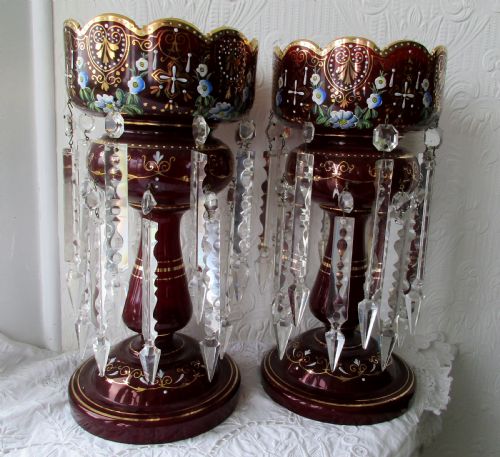
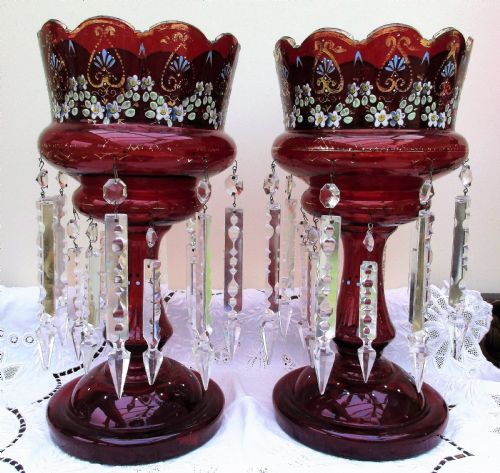
Buyers encounter both single statement pieces and matched pairs designed to sit symmetrically on a mantelpiece or sideboard. The forms demonstrate the shift from traditional Victorian opulence toward early Art Nouveau curves.
Materials and methods
Makers achieved the distinctive red coloration by introducing gold or copper into the molten glass batch during production. Flash glass techniques involved casing a layer of clear crystal with a thin ruby exterior before cutting away sections to reveal the clear base beneath.
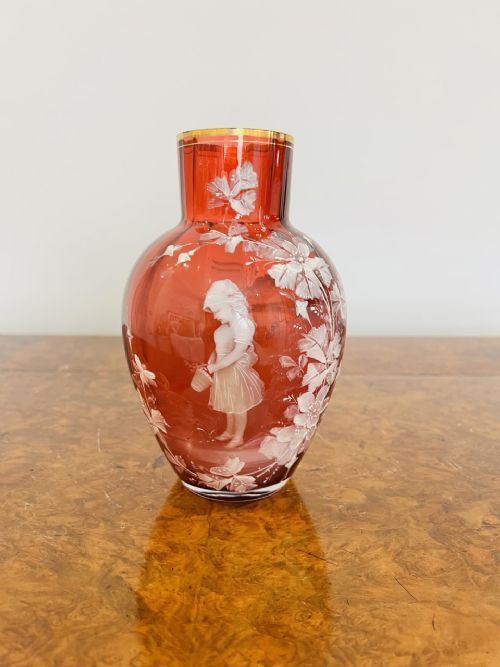
Artisans applied surface decoration using gold leaf gilding and white enamel painting, often depicting figures in the manner associated with Mary Gregory. Heavy cutting and polishing defined the crystal and ruby glass components of larger mantel lustres.
Victorian mantel lustres doubled as sparkling light-catchers, designed to jingle softly whenever a carriage rumbled past the front window.
Factors of quality
Depth and saturation of colour distinguish superior examples, alongside the clarity and weight of the underlying crystal. Master glassmakers achieved a richer, more uniform hue without cloudiness or accidental streaks.
The precision of the hand-cutting and the crispness of any gilt or enamelled decoration reveal the artisan's skill. Intact hanging crystal drops on mantel lustres and well-preserved surface gilding elevate a piece significantly.
Baccarat
The Victorian Red Glass Vase Glossary
- Cranberry glass
- A transparent pinkish-red glass coloured with gold chloride. It became immensely popular during the Victorian period for tableware and decorative vessels.
- Ruby glass
- A deep red glass variety that often appears almost black in dim light until illuminated. It was widely utilised for Bohemian and English mantel lustres.
- Mantel lustre
- A decorative vase fitted with a rim of pendant crystal prisms. These pieces reflected candle or gas light in nineteenth-century drawing rooms.
- Mary Gregory glass
- Glassware decorated with white enamel silhouettes of children in natural settings. The style gained popularity during the late Victorian era.
- Flash glass
- A dual-layer material formed by dipping a core of clear glass into coloured molten glass. Artisans cut through the outer layer to create contrasting patterns.
Victorian Red Glass Vase: Frequently Asked Questions
How do I clean a victorian red glass vase?
Wash the glass gently in lukewarm water using a mild, non-abrasive soap. Avoid submerging pieces with delicate gilt or enamel decoration for extended periods.
Dry thoroughly with a soft lint-free cloth to protect the surface finish and any applied gold leaf.
Were these vases made as pairs?
Many nineteenth-century decorative glass items, particularly mantel lustres and trumpet vases, were produced as symmetrical pairs. These were intended to flank a central mirror or clock on a grand fireplace.
Single examples also appear frequently, often surviving independently from larger epergne table centrepieces.
What is the difference between cranberry and ruby glass?
Cranberry glass relies on gold content to produce a lighter, pinker red tone that remains translucent. Ruby glass typically utilises copper or different mineral mixes to achieve a much darker, heavier crimson appearance.
Both varieties were staple productions across English and Bohemian glasshouses during the Victorian epoch.
How can I tell Bohemian glass from English pieces?
Bohemian glass frequently employs complex flash layering, heavy facet cutting, and elaborate gilt scrollwork. English production often leans toward lighter forms, delicate enamelling, or distinct cranberry hues.
Both regional traditions flourished concurrently during the latter half of the nineteenth century.