

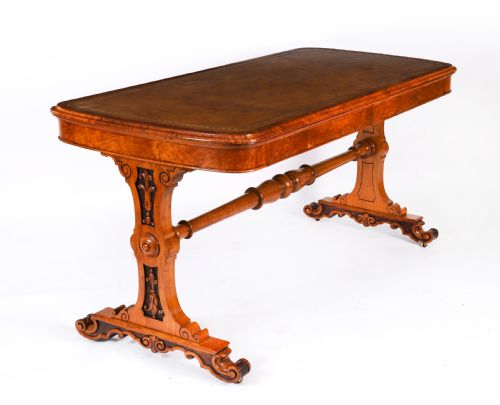


Victorian Pollard Oak Desk
A victorian pollard oak desk brings dense, variegated timber and deep honey warmth into a study.
Victorian Pollard Oak Desk
A victorian pollard oak desk emerges in several distinct forms, from massive partners tables to compact writing slopes and davenports. The heavy pedestal desk and the double-sided partners desk dominate the surviving examples, built for substantial libraries and official chambers. Lesser forms such as stationery boxes and sloping writing desks also appear across the nineteenth century.
Most pieces date from the mid to late nineteenth century, spanning the Victorian period alongside occasional Edwardian pieces and related William IV items. Makers often worked the timber into library tables, centre tables, and secretaire bookcases that matched the grand domestic interiors of the era. The distinct mottling of the wood marks these tables out immediately from plain oak furniture.
Materials and construction
Makers built these pieces using solid oak frames overlaid with veneers of pollard or burr oak, creating turbulent patterns of knots and rings across the flat surfaces. Secondary timbers provided sturdy internal framing for drawers and pedestals, while brass fittings such as drop handles, locks, and hinges reinforced the heavy construction.
Writing surfaces were frequently inset with hand-tooled leather, often in shades like oxblood, bordered with gilt tooling. The distinctive finish relied on the natural figuring of the timber, cut from pollarded trees where branches had been repeatedly cropped to produce tightly clustered growth rings.
Victorian Pollard Oak Desk Retail Price Guide 2026
Typical asking prices for victorian pollard oak desk among the pieces listed under this phrase on Sellingantiques today, from the lower quarter to the upper quarter. They describe what is for sale here now, not the wider market.
Some nineteenth-century makers cleverly concealed secret stationery compartments inside pedestal desks behind dummy book spines.
Judging the work
Quality rests primarily on the choice and matching of the timber veneers, where symmetrical figuring across large expanses denotes superior cabinet work. Lesser pieces display plain timber or disjointed patching, whereas the finest examples show continuous, swirling burr patterns across every drawer front and panel.
The sophistication of the internal secondary framing and the execution of structural details like dovetailed drawer boxes separate standard production from high workshop output. Integrated brass hardware, crisp mouldings, and secondary woods of uncompromised weight signal a piece built by a leading London or provincial cabinet maker.
James Winter and Sons·Williams and Gibton·Thomas Turner·Payne and Co·Howard and Sons·James Shoolbred
The Victorian Pollard Oak Desk Glossary
- Pollard oak
- Timber taken from a tree that has been pruned close to the trunk to encourage dense, knotty regrowth. This harvesting method produces the characteristic speckled grain seen on these desks.
- Partners desk
- A large pedestal desk designed with drawers and cupboards on both sides so two people could work opposite each other. These forms often feature heavy panelled construction and substantial writing surfaces.
- Davenport desk
- A compact writing desk featuring a sloping top above a bank of drawers accessed from the side. They frequently include a stationery compartment on the upper rear.
- Writing slope
- A portable box that unfolds to reveal a baize or leather-lined writing surface and internal compartments for ink and paper. They sit flat on a table during use.
- Secretaire bookcase
- A tall cabinet incorporating a drop-front drawer that opens to form a writing desk concealed beneath upper bookshelf sections. They combine storage and study functions in one heavy piece.
Victorian Pollard Oak Desk: Frequently Asked Questions
How do I care for pollard oak?
Keep the timber away from direct heat sources and strong sunlight to prevent the veneer from drying out or splitting. Feed the surface occasionally with a traditional beeswax polish applied sparingly with a soft cloth.
Avoid liquid cleaners and damp cloths, which can damage both the polished finish and the underlying leather writing inserts. Gentle dusting with a dry cloth is sufficient for routine maintenance.
Were partners desks used at home?
Partners desks were originally commissioned for estate offices, banks, and the libraries of large country houses where two clerks or professionals needed to work face to face. Their generous proportions required substantial rooms with ample floor space around all sides.
Today, they function well as freestanding centrepieces in large studies or open-plan rooms, offering generous storage and work space from multiple angles.
What is the difference between pollard and burr oak?
Pollard oak comes from trees that have been repeatedly pruned back to the trunk, creating a dense pattern of small knots and swirling growth rings. Burr oak originates from a woody outgrowth on the tree trunk, producing even more chaotic and clustered natural patterns.
Cabinet makers frequently combined both types of figuring on the same desk, using burr veneers on prominent drawer fronts and pollard timber on larger flat panels.
How do I identify a Victorian desk?
Examine the construction methods inside the drawers, looking for hand-cut dovetails and solid secondary timbers such as oak or mahogany. The presence of nineteenth-century locks, brass hardware, and characteristic timber veneers generally confirms the period.
Construction styles shifted from the heavier, architectural forms of the mid-nineteenth century towards lighter or more eclectic designs by the late Victorian era.