

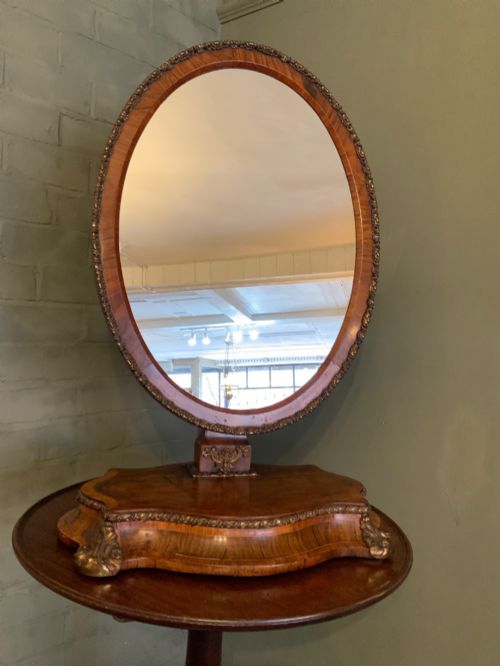


Victorian Oval Swing Mirror
A victorian oval swing mirror sits on the dresser to catch the morning light, combining polished timber and tilting glass in a single compact frame.
Victorian Oval Swing Mirror
A victorian oval swing mirror is a portable looking glass designed to sit on a dressing table or chest of drawers. Most examples found here take the form of toilet mirrors or dressing table mirrors intended for personal grooming.
The glass pivots within two upright supports, allowing the user to tilt the reflection at will. The surviving pieces span the nineteenth century, with Victorian production dominating the selection alongside related nineteenth-century designs.
Makers mounted these tilting plates upon various bases, ranging from simple shaped supports to three-drawer box bases resting on small feet. The glass itself takes a distinct curved shape, held within wooden or gilt frames.
How they were made
Cabinet makers relied primarily on mahogany and walnut for the frames and structural supports, frequently selecting figured flame veneers for the principal surfaces. Secondary materials include brass for pivot screws and fittings, alongside occasional ormolu mounts.
Giltwood and gesso appear on decorative frames influenced by French chateau and rococo revival styles. The glass plates are set into wooden surrounds that hang between carved upright supports.
Victorian Oval Swing Mirror Retail Price Guide 2026
Typical asking prices for victorian oval swing mirror among the pieces listed under this phrase on Sellingantiques today, from the lower quarter to the upper quarter. They describe what is for sale here now, not the wider market.
Listings span the nineteenth century, featuring woods such as mahogany and walnut alongside decorative ormolu and giltwood.
What varies in quality
The distinction between standard examples and finer pieces lies in the choice of timber and the complexity of the base. Plain mahogany frames give way to highly figured flame mahogany veneers and intricate carvings on the upright supports.
Superior items often incorporate functional storage beneath the glass, featuring fitted three-drawer bases with detailed mouldings and bun feet. The integration of cast ormolu mounts or giltwork also separates decorative showpieces from simpler utility mirrors.
The Victorian Oval Swing Mirror Glossary
- Swing mirror
- A looking glass mounted on pivots so that the angle of the reflection can be adjusted. This mechanism sits between two vertical arms.
- Toilet mirror
- A smaller dressing mirror traditionally placed on a dressing table or washstand. These pieces often include small drawers in the base for accessories.
- Flame mahogany
- A veneer cut from the fork of the mahogany tree to create a distinctive flickering flame pattern. Cabinet makers used this on prominent surfaces of better pieces.
- Ormolu
- Gilded bronze used for decorative mounts and decorative highlights. It appears alongside walnut on select mid-century items.
- Gesso
- A plaster-based mixture applied to wood as a base for gilding. It allows for intricate relief moulding on decorative frames.
Victorian Oval Swing Mirror: Frequently Asked Questions
Where did people place these mirrors?
These mirrors sat upon dressing tables, washstands or chests of drawers in bedrooms and dressing rooms. Their portable nature allowed owners to move them around the room to find the best light.
They provided a stable reflection for daily grooming without requiring permanent wall fixings.
How do I date a swing mirror?
Dating relies on timber choices, base construction and the style of the carved supports. Earlier nineteenth-century examples often feature flame mahogany and substantial drawer bases.
Later Victorian and turn-of-the-century pieces show shifts in decorative carving and simpler framing methods.
What is the difference between a toilet mirror and a dressing mirror?
The terms describe similar table-top looking glasses, though toilet mirrors historically accompanied washing and dressing stands. Both variants use the pivoting swing mechanism.
Inventory descriptions often use the terms interchangeably for pieces of comparable size and form.
Are the mirror plates original?
Mirror glass frequently saw replacement over the decades due to accidental breakage or silvering degradation. Examining the backboards and fixings helps indicate the age of the glass plate.
Original glass often shows minor age foxing and imperfections characteristic of nineteenth-century manufacture.
How do the pivot mechanisms work?
Side screws pass through the upright supports and thread into the sides of the mirror frame. Tightening these screws holds the glass at the desired angle.
Brass hardware is standard on most quality pieces from this era.