




Victorian Ormolu Desk Set
These Victorian ormolu desk sets combine heavy gilt bronze with marble, glass, and enamel to organise a proper writing desk in grand style.
Victorian Ormolu Desk Set
A victorian ormolu desk set is a collection of functional writing accessories fashioned from gilt bronze, often incorporating inkwells, candlesticks, and matching stands.
These sets emerge principally from the nineteenth century, displaying French Empire, Napoleon III, and late Victorian aesthetic influences across various desk stands and clock garnitures.
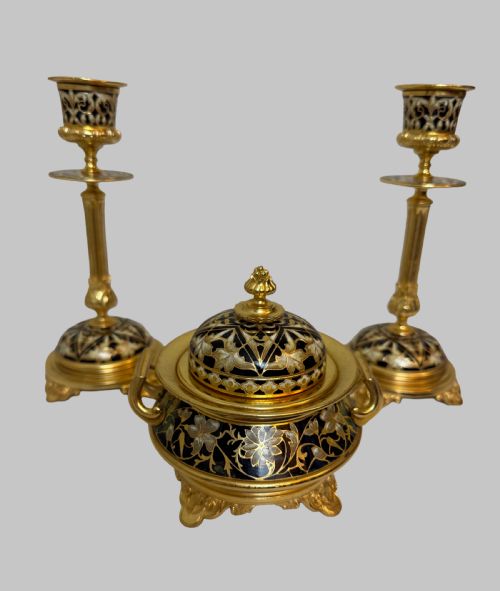
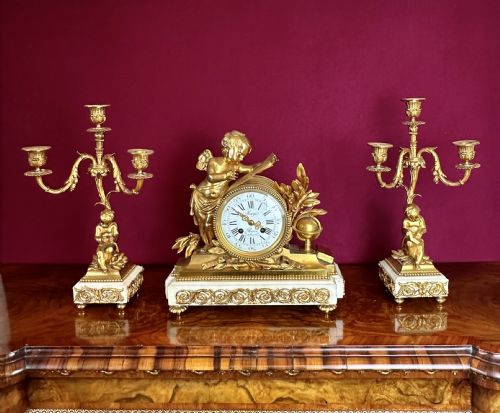
Buyers encounter pieces ranging from simple coromandel-wood desk stands with ormolu mounts to elaborate mult pieza clock sets featuring champleve enamel and figural bronze elements like playing cats.
How they were made
The foundation of these pieces relies on cast bronze, brass, or gilt metal finished with the characteristic ormolu gilding technique to produce a rich golden lustre.
Craftsmen mounted these metal elements onto heavy bases of vert marble, onyx, or exotic coromandel-wood, frequently integrating glass inkwells and vibrant champleve enamel details.
Listings feature nineteenth-century materials including gilt bronze, ormolu, brass, glass, marble, champleve enamel, and coromandel wood.
What varies in quality
The distinction between standard items and superior work lies in the crispness of the bronze chasing and the depth of the gilding applied to the metal surfaces.
Complexity of form and the inclusion of costly supplementary materials like champleve enamel or carved marble elevate the standing of an individual desk set.
A. MARIONNET·Raingo Fres, Paris·Moser
The Victorian Ormolu Desk Set Glossary
- Ormolu
- Gilded bronze, where a layer of finely ground gold mercury amalgam is applied to a bronze base and heated to leave a rich metallic finish. This technique creates the distinctive golden surface seen on nineteenth-century desk accessories.
- Champleve
- An enamelling technique where troughs or cells are hollowed out of the metal surface and filled with vitreous enamel paste before firing. It produces vibrant coloured patterns on clock sets and inkwells.
- Coromandel
- A dense, dark East Indian timber featuring striking contrasting grain patterns, frequently utilised for the wooden bases and boxes of mid-nineteenth-century desk stands.
- Garniture
- A set of matching ornamental objects for a mantelpiece or desk, typically comprising a central clock flanked by matching candelabras or urns.
- Escapement
- The internal mechanical linkage in a desk clock that regulates the movement to ensure accurate timekeeping.
Victorian Ormolu Desk Set: Frequently Asked Questions
What pieces comprise a complete desk set?
A complete desk set typically includes a central inkstand or inkwell accompanied by matching accessories such as candlesticks, desk clocks, or writing trays.
Many surviving examples also form part of larger clock garnitures designed to coordinate across a study or parlour.
How do I care for ormolu metalwork?
Ormolu requires gentle maintenance using a soft, dry cloth to remove dust without abrasive polishing.
Avoid liquid cleaners or chemical agents, which can strip away the historic gilt surface and expose the underlying bronze.
What timber is coromandel wood?
Coromandel is a heavy, highly decorative tropical hardwood prized by nineteenth-century cabinet makers for its rich dark colour and dramatic contrasting stripes.
It forms a durable and handsome base for ormolu mounts and glass inkwells on luxury desk stands.
How do French and Victorian styles differ?
French styles of the period often embrace Empire, Napoleon III, and Louis XVI revivals with lavish marble and champleve enamel.
Victorian English interpretations frequently pair similar ormolu mounts with domestic or exotic hardwoods like coromandel.