
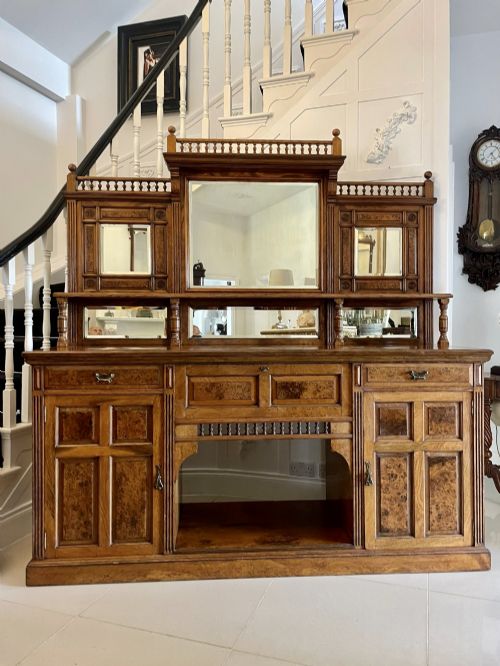
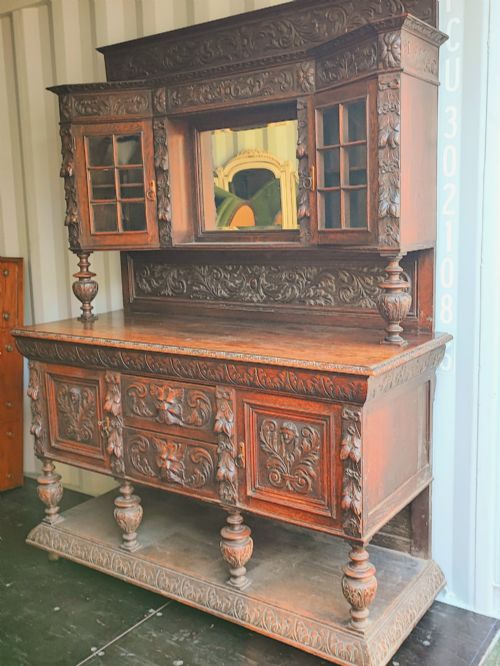


Victorian Oak Mirror Dresser
These robust victorian oak mirror dressers combine timber and silvered glass to anchor a dining room or hall with architectural presence.
Victorian Oak Mirror Dresser
When you search for a victorian oak mirror dresser, you encounter large sideboards, buffet cabinets, and hall stands fitted with tall mirror backs. These pieces emerged primarily during the nineteenth century, utilising dense native timbers to create imposing storage for formal interiors.
The most common examples on this page are mirror-backed sideboards featuring carved decoration, panelled doors, and raised shelves. They span stylistic revivals from Gothic and Renaissance motifs through to simpler Arts and Crafts interpretations.
How they were made
Cabinet makers constructed these pieces predominantly from solid oak and figured pollard oak, sometimes incorporating secondary pine and contrasting specimen woods. Surfaces received deep relief carving, geometric moulding, and hand-rubbed finishes that highlighted the natural grain of the timber.
Silvered mirror glass was bevelled and set securely into heavy wooden frames, often supported by turned columns or carved brackets. Brass hardware such as drop handles and escutcheons completed the construction, anchoring the heavy doors and drawers.
The site records sideboards, hall stands, and dressing tables spanning the Victorian and Edwardian eras.
What varies in quality
The calibre of a victorian oak mirror dresser rests upon the depth and crispness of its hand-carving, particularly on figural elements like Green Man motifs or elaborate strapwork. Superior examples employ highly figured pollard oak veneers and feature heavy, well-cast brass mounts rather than stamped sheet metal.
Structural integrity also separates workshop output, seen in the thickness of the timber, the stability of the mirror backing, and the precise dovetailing of internal drawers. Pieces retaining their original bevelled mirror glass and matching hardware hold greater integrity than those with replaced components.
T Simpson and Son
The Victorian Oak Mirror Dresser Glossary
- Pollard oak
- Timber taken from trees that were pollarded, producing a highly figured, swirling grain pattern prized for decorative veneers.
- Mirror back
- An upright superstructure attached to a sideboard or cabinet, incorporating a large glass plate supported by shelves and carved framing.
- Gothic Revival
- A nineteenth-century design movement drawing inspiration from medieval architecture, characterised by pointed arches, tracery, and heavy mouldings.
- Arts and Crafts
- A design movement prioritising traditional handcraftsmanship, simple construction, and honest use of materials over machine-made ornamentation.
- Green Man
- A sculptural architectural ornament depicting a human face entwined with foliage, frequently found on carved nineteenth-century furniture.
Victorian Oak Mirror Dresser: Frequently Asked Questions
How do I clean the oak and mirror glass?
Dust the carved oak surfaces regularly with a dry, soft cloth and feed the timber occasionally with a traditional beeswax to maintain the finish.
Clean the mirror glass with a mild glass cleaner applied to a cloth rather than sprayed directly, ensuring moisture does not seep behind the silvered backing.
What rooms suit a mirror-backed sideboard?
These substantial pieces are traditionally placed in dining rooms where the surface serves to display silver or ceramics and the mirror reflects light across the table. They also function effectively in large entrance halls as grand storage furniture.
Ensure the wall can support the visual weight and that the floor is level enough to keep the heavy doors hanging true.
How do I distinguish Arts and Crafts from Gothic Revival?
Gothic Revival examples display medieval motifs such as pointed arches, heavy linenfold panelling, and elaborate tracery. They lean towards architectural grandeur and dense ornamentation.
Arts and Crafts pieces emphasise structural simplicity, visible construction methods like pegged joints, and stylized plant motifs with minimal surface carving.