


Victorian Oak Court Cupboard
These Victorian oak court cupboards bring solid timber presence and heavy historic carving into modern rooms.
Victorian Oak Court Cupboard
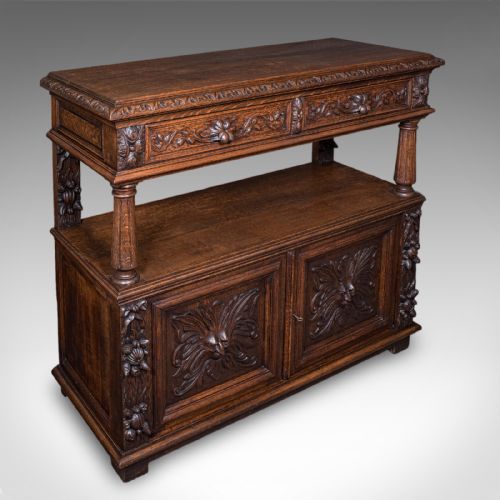
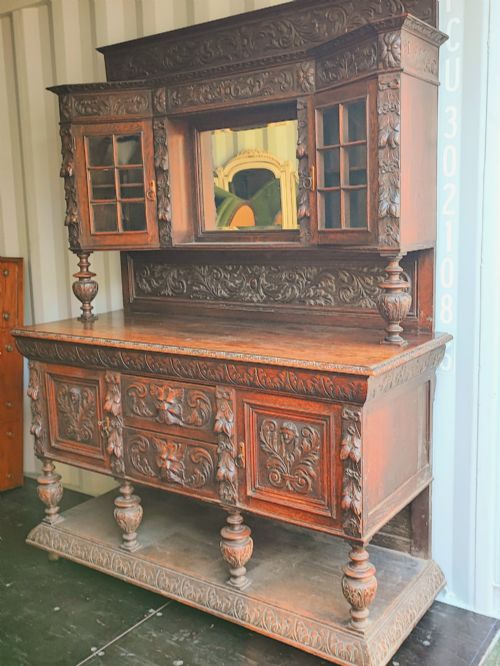
A victorian oak court cupboard is a substantial storage piece grounded in nineteenth-century revival styles, drawing heavily on earlier Jacobean, Gothic, and Flemish aesthetics. Most examples encountered here date from the mid-nineteenth century onwards, often displaying deeply recessed upper tiers supported by carved columns or figures.
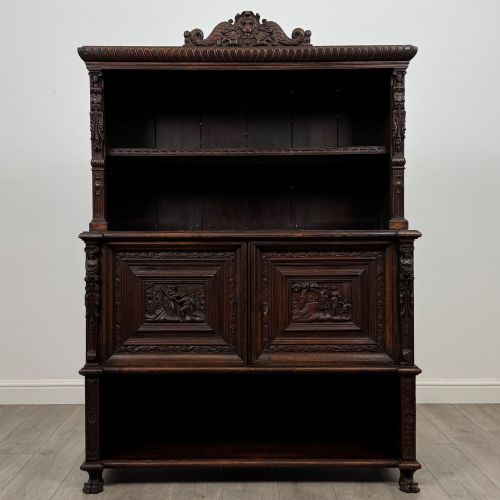
Makers utilised dense native timbers to construct multi-tiered sideboards, buffets, and hall cupboards equipped with panelled doors and drawers. These forms served utilitarian dining and entrance hall functions while projecting status through profuse surface decoration.
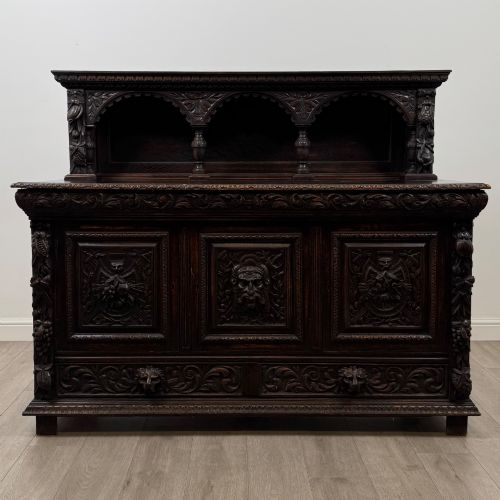
Buyers will find considerable variety in scale, ranging from compact hall cupboards to large multi-door sideboards spanning several feet. The decorative vocabulary shifts between restrained architectural panelling and exuberant relief carving featuring green men, lion masks, and fruitwood marquetry inlay.
How they were made
Carpenters constructed these cupboards primarily from solid oak, sometimes reinforced with fruitwood marquetry inlay and supported by brass or iron hardware. Early examples employ peg-joined framing methods, whilst later nineteenth-century pieces rely on standard joinery combined with heavy machine and hand-carved ornamentation.
Surfaces frequently feature bevelled glass inserts, mirrored backs, and deeply carved relief panels that demonstrate the carver's command of chisel and gouge. The timber was typically finished to highlight the natural grain, ranging from pale golden oak tones to richer, darkened patinas.
Victorian Oak Court Cupboard Retail Price Guide 2026
Typical asking prices for victorian oak court cupboard among the pieces listed under this phrase on Sellingantiques today, from the lower quarter to the upper quarter. They describe what is for sale here now, not the wider market.
The listings here span the Victorian period, nineteenth-century revivals, and early twentieth-century production, utilising solid oak alongside glass, mirror, brass, and iron.
What varies in quality
The distinction between ordinary production and superior work rests entirely on the depth, sharpness, and originality of the carving. Crisp, deeply undercut relief work on figures such as green men or lion masks indicates a skilled hand, whereas shallow, mechanical scoring points to mass production.
Proportion and structural integrity also separate the grades. Pieces that retain their original brass or iron hardware, unwarped panelled doors, and balanced architectural proportions command greater appreciation than those altered or assembled from disparate salvaged elements.
The Victorian Oak Court Cupboard Glossary
- Court cupboard
- A traditional enclosed piece of furniture featuring an upper and lower section, often with a recessed upper cabinet supported by pillars. They evolved from medieval food storage cupboards into decorative reception room furniture.
- Green man
- A sculptural architectural ornament depicting a human face disgorged from foliage or vines. This motif symbolises rebirth and appears frequently in nineteenth-century Gothic and Renaissance revival carving.
- Marquetry
- The art and craft of applying pieces of veneer to a structure to form decorative patterns and pictures. Fruitwood inlays were often utilised on these surfaces to create contrasting floral or geometric designs.
- Renaissance revival
- A nineteenth-century architectural and decorative style that drew inspiration from fifteenth and sixteenth-century Italian and Flemish design. It is characterised by heavy mouldings, classical columns, and bold sculptural reliefs.
- Peg-joined
- A traditional method of securing timber joints using wooden dowels rather than modern metal fasteners. Early Victorian pieces frequently employ this technique to ensure structural stability.
Victorian Oak Court Cupboard: Frequently Asked Questions
What is a court cupboard?
A court cupboard is a traditional form of enclosed furniture featuring stacked compartments, typically with a recessed upper section supported by columns.
In nineteenth-century interpretations, these pieces served as heavy sideboards or hall cupboards designed for displaying plate and storing household provisions.
How do I identify the period?
Dating relies on examining the construction methods, timber patination, and the specific decorative vocabulary employed across the panels.
Earlier Victorian examples often feature peg-joined framing and restrained Gothic motifs, whilst later pieces embrace profuse Flemish Renaissance revival carving and mirror backs.
Where should I place one?
These substantial oak cupboards suit large dining rooms, spacious hallways, or studies where their heavy timber presence can anchor the room.
Ensure the floor space and ceiling height can accommodate the considerable depth and height typical of these grand nineteenth-century sideboards.
How were they used?
Historically, these cupboards functioned as utilitarian storage for dining utensils, linens, and food provisions within wealthy households.
Over the Victorian era, they transitioned into decorative display furniture intended to showcase the owner's taste through elaborate carved woodwork.
What styles influenced them?
Cabinetmakers drew heavily on historical aesthetics, particularly Jacobean, Gothic, and Flemish Renaissance revival styles.
This historicism manifested in architectural mouldings, linenfold panelling, and striking figural carvings like green men and lion masks.